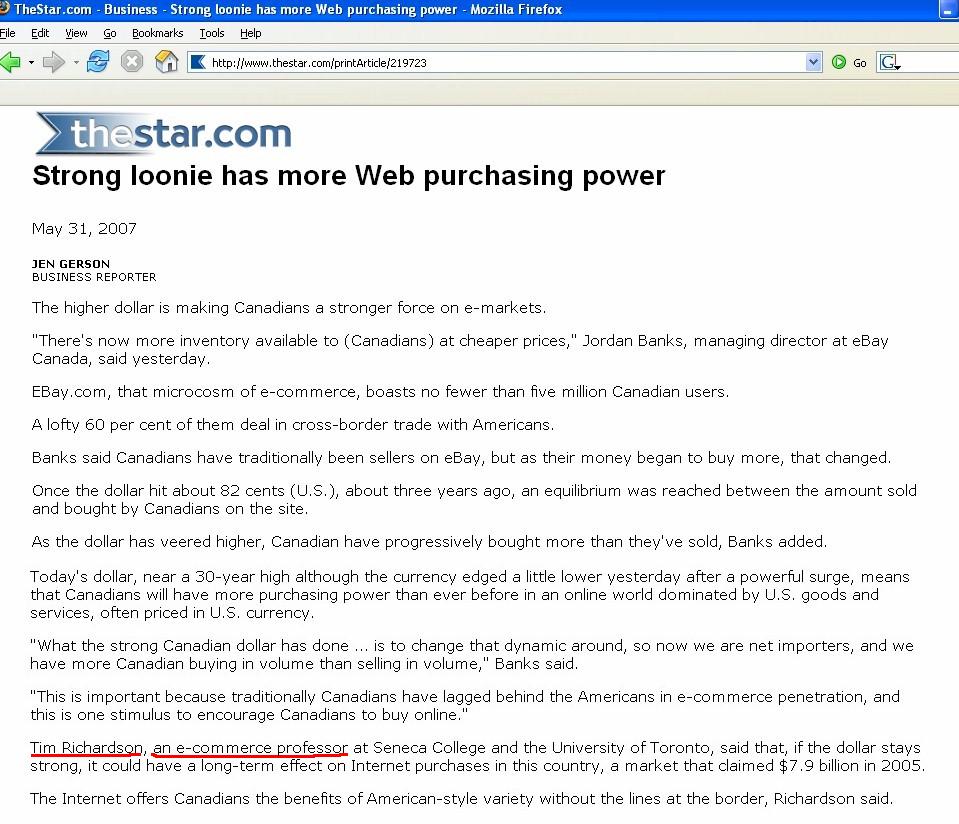
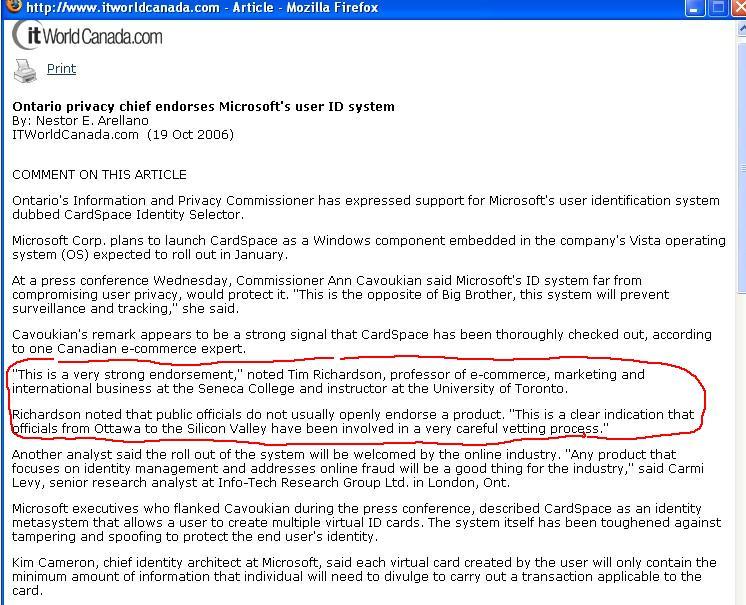
articles and books written by Prof. Richardson, and articles and news items in which Richardson was quoted
last
updated 2018 Nov 27


| PUBLICATIONS
and PRESS and SPEECHES
articles and books written by Prof. Richardson, and articles and news items in which Richardson was quoted last
updated 2018 Nov 27
|
|
|
| Magazines
and Newspapers
Amherst
Daily News, Nova Scotia
|
Web
based Media
bankrate.ca
|
Television
BNN Business News Network
|
Radio
570 News Toronto
|
| 2018 | . |
 |
During the 3rd
week in Nov 2018, Richardson was interviewed by Angie Seth live on CTV
News about Black Friday and Cyber Monday. Richardson explained how more
companies are attracting customers by "drop shipping" to retail outlets
close to the customer. Also discussed the impact of the postal strike and
the fact that much online shopping is for "services" which require no package
to be mailed anywhere.
www.facebook.com/CTVNewsChannel/videos/196837354556241/ |
|
During the 4th
week of June 2018, Richardson gave a speech to the faculty of Moneague
College, Jamaica, about using web-based content in teaching college level
courses, particularly using YouTube and social media.
|
 |
 |
During 2nd week of April 2018, Richardson was interviewed for Fairchild TV by Phyllis Ye (a former Seneca student) for a segment on Bitcoin. Richardson also arranged for two other former UofT students, Maurizio Cavalieri and Ray Khan to be part of the questioning since they had personal knowledge about Bitcoin from their trading activities in cryptocurrencies. |
 |
During
2nd week of March 2018, parts of Richardson's interview on CBC Radio
were quoted in a story by insurancehunter.ca about Loblaws demanding further
ID for people who wanted to obtain the $25 gift cards. As
a result of this issue being raised, it was widely reported that The Canadian
Privacy Commissioner is questioning Loblaws for details on why Loblaws
is demanding such identification from their customers.
insurancehunter.ca/news/loblaws-has-been-demanding-additional-id-their-25-cards Insurance Hunter is an independent online insurance brokerage. |

CBC Radio Live |
On CBC Radio Live.. During 2nd week of March 2018, Richardson was interviewed live on CBC Radio about customers protesting after Loblaws asked for identity information before sending out the $25 gift cards. |
|
On
CBC website. During 2nd week of March 2018, Richardson was interviewed
by journalist Sophia Harris about customers protesting after Loblaws
asked for identity information before sending out the $25 gift cards. When
questioned, Loblaws answered saying "...the ID request is a "standard approach"
for programs like this."
"E-commerce expert Tim Richardson disagrees this is standard procedure, claiming no real precedent has been set. "There isn't a program like this. This hasn't been done before on this scale," says Richardson, a professor at Seneca College in Toronto. He also suggests the ID request could hurt Loblaws more than any potential fraudsters. "Loblaws risks [losing] brand allegiance and brand adherence by causing people to go through a process which is uncomfortable and time-consuming."" .cbc.ca/news/business/loblaws-25-gift-card-personal-information-1.4569422 |
| 2017 | . |
|
During
the 1st week in June 2017(June 3rd), Richardson was interviewed by
journalist Leauren Pelley about a government transportation agency that
provided user data to a police agency. SOme privacy "experts" commented
that such revelations were "unsettling" but Richardson says that for law
enforcement such sharing of data is quite common and " this is a fairly
typical kind of data request from police that is often used to corroborate
other types of evidence in court, such as a photo of a suspect captured
on a CCTV camera." Richardson added another example would be the electric
power agency (Ontario Hydro) sharing electricity usage with a police agency
conducting surveillance on a "grow op".
http://www.cbc.ca/news/canada/toronto/metrolinx-presto-data-police-1.4145132 |
.
| 2015 | . |
.
|
During the 2nd week in May 2015 (May 14th), Richardson was interviewed by producer Terry Reith and journalist Briar Stewart about the hack attack on Starbucks customers. Richardson explained passwords and provided tips on how to create and remember longer passwords, as well as how to change your passwords frequently using a system. |
| 2014 | . |
 |
During the 4th week in November 2014, Richardson was interviewed by Laur Kane of The Canadian Press for a story about YouTube celebrities and how companies may use YouTube in their marketing. |
 |
During the 4th week in November 2014 (Nov 25th), Richardson was interviewed by talk show host Tim Denis for Bell Media affiliate CKTB radio in St. Catharines about the Toronto Police website sufferinig a DDOS attack. |
 |
During the 3rd week in July 2014, Richardson was interviewed for background on a story for CTV News about Microsoft laying off 18,000 employees. Richardson provided deep background as to where the cuts will be in the context of Microsoft's recent acquisition of Nokia. |
|
During the 3rd week in June 2014, Richardson was interviewed live on air for CTV News by Todd Van Der Heyden for a segment about Facebook being 'down" for a short period June 19th and what effect there would be when a major Social Media entity is not active. Richardson explained how Facebook is not only for social connections but also used extensively by large and small businesses for marketing and promotions - and gave explicit examples. |
 |
During the 1st week in May 2014 Richardson was interviewed by journalist Paul Clarke of the Toronto Star |
|
During the 2nd week in April 2014 (April 16th), Richardson was interviewed by talk show host Tim Denis for Bell Media affiliate CKTB radio in St. Catharines about the Heartbleed computer bug. Richardson discussed password security and various online risks. |
|
 |
During
the 2nd week in April 2014 (April 15th), Richardson was interviewed
by Jacqueline Milczarek live on air for CTV News to discuss the Heartbleed
computer bug. Richardson reminded viewers that "the fundamental principle
of security is that you don't have to be perfect, you just have to be better
prepared than people who made no contingency at all"
http://www.ctvnews.ca/video?clipId=325554 |
|
During the 2nd week in April 2014 (April 14th), Richardson was interviewed by Dan Matheson live on air for CTV News to discuss the Heartbleed computer bug. Richardson explained aspects of Identity Theft as a consequence of the stolen SIN numbers. |
 |
During the 2nd week in April 2014, Richardson was interviewed by Tech Reporter Nicole Bogart of Global News about the Heartbleed computer bug and the Canada Revnue Agency announcing that 900 SIN numbers have been stolen. Richardson explained the extent to which this info is /is not vulnerable depending on other profile information on targeted victims. |
|
During
the 1st week in April 2014 (April 10th), Richardson was interviewed
by Jacqueline Milczarek live on air for CTV News to discuss the Heartbleed
computer bug. Richardson commented on the timing of when the patches go
through and how this effects users passwords vulnerability. He also explained
the risk - threat - vulnerability sequence.
http://www.ctvnews.ca/mobile/video?clipId=322864 |
|
During
the 1st week in April 2014 (April 9th), Richardson was interviewed
by journalist Matt Kwong of CBC for background information on the Heartbleed
computer bug. Richardson explained that the risk - threat - vulnerability
may go beyond the Revenue Canada website to other government agencies.
cbc.ca/m/touch/canada/calgary/story/1.2604958 |
|
During the 1st week in April 2014 (April 9th), Richardson was interviewed by Todd Van Der Heyden live on air for CTV News to discuss the Heartbleed computer bug. Richardson explained explained that the problem with passwords is how to make them longer and more secure at the same time allowing the user to have a way of remembering them. Richardson showed a trick to using and remembering mnemonic passwords. |
|
During
the 4th week in March 2014, Richardson was interviewed by Ashley
Rowe of CTV TV about how the University of Toronto med students had their
credit card info hacked as they signed up for elective courses. Richardson
explained the different types of Identity Theft and how people would be
diligent in dealing with credit reporting agencies.
http://toronto.ctvnews.ca/video?clipId=312689 |
 |
 |
During the 2nd
week in March 2014, Richardson was interviewed (for a second time) at length
on TVO's "The Agenda" hosted by Steve Paikin about the digital currency
Bitcoin.
Richardson discussed Bitcoin compared to other payment structures and commented on the secrecy surrounding the alleged founder.. http://ww3.tvo.org/video/201556/tim-richardson-behind-bitcoin |
|
During the 2nd week in March 2014, Richardson was interviewed by Jennifer Palisoc of Global News for a story about the missing Malaysian Airliner and the allegations that the cellphones of the passengers were still appearing to be ringing. Richardson comments on cellphone technology and internet scams. |
|
 |
 |
During the 3rd
weekend in February 2014, Richardson was interviewed by Cindy Pom
of Global TV News for a story about a Twitter account that provided explicit
details on teens "activities".
View 1:45-2:00 of the 2:29 min segment globalnews.ca/video/1153937/ twitter-account-targeting-toronto-teens |
|
During the 1st week in January 2014, Richardson was interviewed by Cindy Pom of Global News for background on a story about how cellphone batteries suffer from extreme cold and the fact that cellphones seem to be improving in features, but the battery power doesn't seem to keep pace. |
| 2013 | . |
|
During the 4th week in December 2013, Richardson was interviewed live on air by Jennifer Ward of CTV News to discuss a trend on Facebook where it seems younger people are dropping this particular social media for alternatives. ctvnews.ca/video?clipId=267201 |
|
During the 4th week in November 2013, Richardson was interviewed by Nicole Bogart of Global News to discuss the Black Friday and Cyber Monday shopping trends. |
|
During
the 4th week in November 2013, Richardson was interviewed live on
air by Dan Matheson of CTV News to discuss the Black Friday and Cyber Monday
shopping trends.
ctvnews.ca/video?clipId=222121 |
|
|
During the 3rd
week in October 2013, Richardson was interviewed at length on TVO's "The
Agenda" hosted by Steve Paikin about the digital currency Bitcoin.
ww3.tvo.org/video/196425/tim-richardson-buying-bitcoin . Richardson discussed why digital currencies are increasingly desired for internet marketing situations and also talked about how Bitcoin works and the anonymous aspect which challenges law enforcement. |
 |
During the 1st
week in October 2013, Richardson was quoted in the Ottawa Citizen about
the MasterCard study of digital personas. Richardson explained that this
strategy was about target market segmentation and said "It's not for you,
it's for them. It's going to decrease the likelihood that they're going
to make a mistake in offering you something,"
http://www.ottawacitizen.com/business/Digital+personalities+will+retail+targets/8996434/story.html |
 |
During the 1st
week in October 2013, Richardson was quoted in the Vancouver Sun about
the MasterCard study of digital personas. Richardson said "companies are
realizing the best way to increase business is not necessarily with new
customers but to get their existing ones to buy more." http://www.vancouversun.com/business/Online+personalities+
give+business+source+target+marketing/8992933/story.html |
|
During the 4th week in Sept 2013, Richardson was interviewed by LuAnn Lasalle of The Canadian Press for a story about by a study done by MasterCard in which they discussed "digital personas" . |
|
 |
During
the 3rd week in Sept 2013, Richardson was interviewed by CTV News
to discuss the decline in Blackberry and the problems with their marketing.
Richardson made some comments about their target market segmentation and
also explained the multiplier effect of the layoffs.
on the CTV mobile site at ctvnews.ca/mobile/video?clipId=1010173 |
 |
During the 3rd
week in Sept 2013, Richardson was quoted in Yahoo Finance about crowdfunding.
Richardson was quoted saying "It takes their product from conceptualization
to be able to actually launch and have people start using it."
http://ca.finance.yahoo.com/news/ crowdfunding-help-startup-businesses-products-market-faster-100010620.html |
 |
During the 3rd
week in Sept 2013, Richardson was quoted in the Calgary Herald re:crowdfunding
and how vendors selling products funded this way can use social media to
gain a quick launch and obtain income from sales to early adopters.
http://www.calgaryherald.com/mobile/business/top-stories/ Crowdfunding+help+startup+businesses+their+products+market/8944047/story.html |
|
During the 3rd week in Sept 2013, Richardson was interviewed by LuAnn Lasalle of The Canadian Press for a story crowdfunding. Richardson said "small companies don't need to ask for a lot of money."It's not the amount. It's the speed,"". |
|
During the 3rd
week in Sept 2013, Richardson was quoted on CTV news about Crowdfunding.
Richardson said the reason why crowdfunding works is not the amount of
the money but the speed with which it can be raised which fits the urgent
time requirements on many entrepreneurs.
ctvnews.ca/sci-tech/crowdfunding-can-help-startup-businesses-get-to-market-faster-1.1465338. |
|
During the 3rd
week in Sept 2013, Richardson was interviewed by journalist Curtis Rush
for a story in The Star about the launch of the new Apple iPhone 5S and
the problems that may be associated with the finger print scanner. Richardson
was quoted about the technology of biometrics as well as the marketing
strategy of adding features to a new model to sell more product.
http://www.thestar.com/business/2013/09/19/iphone5s_fingerprint_reader_10_reasons_its_a_bad_idea.html |
|
 |
During
the 2nd week in June 2013, Richardson was interviewed by Richard Madan
of CTV News to discuss a controversial government program where the Communications
Security Establishment (CSEC) of the Department of Defence collects "metadata"
on Canadians' email and telephone calls. Richardson addressed privacy concerns
saying the average person voluntarily reveals much more personal info through
their everyday use of social media which comes under the category of OSINT
Open Source Intelligence for which no warrants are required by police agencies.
youtube.com/watch?v=hF8v5ZyTAjA on the CTV site atctvnews.ca/canada/data-collection-program-not-targeting-canadians-mackay-1.1319096 |
 |
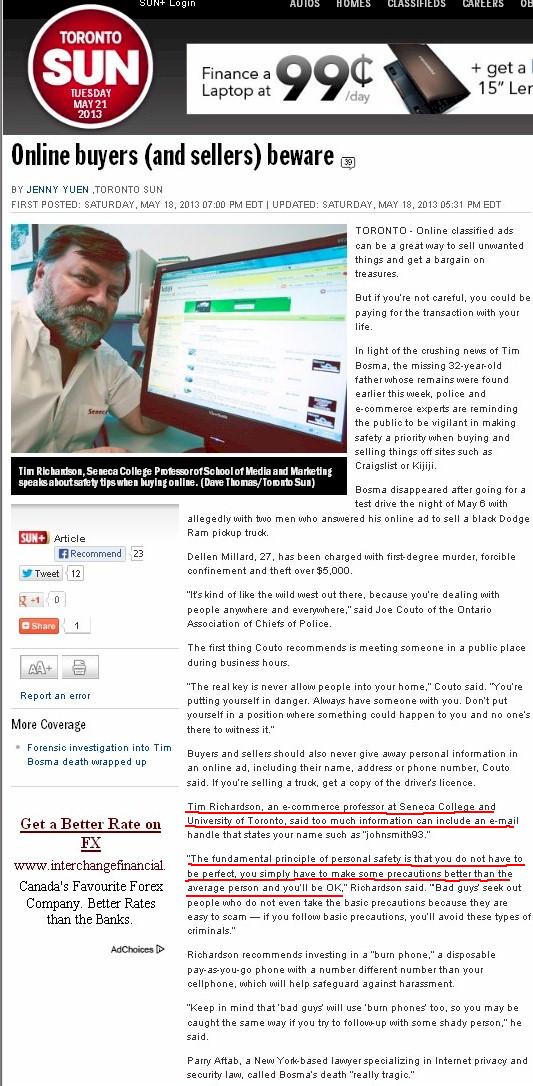 |
During
the 2nd week in May 2013, Richardson was interviewed by Jenny Yuen of The
Toronto Sun about how to be shop safely using online classified ads and
auction sites. Richardson made a number of specific recommendations, including
using a "burn phone" so you can make contact with potential buyers without
compromising your personal communications info.
torontosun.com/2013/05/18/online-buyers-and-sellers-beware |
 |
During the 4th
week in April 2013, Richardson was a guest speaker to the Rotary Club of
Uxbridge. Richardson spoke about business and competition
witiger.com/rotary.htm |
|
 |
During
the 4th week in April 2013, Richardson was interviewed live on air by Sandy
Rinaldo for CTV News to discuss the release of quarterly earnings by Apple
and expectations for future products to be launched. Richardson explained
that just because it is technically possible to produce a product doesn't
mean that the marketing people can sell it to a crowded and competitive
market. youtube.com/watch?v=cQwr_MWPC7k
on the CTV site atctvnews.ca/video?clipId=912150 |
|
 |
During the 3rd
week in April 2013, Richardson was interviewed live on air for CTV News
to discuss the continued drop of Apple stock from the $700 range to $300.
Richardson explained the circumstances of versioning and the absence of
distinct FABs between new models and some decline in innovation, compared
to other smartphone competitors.
youtube.com/watch?v=hGJ0IJw4xaQ on the CTV site at ctvnews.ca/video?clipId=908295 |
|
 |
During the 3rd week in March, Richardson was interviewed by Cindy Pom of Global TV News for a segment dealing with the new telephone area codes for the Toronto region. Richardson explained on air that there are several driving forces 1. the massive numbers of immigrants from India and China + other asian countries which is driving up smartphone usage rates 2. the increasing number of devices and applications that use a mobile telephone number to connect with web based applications, such as video surveillance cameras |
|
During the 3rd
week in February 2013, Richardson was interviewed by Simon Kent of SunMedia
about the Chinese hackers cyber-attack on The New York Times. The quote
was “Finding out what the next move for Apple is may be worth tens of thousands
of jobs to a Chinese company,” Richardson said. “Don’t forget, in China
there is no break between military, commercial and state interests. They
are all interlinked.”
torontosun.com/2013/02/20/china-hacking-shows-were-all-technologically -vulnerable?utm_source=twitterfeed&utm_medium=twitter# and http://www.sunnewsnetwork.ca/sunnews/straighttalk/archives/2013/02/20130220-172513.html |
|
 |
During the 2nd
week in January 2013, Richardson was interviewed live on air for CTV News
by Sandy Rinaldo about the forthcoming announcement by Facebook, Richardson
suggested the new product may be some type of search function - it was
indeed a search function named "Graph Search". Richardson crowd sourced
part of his preparations with his Facebook group of former students. see
youtube.com/watch?v=g-n7CTwnoOQ&feature=youtu.be
facebook.com/home.php?sk=group_170425813017968 interview on CTV's website www.ctvnews.ca/video?clipId=844263 |
| 2012 | . |
.
 |
During the 2nd week of November 2012, Richardson was interviewed by Rosie-Ann Grover of the Hamilton Spectator for a story about credit card skimming fraud related to the incoming use of chip and pin technology versus the vulnerability of cards that still have a magnetic stripe. Richardson discussed the uneven roll-out of pin and chip cards mismatching the rate of adoption by small and medium sized merchants. |

 |
During the 4th
week of October 2012, Richardson was interviewed by Denise Deveau of PostMedia
/ The National Post for a story about online skills and what students need
to work in e-commerce and SEO / SMO marketing. Richardson arranged for
one of his former students (Dev Basu) to be profiled at length in the article.
http://www.canada.com/Online+skills+becoming+name+business+game/7439351/story.html |
 |
During the 3rd
week of October 2012, Richardson was interviewed by Denise Deveau of PostMedia
/ The Financial Post for a story about developing a winning marketing plan.
Richardson was quoted as saying “Word of mouth and viral marketing are
where most companies are going these days with their marketing,”
http://business.financialpost.com/2012/10/23/develop-a-winning-marketing-plan-with-these-10-tips/ |
|
During the 3rd week in October 2012, Richardson was a guest speaker to the Rotary Club of Uxbridge. Richardson spoke about online security and gave some specific tips and tactics about password security. witiger.com/rotary.htm |
|
During the 2nd week in October 2012, Richardson was interviewed live on air for CTV News by Sarika Sehgal for a story about Newsweek magazine suspending print production of hard copies of the magazine and moving exclusively to a digital version. Richardson explained various advantages and disadvantages of e-commerce business models in the context of increasing advertising revenue and obtaining more precise target market segmentation of readers/viewers. |
|
During the 2nd
week in October 2012, Richardson was interviewed by Janet Davison of CBC
News about Cyberbullying. Richardson said "Questions of legal jurisdiction
and the overwhelming volume of postings made every day around the world
compound the challenge police forces face in determining real identities
in the online world.""The difficulty tracking online identities can also
be compounded by the sheer volume of online messages that flow over the
internet each day. The very nature of online communication and social media
can fuel the volume — in a bullying case, for example, one mean or disturbing
comment could quickly be forwarded through cc-ing or bcc-ing one email
message. People clicking additional "likes" on a suspect comment could
also spread the harm."Then it gets kind of clouded as to who was the originator,"
"
cbc.ca/m/touch/news/story/2012/10/16/f-tracking-online-identity.html |
|
During the 2nd
week in Sept 2012, Richardson was interviewed by freelance journalist Kaliegh
Rogers for a story in The Star about online security and password protection
re: personal internet security. Richardson explained about how to make
passwords harder to crack by using upper case and lower case letters in
addition to numbers and added that changing the password frequently helps.
Richardson also provided some specific tactical tips about remembering
multiple passwords.
The article was published Oct 10th at http://www.thestar.com/living/technology/article/1261464--think-your-passwords-are-secure-think-again
|
|
During the 4th
week in August 2012, Richardson was interviewed for a story about Indian
car manufacturer Tata and their plans for expansion into Canada. Richardson
commented on the competitive environment they will face plus the challenge
to find the most appropriate target market
segment.thestar.com/wheels/article/1249562--cars-and-culture-india-s-nano-people-s-car-hits-roadblock |
 |
During the 4th
week in August 2012, Richardson was interviewed by Kate Dubinski of the
London Free Press / Sun Media Chain for a story about how the internet
has changed education - noting it is the 15th anniversary of the internet.
Richardson said the most recent changes to how professors teach is not
the internet, but rather that access to the internet is in the majority,
from mobile devices.
http://www.lfpress.com/2012/08/31/technology-in-the-classroom-shaking-up-learning-and-teaching |
 |
During the 3rd
week in August 2012, Richardson's interview w ECT for a story about eBay
banning sales of supernatural and occult items was carried on technewsworld.com
www.technewsworld.com/story/75938.html
Richardson said "eBay and sites like YouTube are increasingly under pressure from activist shareholders, from comments to the board and from faith-based organizations that are worried about buying or selling products contrary to the tenets of what they practice," |
 |
During the 3rd week in August 2012, Richardson was interviewed by Rachelle Dragani of ECT ecommercetimes.com for a story about eBay and their plans to ban sellers of witchcraft items, potions and hexes. Richardson commented on how auction sites work and explained the deep background to the story. |
 |
During the 3rd
week in August 2012, Richardson was quoted in the Huffington Post about
professors encouraging their students to use portable networked devices
in class.
huffingtonpost.ca/2012/08/23/technology-in-classrooms_n_1824049.html |
|
During the
3rd week in August 2012, Richardson was quoted in the Calgary Herald about
professors encouraging the use of gadgets in class to enhance learning.
http://www.calgaryherald.com/mobile/life/family/Professors+encourage+gadgets+class +saying+enhance+learning/7133881/story.html |
|
During the 3rd
week in August 2012, Richardson was quoted in the Vancouver Sun about BYOT
[bring your own technology] to class.
http://www.vancouversun.com/life/Professors+gadgets+class+enhance+learning/7134031/story.html Richardson explained "One way his students use their portable devices in class is to watch videos he is referencing or research an answer to a question posed in class. Richardson takes it a step further by putting his lectures on YouTube. “I’ve got a website with videos on there of me saying these exact lecture points,” he says, adding they come in handy for students who juggle part-time jobs and can’t always make it to class." |
 |
During the 3rd
week in August 2012, Richardson was quoted on CP24 about students using
tech devices in class. "They (students) live in a digital generation of
instant gratification," says Tim Richardson, a professor at Seneca College
and the University of Toronto. "They expect education to be a product delivered
in the same way."
.cp24.com/news/professors-encourage-use-of-gadgets-in-class-1.926205 |
 |
During the 3rd
week in August 2012, Richardson's interview w Canadian Press was carried
in the Winnipeg Free Press re: the use of electronic devices in the
classrooms. Richardson was quoted as saying "The BYOT [bring your own technology]
movement certainly won't replace professors; it will just enhance the way
they teach while keeping students more focused"
http://www.winnipegfreepress.com/arts-and-life/life/professors-encourage-use-of-gadgets-in-class-sayi... |
 |
During the 3rd
week in August 2012, Richardson's interview w Canadian Press was carried
on Shaw Cable
http://www.shawconnect.ca/NewsArticle/Tech/6442481662_198/Professors_encourage_use_of_g Richardson said of the BYOT movement ""It makes them part of the learning process as participants instead of spectators," he says. "That's what engages students."" |
|
During the 2nd week in August 2012, Richardson was interviewed at length by Jessica Vitullo of The Canadian Press for a story about the use of electronic devices in the classrooms as part of a "back to school" story. Richardson commented about how teachers can be more engaging with students during the class by referencing web-based content that students can access through smart phones, netbooks, tablets and notebooks.. |
|
 |
During the 2nd
week in July 2012, Richardson was interviewed live on air for CTV News
by Amanda Blitz and Todd Van Der Heyden for a segment about the recall
of Ford, Mazda and Honda vehicles and how this would effect branding and
customer loyalty. Richardson also explained how the recall process works
and provided an insight on how large dealerships hoard parts.
https://www.youtube.com/watch?v=hL05jjlzckE http://www.ctvnews.ca/autos/ford-recalls-2013-escape-tells-owners-to-stop-driving-1.885106 |
|
During the 2nd week in July 2012, Richardson was interviewed by Sharon Aschaiek twitter.com/sharonaschaiek writing an article for The Toronto Star about a Toronto company that uses its website for posting jobs. Richardson commented on the importance of knowing the competitive environment while endeavouring to turn your customers into ambassadors as part of cross-selling and upselling your services. |
 |
During the 2nd week of July, Richardson was interviewed by Dan Misener for a story about small businesses successfully using web technologies for marketing. Richardson highlighted www.poweredbysearch.com which is a fast growing SEO firm led by Dev Basu, a former student at the U of T Scarborough campus |
|
During the 2nd
week in May 2012, Richardson was interviewed by Niamh Scallan of The
Toronto Star for a story about R.I.M.'s selection new executives. RIchardson
was quoted in the context of whether these new hires (who are outsiders)
will be able to deal with RIM's existing corporate culture“(RIM) needs
someone who’s really strong to be able to have an opinion against RIM insiders
to say ‘we shouldn’t we following, we should be leading,’” Richardson said.
“They have to fight against the inertia of what’s happened to them for
the past 24 months.”
http://www.thestar.com/.....mpany-resist-internal-corporate-culture-maybe-not-in-that-order?bn=1 |
 |
During the 1st week in May 2012, Richardson was interviewed by Post City Magazine for a story about Peel Region school board adopting a BYOD "Bring Your Own Devices" policy that would allow High School students to freely bring laptops, netbooks, tablets and smart phones into the classroom. |
|
During the 3rd week in March 2012, Richardson was interviewed by Shawn McCarthy of the Globe and Mail for background on a story about the Canadian Prime Minister in Japan on a Trade Mission. Richardson answered as the former Executive-Director of the Canada-Japan Trade Council.. |
|
During the 2nd week in March 2012, Richardson was interviewed by Michael Oliveira, Report/Editor of The Canadian Press for a story about how a convenience store chain is using bluetooth technology to send wireless messages to customers that are in proximity to particular stores. |
 |
During the 1st week in March 2012, Richardson was interviewed live on air by Matt Holmes of CHML Radio in Hamilton for a story about the launch of Google's Privacy Policy |
|
During the 3rd
week in February 2012, Richardson was interviewed by Dan Misener for a
story about using email analytics. Richardson was quoted as saying "...warns
small businesses not to “obsess” over analytics. E-mail analytics can be
useful small business tools, but “you still need to focus on running the
business, too,” . Richardson also arranged for a former student of his
to also be interviewed for, and quoted in the story.
theglobeandmail.com/report-on-business/small-business/digital/web-strategy/ want-to-avoid-ticking-off-customers-use-e-mail-analytics/article2347308/print/ |
|
During the 2nd week in February 2012, Richardson was interviewed by Sophia Harris of CBC News about the story of the Chinese hackers who had hacked Nortel and its senior execs. Richardson commented on the various hacking tactics that could have been employed as well as some of the reasons why particular execs were targeted, related to the access those execs had. ie. in 2007, President Bush appointed Nortel CEO Mike Zafirovski to the National Security Telecommunications Advisory Committee |
|
misquote video "lost in translation" |
During the 4th week in January 2012, Richardson was interviewed by Emily Jackson of The Toronto Star for a story about R.I.M.'s new graphics and imagery for marketing their new Blackberry models. Featured at http://rimblogs.files.wordpress.com/2012/01/be-bold-infographic.jpg Richardson commented saying "this is not Obama's Blackberry" and explained the perils of straying too far from your original "target market segment" saying you should "dance with the girl that brought you", which was misquoted as "dance with the girl that bought you" thestar.com/news/article/1123857 |
|
During the 1st week in January 2012, Richardson was interviewed by Emily Jackson of The Toronto Star for a story about a new Google feature called "Social Search". Richardson commented on how this feature effects personal privacy as well as effecting the ability of vendors to develop more specific target market segments. http://mobile.thestar.com/mobile/business/article/1113490 |
| 2011 | . |
|
 |
During
the 3rd week of December 2011 Richardson was interviewed live in CBC Radio
for a call-in show dealing with a new Facebook feature called "Timeline".
The audio portion of the segment was put on the CBC website at
cbc.ca/ontariotoday/2011/12/20/wednesday-facebook/ |
|
During the 3rd week of December 2011 Richardson was interviewed by the Toronto Sun about "revenge sites" gaining in popularity as more "scorned lovers" look for an opportunity to post pics and comment online. Richardson was quoted as saying There will be more of these sites in the future ...There is a lot of people who have had things done to them and they want to find a vehicle for rage.” http://m.torontosun.com/2011/12/20/revenge-sites-gaining-popularity |
|
During the 4th week of November 2011 Richardson was interviewed by Mark McAllister on Global TV for a story about how a Toronto assault in a very public location was videotaped and ended up on YouTube. Richardson commented on how and why people post sensational content to YouTube relating to "clicks" and banner ads.v |
..
 |
During the 3rd week of November, Richardson was interviewed by Kyle Daly of SNL Financial news www.snl.com for a story about the business model of Zaarly.com, an emerging consumer-to-consumer structure that allows people to do business locally, on their smartphones. |
 |
During the 1st week of October, Richardson was interviewed by Ming Pao about safety issues related to the recycling of computer parts, specifically content on hard drives that might not be properly wiped clean. Richardson explained the time pressures that sub-contractors are under to achieve certain time constraints which leads to situations were certain processes are not completely finished. Knowing this, means people working in companies should delete the hard drives themselves to prevent corporate intellectual property theft and personal Identity theft situations. |
|
During the 4th week of July 2011, Richardson was interviewed by Ian Bailey of The Globe and Mail for a story about "swatting" .theglobeandmail.com/news/national/british-columbia/bc-family-victims-of-swatting-hoax/article2112354/Swatting is a new situation where "bad guys" make a false call to 911 and report an incident happening at a specific location that often involves some innocent person - the result is a team of "First Responders" descend on some house thinking a violent crime is in place, only to find that it was a prank call. |
|
|
During the 4th week of July 2011, Richardson was interviewed by Laura Baziuk of PostMedia / The National Post about phone hacking and how widespread the practise is in Canada. |
|
During the 3rd week of July 2011 Richardson's PostMedia interview about the NATO hack was carried on Global News. http://www.globalnews.ca/NATO+investigating+hacking+claims/5143332/story.html.v |
.v
|
During
the 3rd week of July 2011 Richardson was quoted in the Ottawa Citizen about
NATO security and hacking. http://www.ottawacitizen.com/news/NATO+investigating+claims+hacking/5143066/story.html
Richardson explained that when hackers broke into NATO's computer system and stole classified documents "You're dealing with security secrets that affect people's lives which can be very easily fatal in a country like Afghanistan" |
 |
During
the 3rd week of July 2011 Richardson was quoted in the Edmonton Journal
about NATO security and hacking. edmontonjournal.com/news/canada-in-afghanistan/Hack+claim+chilling+NATO+prof+says/5142678/story.html
Richardson explained that "A pure hardcore technical hack is extremely difficult," he said. "You see it in the movies - some 15-year old kid breaking into the Pentagon computer. That doesn't happen in real life."hackin |
 |
During the 3rd
week of July 2011, Richardson was quoted in the Vancouver Sun about NATO
security and hacking.
http://www.vancouversun.com/news/partner/shell/NATO+
|
 |
During the 3rd
week of July 2011, Richardson was quoted in the Nanaimo Daily News about
NATO security and hacking.
http://www2.canada.com/nanaimodailynews/news/s tory.html?id=416919b9-7ec1-445a-9d00-ce2ad77fa323 |
|
|
During the 3rd week of July 2011, Richardson was interviewed by Beatric Fantoni of PostMedia / The National Post about hackers that broke into NATO's computer system and stole classified documents. Richardson explained the difference between "a pure hardcore technical hack" and social engineering. |
..
|
|
During the 3rd
week of July 2011, Richardson was interviewed by Aileen Donnelly of PostMedia
/ The National Post about the consequences of the phone hacking scandal
in the U.K. and privacy issues and identity theft concerns.
http://news.nationalpost.com/2011/07/21/what-the-the-definitive-guide-to-phone-hacking/ |
 |
 |
During the 2nd
week of July 2011, Richardson was interviewed for a story about the negative
effects of taunting and teasing within Twitter
http://www.metronews.ca/ottawa/life/article/915908-- mob-mentality-yielding-mean-tweets-on-negative-stereotypes also http://metronews.ca/news/207481/hashtag-mob-mentality-yields-mean-tweets-on-negative-stereotypes/ |
|
 |
During
the 1st week in June 2011, Richardson was interviewed on CBC news by business
reporter Havard Gould for the story about the SONY PlayStation hack
view at http://www.youtube.com/watch?v=bdcHv8d7Hc4 |
|
During the 3rd week in May 2011, Richardson was interviewed by CTV journalist Jerry Lalonde for a story about the head of the IMF and the possibility that Canada's Mark Carney (current head of the Bank of Canada) may be a contender for this international position. Richardson provided background on the possibilities of Carney's competitiveness. |
|
During the 2nd week of May 2011 Richardson was interviewed for a segment on air for CBC Radio by Mike Hornbook, about the possibility that the head of the Bank of Canada (Mark Carney) might be the next head of the IMF. RIchardson went on record saying that there was a very good chance that would happen.. |
 |
During the 2nd week of April 2011, Richardson was interviewed by Katherine Brulotte for an on-air segment about teachers using social media. Richardson commented about his use of Twitter and YouTube and expressed caution about using FaceBook |
 |
During the 2nd week of April 2011, Richardson was interviewed for a segment about teachers using social media. Richardson commented about using YouTube as a tool to communicate particular segments in a lecture, and also allow students to earn class participation marks when they use the comments part of YouTube. |
|
During the 1st week of April 2011, Richardson was interviewed by Ivor Tossell of the Globe and Mail. Tossell quoted Richardson about using translation services for e-commerce and Richardson said “All e-commerce is m-commerce.”theglobeandmail.com/report-on-business/your-business/bust.................... |
 |
During the 1st week of April 2011, Richardson was interviewed by Sandy Lo, the Deputy Managing Editor of BusinessNext Publishing Corp. in Taiwan for an article about e-commerce security concerns for vendors operating internationally. |
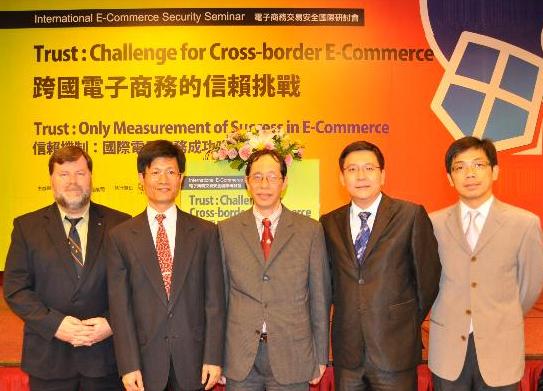 |
During the 1st week of April 2011, Richardson was invited by the Taiwan government to be the keynote speaker at an international conference on e-commerce security. Held in Taipei, the conference, co-sponsored by BusinessNext magazine, featured speakers on techical and non-technical aspects of e-commerce security for vendors and customers. |
 |
During the 3rd week of March 2011, Richardson was interviewed by John Gormley for a live on air segment about the economic consequences of trade regarding the earthquake in Japan and the possible effect on Saskatchewan exporters. Gormley is news talk radio host at 650 CKOM in Saskatoon. |
|
During the 3rd week of March 2011, Richardson was interviewed by Ron Charles for an on air segment about the economic consequences of Canada-Japan trade regarding the earthquake in Japan. |
|
During the 3rd week of March 2011, Richardson was interviewed by Sarah Gladney for an on air segment about Canada's future trade prospects with Japan. Richardson commented on the logistical and communication challenges which will impede resumption of trade. |
|
During
the 3rd week of March 2011, Richardson 's story about the expected decline
of Canadian exports to Japan was carried in the Toronto Star and thestar.com
http://themes.thestar.com/article/04sVc3EeX9g2z . |
 |
During
the 2nd week of March 2011, indiatimes.com quoted Richardson or a story
about the earthquake in Japan.
http://iplextra.indiatimes.com/article/04sVc3EeX9g2z |
 |
During
the 2nd week of March 2011, Richardson's interview on the earthquake in
Japan was carried on air, and on the website of 630 AM CHED News Radio
www.630ched.com/News/National/Article.aspx?id=267949 |
 |
During
the 2nd week of March 2011, Richardson's interview on the earthquake in
Japan was published on the Saskatchewan portal mysask.com
http://www.mysask.com/portal/site/main/template.M......e3921802ac01tte.cachetoken |
|
During
the 2nd week of March 2011, Richardson's interview on the earthquake in
Japan was broadcast on CablePulse 24
cp24.com/canada-will-lose-out-on-short-term-trade-as-japan-recovers-1.617318 |
|
During
the 2nd week of March 2011, Richardson was interviewed for an on-air segment
about the impact of the earthquake in Japan on Canada-Japan trade
radio-canada.ca/nouvelles/Economie/2011/03/14/005-japon-canada-retombees.shtml |
 |
During
the 2nd week of March 2011, Richardson was quoted in Canadian Business
magazine about the earthquake in Japan
canadianbusiness.com/markets/headline_news/article.jsp?content=b6218378 |
|
During
the 2nd week of March 2011, Richardson was quoted in the Winnipeg Free
Press about the earthquake in Japan
winnipegfreepress.com/business/breakingnews/ca.................arthquake---117813913.html |
 |
During the 2nd week of March 2011, Richardson was quoted in the Lethbridge Herald about the earthquake in Japan www.lethbridgeherald.com/business/.......................trade-as-japan-recovers-from-earthquake.html |
 |
During the 2nd week of March 2011, Richardson was quoted in the Brandon Sun about the earthquake in Japan www.brandonsun.com/national/breaking-news/canada-will-lose-out-on-short-term-trade-as-japan-... |
|
During the 2nd week of March 2011, Richardson was quoted yahoo.ca about the earthquake in Japan ca.finance.yahoo.com/news/Canada-lose-short-term-trade-capress-24..ml?x=0 |
 |
During the 2nd week of March 2011, Richardson was quoted on MSN.com new about the earthquake in Japan msn.com/money/article.aspx?cp-documentid=27969859 |
|
During the 2nd
week of March 2011, Richardson was quoted in the Metro News about the earthquake
in Japan
metronews.ca/halifax/business/article/800234--canada-to-lose-out-on-trade-due-to-quake |
 |
During the 2nd week of March 2011, Richardson was interviewed by 680 News for an "on air" segment about the earthquake in Japan. Richardson talked about Canada's exports of building materials |
 |
During the 2nd week of March 2011, Richardson was interviewed by Mike Attenborough of BNN television about the earthquake in Japan. |
|
During the 2nd week of March 2011, Richardson was interviewed by journalist Mary Gazze of Canadian Press about the earthquake in Japan and the possible economic effect on Canada's exports to that region. The interview was carried in various newspapers and also on CP radio segments |
 |
During the 4th week of February 2011Richardson was interviewed by itWorldCanada.com regarding Google's update to their search engine alogorithm and how Google's content farm crackdown may affect Canadian rankings. Richardson said, organizations are still very concerned about how to gain high ranking scores on Google searches. “However, many businesses are also beginning to shift their focus on social media presence as well.” /www.itbusiness.ca/it/client/en/home/News.asp?id=61475&PageMem=2 |
| During the 2nd week of February 2011, Richardson was interviewed by Lisa Kopochinski for an article in Travel Goods Fashion and Accessories magazine www.mediaedge.ca/tgfa.shtml about virtual retailing and e-commerce. |
|
During
the 1st week of February 2011, Richardson was quoted in the Winnipeg Free
Press about social media and translation
http://www.winnipegfreepress.com/.............edia-possible-takeo9&sortBy=oldest |
|
During the 1st week of February 2011, Richardson's interview for CP was carried in Yahoo Finance. Richardson was quoted regardiing real-time translation for social media. http://ca.finance.yahoo.com/news/Ortsbo-com-real-time-capress-3162009869.html?x=0 |
 |
During
the 3rd week of January 2011, Richardson was interviewed by Anca
Gurza of the Embassy: Canada's Foreign Policy Newsweekly out of
Ottawa. www.embassymag.ca
Richardson answered questions about Canadian companies are blocked from acquiring or expanding their natural resource ownership in a foreign country. embassymag.ca/page/view/Iceland-01-19-2011 |
|
During the 2nd week in January 2011, Richardson was quoted on CTV News regarding IT training saying that “Despite the economy clawing back, we still have tens of thousands of people trying to go from part time to full time in IT, trying to rack up these qualifications,” www.ctv.ca/generic/generated/static/business/article1863974.html |
|
During the 2nd week of January 2011, Richardson was interviewed by Ivor Tossell of the Globe and Mail. Tossell wrote a 4 part series about online IT training and Richardson commented about the value of SMEs having employees do training online. http://m.theglobeandmail.com/report-on-business/yo......icle1863974/?service=mobile |
|
During
the 1st week of January 2011 Richardson was interviewed by journalist Chad
Skelton of the Vancouver Sun for a story on a new regulation being proposed
related to "impersonation" online.
http://www.vancouversun.com/news/against+on.....rts/4055551/story.html |
| 2010 | . |
|
During the 3rd week of November 2010 Richardson was interviewed by CHED 630 radio www.630ched.comin Edmonton for a segment on air about NFC "Near Field Communication" technology re: mobile e-commerce payments. Tim did this radio interview while in Korea for Seneca conducting a series of e-commerce lectures. |
|
During the 2nd week of November 2010, Richardson was interviewed by Ivor Tossell of the Globe and Mail. Tossell's piece was about setting up an online store and Tim contributed the information about domain name registration and hosting. |
|
During the 2nd week of November 2010 Richardson was interviewed by Darryl Konynenbelt of Global News for a segment on air about a study connecting excessive text messaging and risky behaviour of teens re: sex, drugs and alcohol. Richardson explained parents need to be more "in your face" about young people using technology and help teens be more cautious about sharing personal information indiscriminately through social media sites. |
| During
the 2nd week of November 2010 Richardson was interviewed by Andrew Sutherland
of Convergence Magazine about Viral Marketing
http://convergencemag.ca/ |
|
During
the 1st week in October 2010, Richardson was interviewed by Carl
Meyer of the Embassy: Canada's Foreign Policy Newsweekly out of
Ottawa. www.embassymag.ca
Richardson answered questions about what the Conference Board of Canada wrote in its assessment of the risks and opportunities associated with a possible takeover of Potash Corporation of Saskatchewan. Richardson strongly spoke against foreign majority investment in Potash Corp. |
 |
During the 3rd week in Sept 2010, Richardson was interviewed by Caroline Grech, Reporter at the Vaughan Citizen of YRMG York Region Media Group, regarding municipal candidates in the upcoming election and their use of particular items to hand out in the context of making an impression with voters. |
 |
 |
During the 2nd week in Sept 2010 a portion of Richardson's interview with Gazze of CP was carried in Maclean's. Richardson said "...trade disputes rarely run their full course. There are often several complaints between two countries, and disputes tend to be resolved by offering concessions in exchange for dropping the issues..." |
|
During
the 2nd week in Sept 2010 a portion of Richardson's interview with
Gazze of CP [about Japan's complaint to the WTO about Canada] (in the form
of an audio clip) was broadcast on CTV news and on the CTV website
http://toronto.ctv.ca/servlet/an/local/CTVNews/20100914/green-energy-fight-100914?hub=TorontoNewHome ctv.ca/CTVNews/QPeriod/20100914/green-energy-fight-100914/ |
|
During
the 2nd week in September 2010, Richardson was quote in MSN regarding
the WTO and the consequences of Canada having lost a dispute with Brazil.
http://money.ca.msn.com/investing/news/business-news/article.aspx?cp-documentid=25570335 |
|
During
the 2nd week in September 2010, Richardson was interviewed by journalist
Mary Gazze of Canadian Press about a story on Japan
launching a complaint to the WTO over how Ontario is restricting green
energy suppliers of solar powered products to be Ontario-based companies.
story was titled "Ottawa has Ontario's back in green energy subsidy fight with Japan" |
|
During the 2
week in September 2010 Richardson was quoted regarding Ontario's green
energy policy against a complaint from Japan.
metronews.ca/toronto/canada/article/634505--ottawa-has-ontario-s-back-in-fight-with-japan |
|
During the 1st
week of September 2010 Richardson was interviewed by Raf Brusilow for an
article about professors and students using social media such as Facebook
and YouTube and Twitter.
metronews.ca/ottawa/work/article/645585--how-to-use-social-media-to-get-ahead |
|
During the 2nd week of June 2010 Richardson was queried by Associate Producer, Diana Bumbaca regarding the rising costs associated with the G8 and G20 meetings. Richardson commented that a big component of the increased costs is the allocation for security services covering ground travel within the host city, access control into, and within buildings, and IT costs to affect Command, Control and Communications. |
 |
During
the 4th week of April 2010 Richardson spoke on "Optimizing Your Web Presence
" at the RIC Centre in Mississauga. The speech was posted on YouTube at
youtube.com/user/RICCentre#p/a/u/2/sMJAI80cDy4 |
|
During the 4th week of April 2010 Richardson was interviewed by Darryl Konynenbelt of Global News for a segment on air about the launching of a new political party in Canada. The "Pirate Party of Canada" has a platform that deals with internet privacy issues and reforming software patents. |
|
During
the 4th week of March 2010, Richardson was interviewed by Chris Tucker
of YRMG York Region Media Group, regarding aspects of the real estate industry
using the web, and how this affects opportunities for people to sell their
house online. The issue is whether the online MLS should be opened up to
allow individual owners to list their properties for sale without being
associated with a licensed real estate agent.
yorkregion.com/news/local/article/659199--re-writing-real-estate-rules |
 |
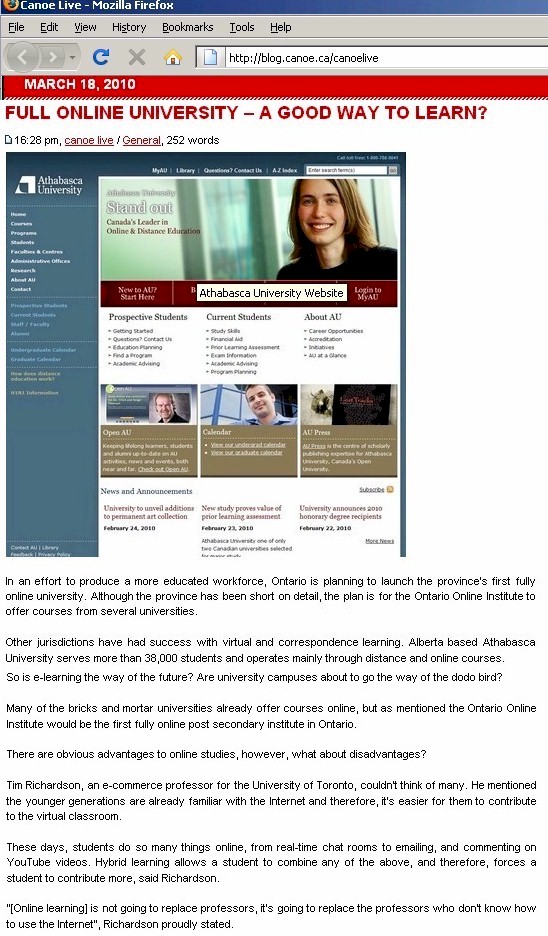 |
During
the 3rd week of March 2010 Richardson was interviewed by Jacqui Delaney
of Sun TV (Canoe Live) for a segment on air about offering college and
university courses online, and aspects related to that. Richardson was
quoted as saying "the internet won't replace professors,
it will replace professors who don't know how to use the internet".
/blog.canoe.ca/canoelive/2010/03/18/full_online_university_a_good_way_to_lea |
|
During the 3rd week of March 2010 Richardson was interviewed by Darryl Konynenbelt of Global News for a segment on air about a particular social networking chat room and the risks associated with participating. |
|
During the 2nd
week of March 2010 Richardson was interviewed for an article title "One
more reason to hate spam". Regarding jokes and spam sent by email, Richardson
said “If you pass on a message, what you’re doing is allowing the originator
of the message to collect all these email addresses, which will then be
used to send out spam email,”
metronews.ca/ottawa/life/article/472618 |
|
During
the 2nd week of March 2010 Richardson was invited by itWorldCanada.com
to begin be on a panel discussing mobile commerce payment issues.
online clip of the segment is at www.itbusiness.ca/it/client/en/home/News.asp?id=56842 video link http://www.itbusiness.ca/video.asp?bcpid.................UiqelOcv_MTi8l&bctid=72637996001 |
|
During the 2nd week of March 2010, Richardson was interviewed by staff writer Teresa Latchford of the Newmarket Era and YRMG York Region Media Group, regarding how textbooks are being pushed out of the education system as more technology is being utilized in the classroom. http://www.yorkregion.com/news/article/652896--death-of-the-textbook |
|
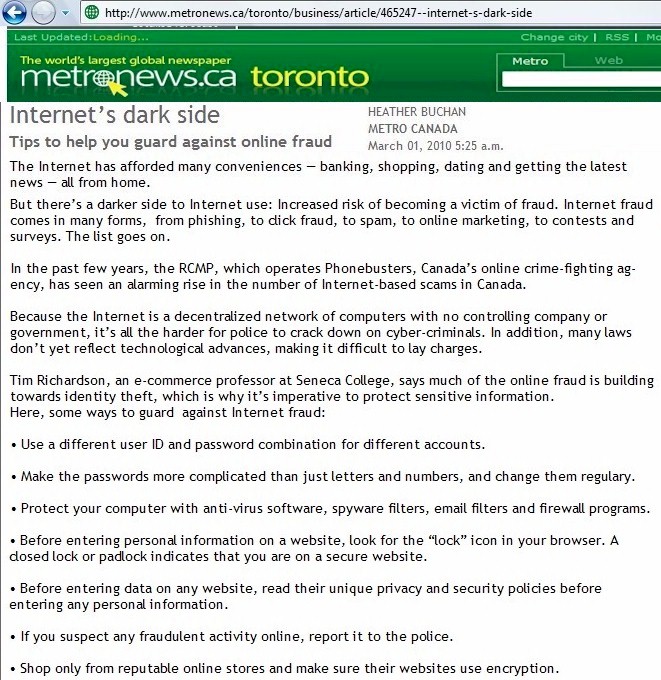 |
During the 1st
week of March 2010 Richardson was interviewed for an article title "Internet’s
dark side: Tips to help you guard against online fraud "
metronews.ca/toronto/business/article/465247--internet-s-dark-side. |
 |
During March
2010 Richardson was quoted in Canadian Business magazine regarding online
business models for shopping and the dangers of particular strategies.
www.canadianbusiness.com/entrepreneur/sa..nt=20100218_115710_9044 |
 |
During March
2010, Richardson's interview, with Michelle Warren of Profit Magazine,
was published.
Titled "Online Shopping: By invitation only", the article http://www.canadianbusiness.com/entrepreneur/sales_marketing/article.jsp?content=20100218_115710_9044 quoted Richardson discussing the challenges of particular business models |
 |
During the 4th week of February 2010, Richardson was interviewed live on air for the BNN Business News Network for a segment discussing Toyota and the testimony given by President Toyoda regarding the accelerator pedal problems. Richardson spoke as the former Exec.Dir. of the Canada-Japan Trade Council and explained the problem of Toyota's "black boxes", Event Data Recorders being encrypted which prevented U.S. law enforcement from finding out what happened in the final seconds when Toyota cars crashed. The clip is available online at http://watch.bnn.ca/#clip270260 |
 |
During the 1st week of February 2010 Richardson was interviewed by Kiah Haslett, Business Reporter for the Chicago Tribune. The interview was wide ranging and covered Search Engine Optimization and things to be convincing on an e-commerce website..v |
|
During the 4th week of January 2010 Richardson was interviewed by Global News for a story about how Toyota launched a massive recall for cars and trucks in North America..v |
|
During the 4th week of January 2010 Richardson was interviewed by Associate Producer at CBC News, Laura MacNaughton for a story about a new Apple product which has tablet features. |
 |
As
a result of being quoted in the Jan 20th 2010 CP story on Wireless bill
payment kiosks, Richardson's quotes ran in a number of newspapers (online
and printed) throughout North America, including national sites like Yahoo.ca,
"Wireless bill payment kiosks in retail locations to appeal to cash strapped" http://ca.news.yahoo.com/s/capress/100120/technology/technology_cyberfile_wireless_kiosks http://ca.tech.yahoo.com/cell_phones/phones/canadianpress/article/4191 (current in Feb 2011) |
|
During the 2nd week of Jan 2010, Richardson was interviewed by journalist Luann Lasalle of Canadian Press about a story on wireless kiosks that allow bill payments for mobile phones, cable, utilities, etc. Richardson was quoted as saying "... he doesn't believe wireless payment kiosks will stand the test of time. Consumers will use their mobile phones as digital wallets, something already starting to happen" |
| 2009 | . |

http://blogs.itbusiness.ca/ |
Dec
16th 2009 Richardson's first blog with ITBusiness.ca
of ITWorldCanada.com was launched. Titled "The “Holy Grail” of marketing
with mobile web access" Richardson discussed the possibilities for a web
interactive cell phone payment system that could be hypothetically launched
in Canada through Tim Horton's.
www.itbusiness.ca/it/client/en/home/News.asp?id=56842 |
|
During
the 2nd week of December 2009 Richardson was interviewed by Katie Dobbs
for a story in the Toronto Star about a controversial ad running
on the TTC. Richardson discussed the aspects of viral marketing and how
publicity can be generated, which gives a company exposure for free.
www.thestar.com/news/gta/article/737900--adultery-website-gets-free-ride-without-paying-ttc-a-cent |
|
During
the 1st week of December 2009 Richardson was interviewed by Peter Evans
for background on a story about how internet marketing has progressed in
the past 10 years and particular new web technologies used by marketers
in the ending years of the decade. Richardson's interview was published
online Dec 11th at
cbc.ca/money/story/2009/12/09/f-decade-ecommerce-2010.html |
| "Right now, the internet is at the level of black-and-white televisions,” University of Toronto professor Tim Richardson, a specialist on e-commerce, told CBC News. “We're all very impressed with what we're seeing, but we've barely scratched the surface of where it is going." |
 |
During
the 4th week of November Richardson was quoted by Maya Saibil in
an article for Bankrate.com, which was picked up by YahooCanada Finance.
The article discussed security aspects of fraudulent use of SIN numbers.
Richardson commented on ways to deflect SIN inquiries, in the context of
Identity Theft.
http://ca.finance.yahoo.com/personal-finance/article/bankratecanada/1340/all-about-sin |
 |
During the 3rd week of November Richardson was an invited speaker at the national conference of the National Ethnic Press and Media Council of Canadawww.nepmcc.ca . With the lead off by Prime Minister Harper, this well attended conference dealt with issues facing publishers of ethnic newspapers and magazines in Canada. Richardson delivered a special session titled "Challenges facing ethnic media as competition for readership becomes more intense in the Digital Age" |
|
During the 3rd week of November Richardson was invited by itWorldCanada.com to begin blogging on current applications of kewl technologies. Over the past several years Richardson has regularly given interviews to itWorld on a number of e-commerce and internet marketing issues. |
|
During the 2nd week of November 2009 Richardson was interviewed by Charlene Sadler for background on a story about how marketing on the web has progressed in the past 10 years. |
 |
Prof. Richardson has been named to the "Global Board of Advisors" for the Certified eMarketing Consultant (CeMC™) program is awarded by the eMarketing Standards Board of the Sales and Marketing Institute International (SMI). Based in Australia, SMI is one of the largest professional bodies for sales and marketing in the world. |
|
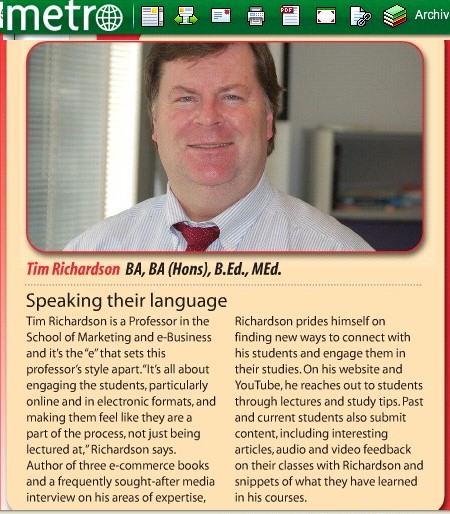 |
During the 3rd week of October 2009, Richardson was profiled in the Metro for a piece on college professors. the Metro described Richardson as "author of three e-commerce books and a frequently sought-after media interview on his areas of expertise" |
 |
During the 3rd week of October 2009, Richardson was interviewed at length by journalist Mark Tutton (London) for a segment on CNN International about new technologies facilitating web-based businesses. |

|
During
the 4th week of September 2009, Richardson was interviewed by Jamie
Sturgeon of the Financial Post for a story about a live-blogging
platform and the appropriate business model in the context of Web 2.0 |
|
During
the 4th week of Sept 2009 Richardson was interviewed by Associate Producer
Rebecca Shi of Fairchild Television for a documentary on the Freemasons  and
Dan Brown's new book "The Lost Symbol". and
Dan Brown's new book "The Lost Symbol".
episode Broadcast Oct 9th 2009 |
|
During the 2nd week of Sept 2009 (published Oct 5th) Richardson was interviewed by Iain Marlow for a story in the Toronto Star about teaching English in China through an interactive website. www.thestar.com/business/article/705303 |

www.theepochtimes.com |
During
the 1st week of September 2009, Richardson was interviewed by Matthew Little
for the English-Canada version of the international newspaper The Epoch
Times. The story was about students going back to school and dealing
with courses supplemented by online resources.
www.theepochtimes.com/n2/content/view/21969/ |
| Epoch Times said about Prof. Richardson "His name tops Google's results for the term “ecommerce professor,” a testament to the amount of content he has put on online and the number of times other websites have linked to it." |
|
During the 4th week of Aug 2009, Richardson was quoted extensively in an article about web-based jobs. www.metronews.ca/toronto/work/article/297077--online-jobs-offer-wide-variety |
|
During the 4th week of Aug 2009 Richardson's comments about Online sites that let people work at home, was carried in the Winnipeg Free Press. http://www.winnipegfreepress.com/life....nt-to-work-at-home-55456537.html |
|
During the 4th week of Aug 2009, Richardson was interviewed by journalist Luann Lasalle of Canadian Press about the many websites that allow home-based entrepreneurs to make money. Richardson was quoted as saying " it's not as easy as it appears to start an online business. And lots of these online schemes at best offer a way to make a few bucks and aren't considered "real jobs." "Great ideas have no value. What you need is the money to go with them," he said. |
 |
|
 |
|
| During the 4th week of Aug 2009 Richardson's comments about Facebook and the conflict with the Canadian Privacy Commissioner were broadcast on several radio stations such as CFRB Toronto, CKTB St. Catharines, AM 1150, as well as CablePulse24 TV www.cfrb.com/news/14/982298 |
|
During
the 4th week of Aug 2009 Richardson was quoted in the Toronto Star for
a story about Facebook and privacy issues. Richardson said "We live
in a celebrity generation where people want to be more famous than cautious,"
he said "But it's an opportunity for social networking sites to use better
privacy policies as a opportunity to bring more people to their site and
get more business."
www.thestar.com/news/canada/article/686928 |
|
During the 4th week of Aug 2009, Richardson was interviewed by journalist Luann Lasalle of Canadian Press about the conflict between Facebook and the office of the Canadian Privacy Commissioner. Canada's privacy commissioner has stated publically that the social media company must change its business practices to comply with Canada's privacy laws. |

m |
During the 3rd week of July 2009, Richardson's CP interview about employees using social media to comments, was carried on CTV's website under the heading "Don't be a twanker on Twitter". Richardson was quoted as saying ""It's a doubled-edged sword...companies want their employees to be creative and spontaneous and that same type of freedom should extend to Twitter and other social networking sites...If you're really Machiavellian and controlling, then it just won't work. You can't have your cake and eat it too" |
 |
During
the 3rd week of July 2009, Richardson's CP interview about employees
using social media to comments, was carried in several newspapers in Western
Canada, including the Calgary Sun. Richardson was quoted as saying "employees
can mix the personal and professional on Twitter, but need to exercise
some restraint to prevent their comments from coming back to haunt them".
www.calgarysun.com/life/2009/07/31/10323101-sun.html |
|
During
the 4th week of July 2009, Richardson was interviewed by journalist
Luann Lasalle of Canadian Press again about how people are using
social media - this time in the context of Twitter being used by employees
to make personal comments. Richardson was quoted as saying "Employees can
promote charitable events they're involved in, for example, but shouldn't
be passing on gossip."
http://technology.canoe.ca/2009/07/29/10303696-cp.html |
|
During
the 3rd week of July 2009, Richardson's CP interview about using
social media to comment on scams and crime, was carried in the London Free
Press
www.lfpress.ca/newsstand/Business/BusinessMonday/2009/07/20/10190721-sun.html |
|
During the 3rd week of July 2009, Richardson's CP interview about using social media to comment on scams and crime, was carried in the Winnipeg Free Press |
|
During the 3rd week of July 2009, Richardson was interviewed by journalist Luann Lasalle of Canadian Press about how people are using social media such as Facebook and MySpace to vent about being scammed or having lost money when companies behave unethically. Richardson was quoted as saying that "using social media in this way is "fulfilling" for the people involved. They can pass on a lot of content to a large group of people...People who are bad guys and thinking about committing these kinds of crimes should be fearful of this because of the empowerment that people are given through social media is exponentially greater than it was before." http://technology.canoe.ca/2009/07/16/10160711-cp.html |
 |
During May 2009, Richardson was was interviewed by fraudsquadTV.com for a segment dealing with online fraud and tactics to commit Identity Theft. The segment was to air in June 2009. |
 |
During
the 2nd week of April 2009, Richardson was invited (and accepted) to be
on the Editorial advisory and Review board of the International
Journal of e-Business Management - a peer reviewed publication
that originated in Australia and by early 2009 includes academics in leading
universities in Canada, China, Brazil and Europe. www.rmitpublishing.com.au/ijebm.html
"It presents an international forum for researchers and practitioners to advance knowledge and promote innovation and best practices in e-business management." |
|
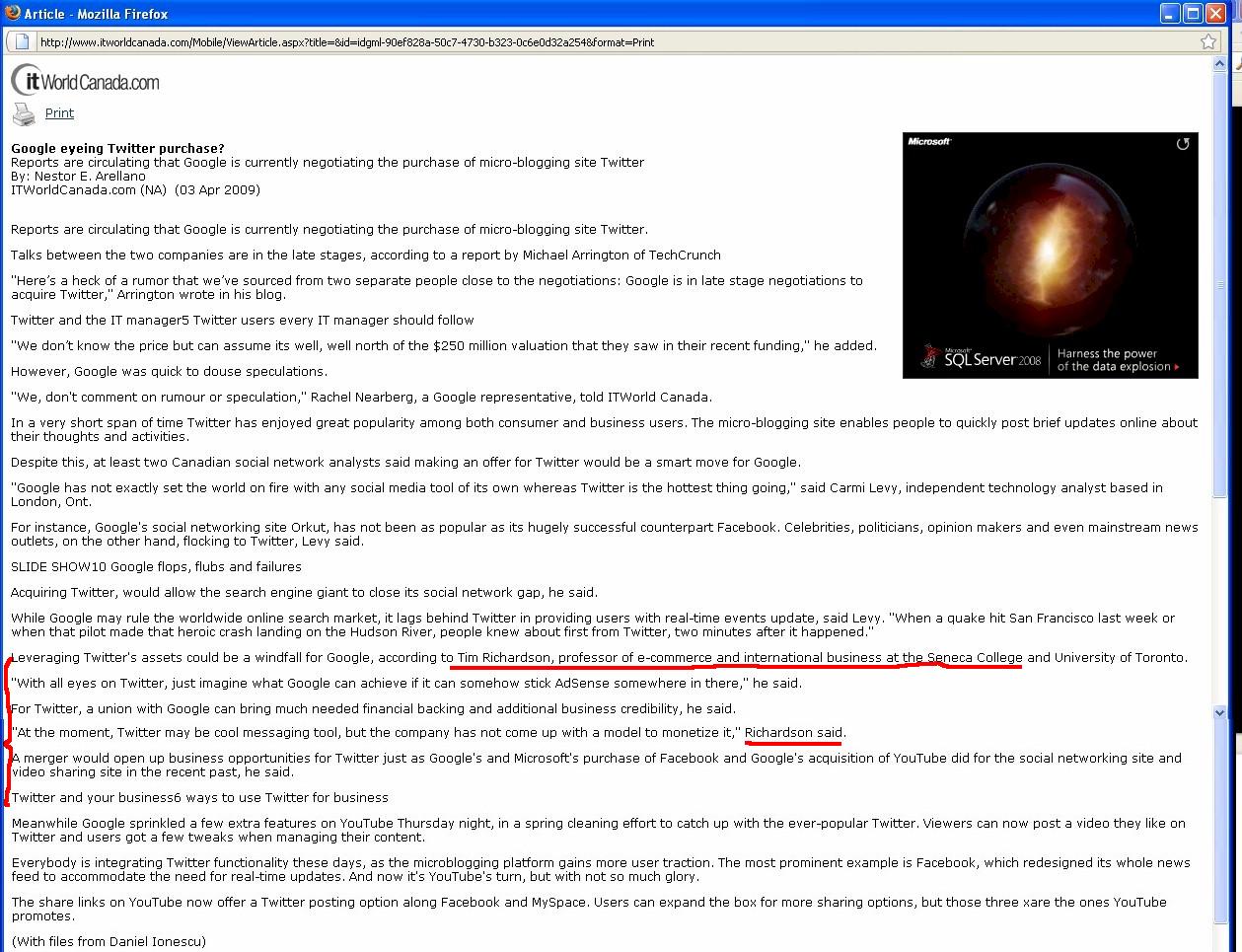
During the 1st week of April, Richardson was interviewed by itWorldCanada.com for a story about Google possibly buying Twitter. Richardson commented that it seemed like a good acquisition in the context of Google's drive to add in real-time search info plus information on people's GPS location. witiger.com/ecommerce/scanTwitterGoogle.jpg |
|
During
the 2nd week of March 2009 Richardson was interviewed by Emily Chung of
CBCNews.ca for an online article about the launch of Google's interest-based
advertising which is trying to be more specifically targeted to searchers.
Richardson was quoted as saying "advertisers are increasingly turning to
more targeted advertising because it's more efficient than mass advertising.
If it's more targeted, then they're going to increase their success rate,"
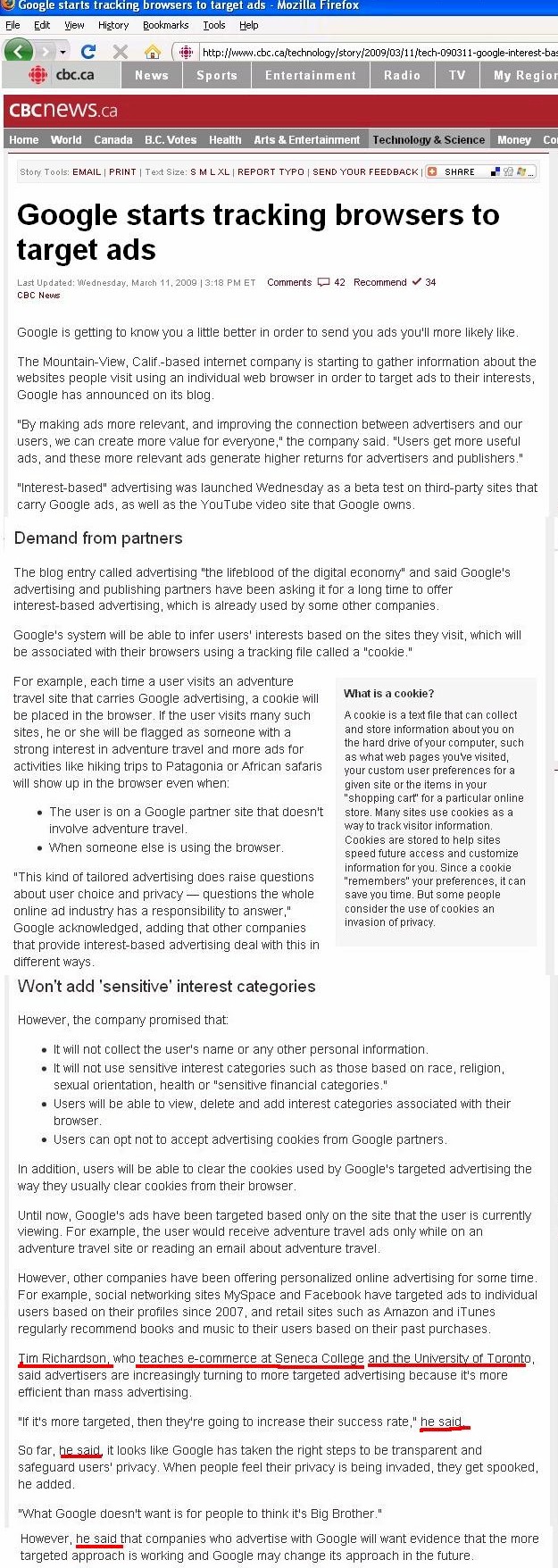
witiger.com/ecommerce/screenArticleCBC2009March11.jpg http://www.cbc.ca/technology/story/2009/03/11/tech-090311-google-interest-based-advertising.html |
|
During the 1st week of March 2009, Richardson was interviewed by freelance journalist Jennifer Yang for an article in the Globe & Mail about teenagers using Facebook for selling "urban themed" products among their friends and acquaintances. |
|
During the 4th week of January 2009, Richardson was interviewed by Business Reporter Naomi Powell for a story on the stimulus package of President Obama and the restrictions on importing due to the "buy America" clauses. Powell''s questions were related to how the "buy American" clauses would effect Canadian steel exporters. Richardson commented on the integration of the North American steel industry and the associated political sensitivities. |
| 2008 | . |
| During the 1st week of December 2008, Richardson was interviewed by Lynn Fraser for an article on podcasting for a future article in the Human Resources Professionals Association www.hrpa.ca members' magazine |
 |
During the 4th week of November 2008, Richardson was interviewed for a documentary to be broadcast on PBS about the expected economic downturn in the U.S. and Canada. Richardson's comments were related to e-commerce circumstances as well as international trade situations that may be effected. |
|
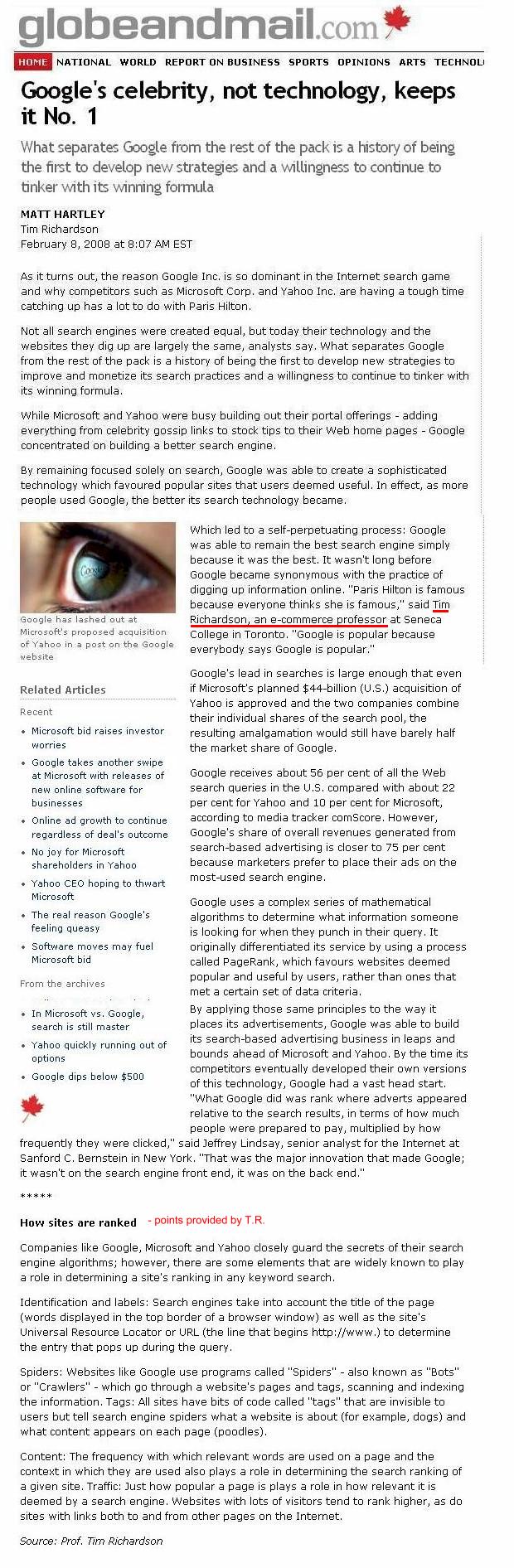
During the 3rd week of November 2008, Richardson was interviewed by Matt Hartley of the Globe and Mail about search engine strategy and the search engine live.com and search engine Google. |
|
During
the 3rd week of October 2008 Richardson was interviewed live on CTV Newsnet
for a story about the possibility that cellphone and internet use may be
effected by an economic downturn in the economy. Richardson provided several
examples of how cellphones and the internet are such an integral part of
everyday life that it is difficult to imagine much "cutting back" of these
technologies and services. Parts of Richardson's interview on TV were also
delivered as text on the CTV website.
original http://www.ctv.ca/CTVNews/SciTech/20081023/essentials_study_081023/ also posted on http://people.senecac.on.ca/tim.richardson/video/CTVInterviewOnGPS.wmv |
 |
During the 2nd week of October 2008 Richardson was interviewed by Arlene Bynon (for the 2nd time) for a televised panel discussion on Scams and Online Security for iChannel. Richardson served as the academic expert and discussed how criminals use various techniques to commit fraud online. The segment Season Ep 8-39 : The 419 Scam - Aired/Airs April 18, & May 1 & 2, 2009. www.ichannel.ca/issue |
 |
During the 1st week of October 2008 Richardson was interviewed by Alex Dobuzinzk of Reuters for background information on a story about a soft-core porn site and a particular target market segment. |
|
|
During
the 4th week of September 2008, Richardson was interviewed by Eric
Lam of the Financial Post for a story about the security risk of
trading stocks online. The story was carried in the Vancouver Sun and other
papers of the canada.com network (a division of Canwest Publishing Inc).
Richardson explained about the consequences of Identity Theft and certain
privacy issues. Richardson was quoted as saying ""In most cases it isn't
a technical hack. The victim knows the perpetrator," he said. This can
be just about anyone, including relatives, family friends or someone with
access to your computer."
www.canada.com/vancouversun/news/business/story.html?id=02b75777-93b5-47b8-896f-0786c54dad61 |
|
(part of Astral Media) |
During
the 3rd week of September 2008 Richardson was interviewed, live on air,
by host Jim Richards on CFRB newstalk 1010 for a short segment on
the upcoming "Do Not Call List". Richardson answered questions live on
air, the segment can be heard by clicking on the link below
http://people.senecac.on.ca/tim.richardson/audio/CFRB2008Sept22DoNotCallList.mp3 |
 |
During the 2nd week of September 2008 Richardson's interview with The Globe re: semantic Search Engines was carried, in its entirety, on usatoday.com. |
|
During the 2nd week of September 2008 Richardson was interviewed by Lisa Goetz from CTV's television show "CanadaAM" for background info on a segment related to election blogs and the upcoming Canadian election. |
 |
During the 2nd week of September 2008, Richardson was interviewed by Sharon Oosthoek for a story on CBC Online about how air carrier Virgin America has been using social networking sites such as Twitter to market and promote their brand. |
|
During
the 2nd week of September, Richardson was interviewed by itWorldCanada.comfor
a story about how Canadian call centres are coping with the "Do Not Call"
registry www.crtc.gc.ca/ENG/dncl.htmand
what "Best Practices" could be adopted.
http://www.itbusiness.ca/it/client/en/home/news.asp?id=49921 |
|
During
the 1st week of September 2008, Richardson's interview, given to Matt Hartley
of the Globe and Mail about semantic search engines, was published.
Richardson said "The key to success in semantic search is all about putting
results in context. That becomes more difficult as the amount of information
on the Web increases,Mr. Richardson said. "The reason why people wanted
to develop semantic Web search engines is because it's a more real way
of finding stuff," he said. "Keeping in mind that the content is growing
faster, search engines need to be more effective at reflecting the thinking
of real people.""
http://ago.mobile.globeandmail.com/generated/archive/RTGAM/html/20080813/wrsearch14.html |
|
During the 2rd week of Aug 2008 Richardson was interviewed by Carmen Chai of the Toronto Star about how internet-based social networking is being used by small businesses. Chai said Richardson thinks capitalizing on new technological changes is what businesses need to do to survive. "Everyone has to get creative because there is no more intermediary." thestar.com/Business/article/480216 |
 |
During the 4th week of July 2008 (July 30th) Richardson was interviewed live on CBC Newsworld by Andrew Nichols for a segment on the WTO and the collapse of the Doha round. Richardson explained the position that Canada had on subsidies in the agricultural sector and Canada's intentions to develop further bilateral relations for trade with countries. |
|
During the 4th week of July 2008 (July 22nd) Richardson was interviewed by Chris McInnis of CBC Radio (Sudbury) for a broadcasted segment on privacy issues related to web content posted about relations between neighbours who have disputes. |
|
 |
 |
During
the 3rd week of July, Richardson was interviewed by Susan Mohammed
of Maclean's magazine for a story about a British-based website
and their strategies to be profitable.
4th week in July / 1st week
in August the link was
|
|
During
the 2nd week of July 2008 Richardson was interviewed by Marci Ien on CTV's
television show "CanadaAM" for a segment on how GPS technology is
helping us, and concerns about privacy issues. You can watch the clip on
the CTV website at
http://watch.ctv.ca/news/top-picks/wireless-world/#clip65751 see also http://gpssatellitenavigationsystem.com/gps-2008-interview-given-to-ctv-tv-by-prof-tim-richardson/ |
|
During the 4th week of June 2008 Richardson was interviewed by the Toronto Star about aspects of entrepreneurs using Facebook and MySpace and other social networking sites for marketing and advertising.. |
 |
During the 4th week of June 2008 Richardson's comments about children being exposed to porn on the web and how measures may be taken to mitigate this, were included in www.thecanadianencyclopedia.com http://www.thecanadianencyclopedia.com/index.cfm?PgNm=TCE&Params=M1ARTM0013253 |
|
|
 |
During the 3rd week of June, Richardson was interviewed by Colin Campbell of Maclean's magazine for a feature cover story about issues associated with children being exposed to porn on the web and how measures may be taken to mitigate this. Richardson explained the technical limitations - web-based content is being produced each day at a rate greater than the ability of search engines to index the content - and also noted the importance of parental responsibility. |
|
During
the 2th week of June, Richardson was interviewed by itWorldCanada.com
for a story about how retailers are using new technologies to guard against
loss prevention. Retailers in Canada are losing around
$3.6 billion yearly to various criminal activities. These include tech-enabled
crimes such as pin pad tampering, debit and credit card fraud. "But at
least one Canadian expert believes the best defence against high-tech crime
is a low-tech response."
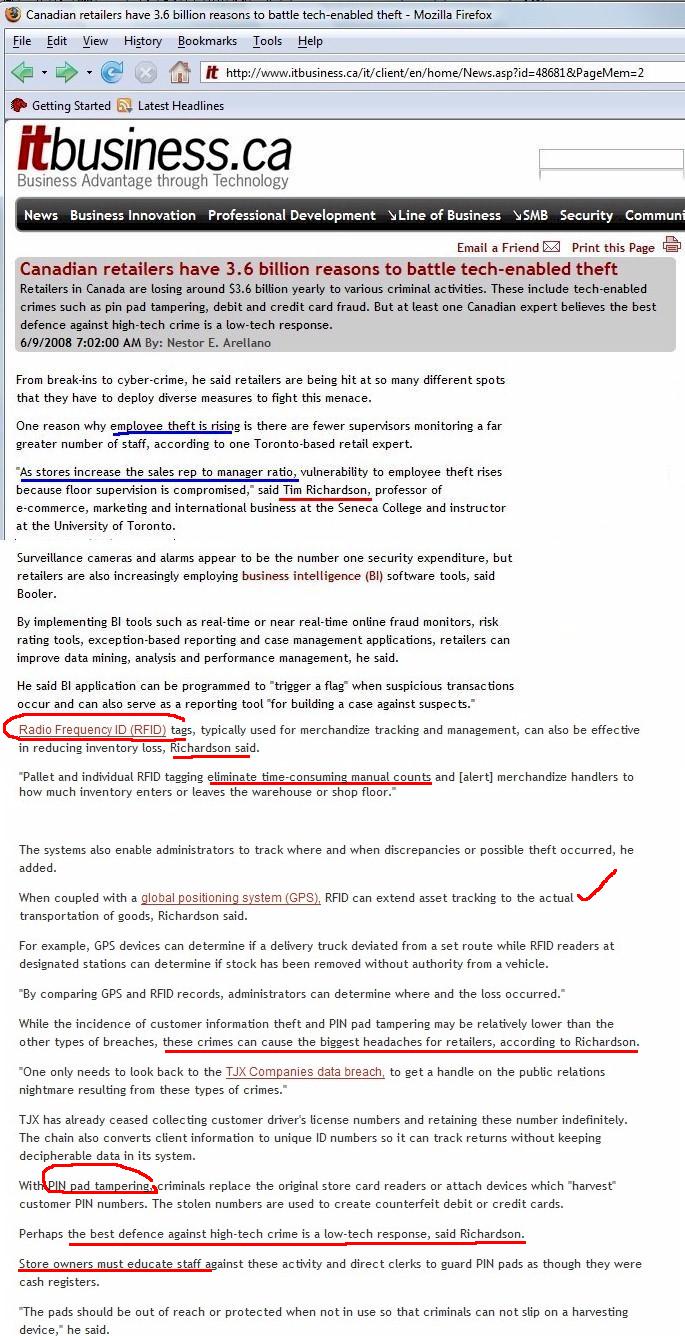
- screen capture of the article here witiger.com/ecommerce/screenArticleRFID-ITworldCanada1.jpg |
| Richardson explained the problem can be outlined in 4 parts; 1. customers: theft and fraud; 2. employees, internal theft - application of biometrics; 3. suppliers and business partners, ie use of RFID in inventory control; 4. external environment, weather extremes, power blackouts etc. |
|
During the 1st week of June, Richardson was interviewed by itWorldCanada.com for a story about how Canadian groups oppose government move towards "US-style" digital copyright laws |
|
During
the 2rd week of May 2008 Richardson was interviewed by Rita Trichur
of the Toronto Star about the CRTC consultation on broadcasting
in "new media". Under the heading "Watchdog revisits Internet Oversight"
www.thestar.com/Business/article/425899
Trichur said Critics questioned the CRTC's motives for reopening the new media file after nearly a decade of taking a hands-off approach. |
| "It's typical Canadian government – peace, order and good government – other people are doing something so let's try to control it because if we don't, oh gosh, they may try to do something interesting," said Tim Richardson, an electronic-commerce and technology expert at the University of Toronto. He added that any effort to regulate the Web is likely to be stymied by practical considerations, including the role search engine rankings play in determining where people surf online. |
 |
During the 2nd week of May 2008, Richardson was interviewed by John Downs of AM 640 news for a segment about the consequences of a company involved in a foreign investment where terrorists benefit from the investment. Several American victims of terrorist attacks in Israel are demanding millions in compensation from a Swiss bank. The Americans claim the Swiss bank should have known that sending money to Iran would result in terrorism being financed. |
| Richardson explained there are a number of examples of situations where a business directly or indirectly does things which benefit terrorists or rogue states - a Canadian example cited by Richardson was the Quebec based helicopter parts manufacturer who sold technology and parts to a Chinese company that made the Z-10 "attack helicopters" for the Chinese army. see http://www.cbc.ca/world/story/2007/10/19/pratt-engines.html Richardson noted that various human rights organizations such as www.oxfam.ca have researched how Chinese attack helicopters have been used in the Sudan by the Muslim backed government to attack and kill Christian refugees in western Sudan's Darfur region. |
|
During
the 2nd week of April 2008, Richardson was interviewed by Tim Appleby of
the Globe and Mail for a story dealing with how government agencies
could use advanced software and IT processes to monitor web content in
order to predict violence which might be expressed in advance by possible
perpetrators. Richardson explained the enormous technical complexity of
handling the fast growing number of web pages and noted that even Google
cannot keep pace in indexing new web content produced each day.
theglobeandmail.com/servlet/story/RTGAM.20080422.wgtshoot23/BNStory/Technology/ link still good March 2009 |

carleton.ca/jmc/cnews/04042008/n2.shtml |
During the 1st week of April 2008, Richardson was interviewed by Christina Atallah of Carleton University for their Capital News Online publication. In the context of the growth of social networking sites and possibilities of privacy violations, Richardson said "These sites are like "shooting fish in a barrel" for identity thieves". Richardson added "many users are not cautious when revealing personal details, creating a hotbed for cyber criminals" |
|
During
the 3rd week of March 2008 Richardson was interviewed by Rita Trichur
of the Toronto Star about the CRTC and a forthcoming report about
the possibility the CRTC will be involved in aspects of controlling web
based content. Richardson was quoted as saying Canadians are "incredibly"
fixated on the regulation of Canadian content and questioned enforceability
of such so-called Can-con rules given that the Internet is effectively
borderless. www.thestar.com/printArticle/349575
screen capture of the article witiger.com/ecommerce/screenTorStarCRTC.jpg |
|
During the 3rd week of March 2008 Richardson was interviewed by Arlene Bynon for a televised panel discussion on Identity Theft for iChannel. Richardson served as the academic expert on Identity Theft and discussed the fraudulent use of domain names (phishing) and other techniques to obtain and fraudulently use IDs. |
|
During the 2nd week of March 2008, Richardson was interviewed by journalist Kristian Peltonen for Canadian Press about how companies would consider "due diligence" in the context of preventing, and minimizing the effects of Identity Theft. |
|
During the 2nd week of March 2008 Richardson was interviewed by Rita Trichur of the Toronto Star about several things to do with how the CRTC can effectively operate in the "information age" were circumstances of web based content challenges the traditional situations of media consumption. |
 |
During the 1st week of March 2008, Richardson was interviewed by Maho Kawachi for Japanese newspaper Nikkei (Nihon Keizai Shimbun - Japan Economic Newspaper) for a story about viral marketing and how companies may be concerned about the equity of a brand who's product is used by a segment other than what they target or used in a way different than "normal", eg. mentos candies into diet coke. |

|
During
the 1st week of March 2008, Richardson was interviewed for CanWest Global
(Edmonton Journal) by Edmonton-based journalist Marta Gold for a
story about discrepancies in pricing between U.S. websites prices in U.S.
dollars, and prices of their products "in the store" in Cdn dollars in
Canada.
canada.com/reginaleaderpost/news/story.html?id=eaeee061-64b0-452a-ab52-a84e21b8b6fa |
 |
During the 1st week of March 2008, Richardson was interviewed for CanWest Global by Halifax-based journalist Charles Mandel for a story about what makes websites "sticky". Richardson explained the "things to be convincing" about on consumer websites. |
 |
During the 3rd week of February 2008, Richardson was queried by CBC newsworld to provide background information on a "front-page" hacking story in the province of Quebec. |
|
During the 3rd week of February 2008, Richardson was interviewed by Matt Hartley of the Globe and Mail about additional circumstances related to an ongoing story about search engine Google. |
|
During the 2nd week of February 2008, Richardson was interviewed by Matt Hartley of the Globe and Mail about search engine Google for an article titled "Google's celebrity, not technology, keeps it No. 1". Richardson explained why Google ranks as the No. 1 Search Engine and also provided some tips as to how websites are ranked. witiger.com/ecommerce/articleGoogle2008Feb8th.jpg |
|
During the 1st week of February 2008, Richardson was interviewed by Katie Daubs of the Ottawa Citizen about a new dot.com dating site scientificmatch.com that allows people to use their DNA profile to pick matches for dating and weed out potential marriage partners that may have immunological differences for any offspring. |
|
During the 4th week of January 2008, Richardson was interviewed by Jennifer Watson of CTV Newsnet about France’s second largest bank reporting US$7 billion in fraud. Richardson said as banks, in a highly competitive business sector, cut back senior staff while pushing for productivity, it creates a working environment prone to stress, bitterness and frustration and it is more and more common for insiders to use their inside knowledge of security passwords and systems against their employer - whereas most companies focus on security is external, not internal. |
|
During the 1st week of January 2008, Richardson was quoted extensively in an article about Domain Names. |
 |
During the 1st week of January 2008, Richardson was quoted on DomainPulse.comwhich is a leading webportal about the domain name business. Richardson provided comment about individuals buying domain names and the .ca domain. |
 |
During the 1st week of January 2008, Richardson was quoted extensively in an article about Domain Names. |
| 2007 | . |
|
As
a result of being quoted in the Dec 26th 2007 CP story on Domain Names,
Richardson's quotes ran in a number of newspapers (online and printed)
throughout North America, including national sites like Yahoo.ca,
http://news.yahoo.ca/s/capress/071226/technology/technology_cyberfile_personal_domain_1 the Washington Post, and local papers such as the Edmonton Sun, Belleville Intelligencer, Lethbridge Herald, the Thunder Bay Chronicle, Halifax Daily News |
|
|
During
the 4th week of December 2007, Richardson's comments to CP about Domain
Names were carried at length in an article on the CBC and CTV websites.
Richardson was quoted as saying
http://www.ctv.ca/CTVNews/SciTech/20071226/domains_names_071226/ www.cbc.ca/cp/technology/071226/z122604A.html |
| "The .ca tag, said Richardson, has become the next logical step for net-savvy users already connected and interconnected on such social sites as Facebook and MySpace. "It's the whole empowerment thing of the Internet,'' he said. "As people realize that the ability to put content on their little Geocities web page and MySpace and Facebook is limited by the built-in software that those circumstances allow, they say, `I don't want to be limited by only putting up five pictures in a square.' "And they realize that they can just buy their own domain and put up their own domain however they feel like it.'' |
|
During the 2nd week of December 2007, Richardson was interviewed by journalist Shannon Montgomery for Canadian Press about considerations regarding buying a domain name. The story was put on the wire Dec 26th and carried by several print and broadcast media. |
|
During the 4th week of November, Richardson was interviewed by itWorldCanada.com for a story about holiday shopping online. Tim explained there are 10 Reasons why Canadians will be doing more online shopping in 2007. |
|
During the 3rd week of November, Richardson was interviewed by itWorldCanada.com for a story about how eBay was a victim of some hackers that launched a program (precipitated by a tricky phishing technique) that installed Trojan viruses on users PCs. These viruses were then used to obtain password and login info that allowed the hacker to use the eBay account and ancillary accounts such as PayPal see http://www.itbusiness.ca/it/client/en/home/News.asp?id=46033 |
|
During the 4th week of October 2007, Richardson was interviewed by journalist James Keller of the Canadian Press office in Halifax for a story on how Google is responding to software that kills pop-up ads and banner ads. |
|
As
a result of being quoted in the October 31st 2007 CP story on Ad-blocking
software, Richardson's quotes ran in a number of newspapers (online
and printed) throughout North America, including Yahoo.ca and msn.com
see article at witiger.com/ecommerce/articleCPinterview.jpg |
|
During
the 4th week of October 2007, Richardson was quoted in a story titled
"Ad-blocking software could change online advertising industry". The quote was "There's so much advertising in various forms cluttering up the screen, it's become very irritating to people who are browsing, so they are shutting things out," says Tim Richardson who teaches about e-commerce at the University of Toronto. "So other companies are saying, 'We're not getting into the banner ad market, we're going to do things like viral marketing, and other creative word-of-mouth things."' |
 |
During the 1st week of October 2007, Richardson was contacted by Oxford Scientific Films www.oxfordscientificfilms.tv which produces documentaries for Southern Star, Australia's largest independent television group www.southerncrossbroadcasting.com.au - related to content in Richardson's site that was part of a topic they were researching. |
|
During the 1st week of October 2007, Richardson was interviewed by Brett Popplewell of the Toronto Star about "marketing blunders" in the context of the recent mistake when someone accidentally drank some beer that had been in a display window - and it was not beer..it was filled with ethanol. see witiger.com/marketing/articleBeer3.jpg |
|
www.theepochtimes.com |
During the 1st week of October 2007, Richardson was interviewed by Joan Delaney for the English-Canada version of the international newspaper The Epoch Times. The story was about Identity Theft and associated circumstances such as viruses, hacking and social engineering http://en.epochtimes.com/news/7-10-11/60641.html |
| Richardson
was quoted saying "one of the reasons identity theft is on the rise is
the ease with which intruders can hack into people's computers. "Think
about guns for example; … can you imagine what would happen if you're walking
down the street and guns are lying on a ditch and there's an arrow that
says here's the bullets and there's another little arrow that says here's
how to load it? Well, this is the problem with the Internet," says Richardson.
"There are many websites where people can download simple hacking software and then use it to hack people, and then [there are] instructions in chat rooms and message boards about how to do hacking, and there is no law against that." " |
|
During
the 4th week of September 2007, Richardson was interviewed by technology
and science writer Paul Jay of CBC Online for a story about Targeted
Advertising in the context of Search Engine ranking and privacy issues."Increasingly,
sophisticated mobile handsets are incorporating Global Positioning System
satellite technology to provide users with mapping information. Tying mapping
data into advertising is a natural move, said Richardson."
www.cbc.ca/news/background/tech/hightech/personalized-ads.html |
|
During the 2nd week of September, Richardson was interviewed by itWorldCanada.com for a story about some of the newer aspects of Search Engine Optimization. www.itbusiness.ca/it/client/en/home/News.asp?id=45137?cid=9 |
|
During
the 3rd week of August 2007, Richardson was interviewed by Ian Marlow of
the Toronto Star about the effectiveness of using extreme imagery in an
internet marketing campaign - the particular campaign was about raising
awareness of child soldiers in Africa and used images of North American
children pretending to shoot and kill each other.
witiger.com/ecommerce/articlechildsoldiers3.jpg |
| This "viral" marketing strategy spreads the message widely, but could also distort the creator's original intent, said Tim Richardson, a professor of e-commerce and Internet marketing ...Still, "any kind of controversy that helps to get the message out can be helpful ... You have to be more extreme," he added. "It's kind of a sad comment on our society." |
|
During the 2nd week of August, Richardson was interviewed by itWorldCanada.comfor a story about spamming. Richardson explained that “Marketing firms continue to use it simply because of mathematics...Even if 99 per cent of marketing e-mail ended up being deleted, the one per cent that is read can still have a profound impact, he said." The point being that 1% of 300,000 spam emails ends up with 3,000 customers, or in the case of a phishing campaign, 3,000 victims. |
|
During the 2nd week of June 2007, Richardson was interviewed by itWorldCanada.com for a story about online tech support service companies for SMEs. http://www.itworldcanada.com/a/search/63c74e36-e7ba-4153-9d38-f481dcbaf6d2.html |
|
During the 4th week of May 2007, Richardson was interviewed by the Toronto Star about the effect of the rising Canadian dollar on Canadian e-commerce, particular the consequences for business with the U.S. article scanned |
|
|
During the 4th week of May 2007, Richardson was contacted by journalist John Greenwood of the Financial Post for a story they were working on about the security industry and the risks faced by companies operating in the Middle East - particular the circumstances of private security contractors (bodyguards). |
|
During the 4th week of May 2007, Richardson was interviewed by itWorldCanada.com for a story about Bank of America launching a mobile commerce system using cell phones. Richardson was asked if such a system could be launched in Canada and he explained about the WPSPAY.COM consortium of Telus, Rogers and Bell Mobility. |
|
During the 3rd week of May 2007, Richardson was interviewed by itWorldCanada.com for a story about Google's development of up-to-date statistical information on trends and consumer uses of products and services. |
 |
During the 1st week of May, Richardson gave a presentation on SEO - Search Engine Optimization in Halifax to a conference hosted by Compu-quote.Compu-quote.com |
 |
During the 3rd week of April, Richardson was interviewed by CTV News for background information on the story about the continental-wide failure of the BlackBerry network as it related to mobile devices used in e-commerce. |
|
During the 3rd week of April, Richardson gave a presentation on SEO - Search Engine Optimization as it applies to the websites of insurance brokers to a conference hosted by Compu-quote.Compu-quote.com is a nationally known I.T. company supplying software and I.T. services to insurance brokers coast-to-coast. |
 |
During the 3rd week of March 2007, Richardson was interviewed by ecommercenews.org for a story about "click to call" technology. CTC technology offers eCommerce site visitors a chance to speak directly with a customer service agent through their computer. In discussing shopping cart abandonment, Richardson was quoted as saying "poor customer service or a mediocre client interface that isn't user-friendly is often one of the many reasons behind abandoned eCommerce shopping carts." see ecommercenews.org/e-commerce-news-010/0263-032707-ecommerce-news.html |
|
During the 3rd week of March 2007, Richardson was interviewed by itWorldCanada.com for a story about the development of voice-enabled business applications that can be used with any existing wired, VoIP, or wireless telephone. The story focused on jaduka.com which is a voice-enabled Internet technology provider which launched an interface which enables the next generation of web-to-voice applications. |
 |
During the 2nd week in February 2007, Richardson was a guest expert on the Bill Good Show on CKNW Radio in Vancouver. Tim was interviewed about Identity Theft issues in the context of the recent report of the Auditor General and the study by the Fraser Institute. It has been discovered that there is a lot of management and fraud within Canada's Social Insurance Number systems and this is leading to speculation about how fraudulent identities are costing the government and private sector. |
| Tim explained that companies recognize that mass marketing to new customers is not as effective as focusing on building a business by selling more to existing customers. Compaines then focus more on gathering detailed profile information on existing customers in order to up-sell and cross-sell products, and by collecting such information (birthdates, credit card numbers, home addresses etc.), put customers in a position of vulnerability when such databases become compromised. CKNW is part of the CORUS radio network. |
|
During the 2nd week of February 2007, Richardson was interviewed by itWorldCanada.com for a story about the use of special effects and animation in TV commercials and websites and how such IT wizardry relates to enhance capabilties of various software programs newly available. |
 |
During the 2nd week in February 2007, Richardson was interviewed by Deepika of OMNI television for a story on Canada's ability to attract Foreign Direct Investment in a competitive global situation. |
|
During
the 1st week in February 2007, Richardson was interviewed by Lee
Bethiaume of the Embassy: Canada's Foreign Policy Newsweekly out
of Ottawa. www.embassymag.ca
Tim answered questions about the upcoming round of WTO talks and the issue of subsidies for Canadian farmers. |
 |
During the 2nd week of January 2007, Richardson was interviewed by InterGovWorld.com for a story about Bill C6, (the PIPEDA Act) regarding new lesgislation about security breach notifications |
| PIPEDA is currently [2007Jan] under review by the House of Commons Standing Committee on Access to Information, Privacy and Ethics. Richardson was quoted in the context of security breach notification requirements saying "This proposal is extremely important, otherwise PIPEDA would have no teeth,""The question now is, how will the law be enforced? "Richardson points out that it's yet unclear which agency would enforce the proposed law and how its enforcement would be handled. |
 |
During the 2nd week of January 2007, Richardson was interviewed by Nick Dinka for a story in Report on Business: Small Business Magazine about the issues facing online vendor justwhiteshirts.com. Tim commented on how inventory problems, (related to having enough SKUs) challenge small and medium sized companies selling clothing online. |
|
During the 2nd week of January 2007, Richardson was interviewed by itWorldCanada.com's Nestor Arellano for a story about security breach notifications. Bill C6, the PIPEDA Act was federal legislation that required companies to keep customer profile information confidential and free from risk. |
| The problem is that there is no legislation giving Bill C6 teeth - there are no consequences for companies who have situations were customer data is stolen or put at risk. Richardson explained that organizations like CIPPIC have argued for a Canadian law requiring that companies notify individuals when their personal profile data has been compromised as a result of some risk or threat situation that developed. Tim explained that presently there is no pressure for companies to let customers know they are/were at risk, other than pressure that comes about as a result of media exposure if a story breaks. |
|
During the 1st week of January 2007, Richardson was interviewed by itWorldCanada.com's Nestor Arellano for a story about web managed hosting facilitated through a franchise structure. |
 |
Textbook
# 6
During the 1st week of January 2007, Tim Richardson had his 6th text (4th e-commerce text) published. Titled "Current Issues in Marketing in the Information Age: 2nd Edition", the book, published by Thomson Nelson is used at UTSC, UTM and other post-secondary institutions. The interesting thing about the book is that the chapter content is replicated on a matching website which is updated with student contributions from students that take the course in which the book is used. |
| 2006 | . |
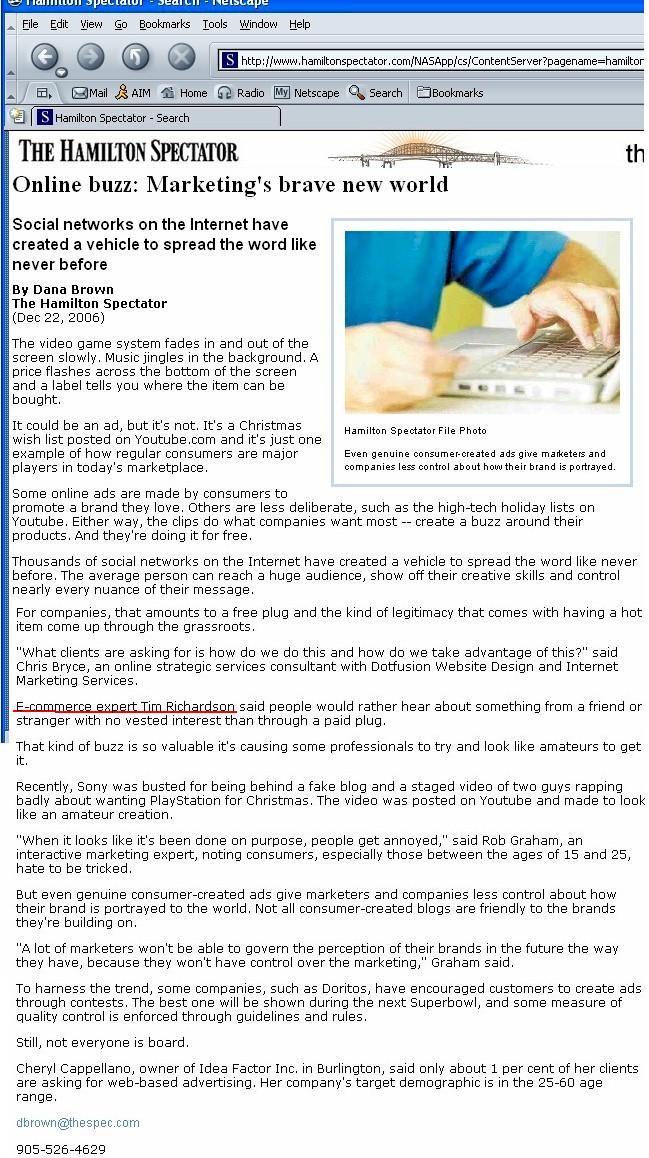 |
During the 4th week of December the Hamilton Spectator's Dana Brown interviewed Tim Richardson about "viral marketing" and how social networks on the Internet have created a vehicle to spread the word like never before. |
| The story was in the context of "Some online ads made by consumers to promote a brand they love. Others are less deliberate, such as the high-tech holiday lists on Youtube. Either way, the clips do what companies want most -- create a buzz around their products. And they're doing it for free." |
|
During the 2nd week of December 2006, Richardson was interviewed by journalist Cassandra Szklarski of the Canadian Press office in Toronto for a story on CP's "The Cyber File". Tim was asked about how companies are dealing with fraudulent purchase returns during the holiday season and how companies are using technology to assist with cutting losses. Tim explained about the new applications of RFID chips and other technologies. |
|
During the 2nd week of December The Globe and Mail carried the CP story about stores dealing with fraudulent holiday returns in which Tim Richardson was quoted at length. see www.theglobeandmail.com/servlet/story/RTGAM.20061214.gtcyberfile1213/BNStory/Technology/home |
| The Globe quoted Richardson - "More and more retailers are relying on computer databases to track returns so they can know if someone has been hitting a chain repeatedly for questionable refunds at different outlets, says e-commerce expert Tim Richardson." "Richardson says new technology known as RFID is helping more stores keep track of their products. These tiny tags store information the same way a barcode does but can be hidden inside clothing, toys or games, he says. They're most often used for high-end electronics. A stolen good brought into the store by someone with hopes of getting a “refund” would be readily identified, says Richardson, and the tags make inventory counts a breeze." |
|
During the 2nd week of December the Metro news carried an abbreviated version of the CP story about stores dealing with fraudulent holiday returns in which Tim Richardson was quoted. |
|
During the 2nd week of December the Hamilton Spectator carried an abbreviated version of the CP story about stores dealing with fraudulent holiday returns in which Tim Richardson was quoted. |
|
During the 4th week of November 2006, Richardson was interviewed by itWorldCanada.com's Nestor Arellano for a story about online shoppers clicking through the "shopping cart" on websites, then abandoning the checkout without buying. Tim explained that sometimes this is not a bad thing - |
| - in fact many times online shoppers are simply looking at the detailed description of the product as described in the shopping cart, and then they go into the store and buy the product. Tim added that sometimes it is more desirable to encourage the shopper to go in to the store because then you can hit them with in-store promotions and cross-sell them or up-sell them on other products they see in-person. |
|
During the 4th week of October, Richardson was interviewed by journalist Peter Rakobowchuk of the Canadian Press office in Montreal for a story they were putting "on the wire" about a Quebec based online auction house, MightyBids.com, which makes claims to be able to steal away some market share from eBay. Tim was asked for his opinion about what makes an auction house competitive. |

|
During the 3rd week of October 2006, Richardson was interviewed by journalist Robert Hercz of the Financial Post (of the National Post) for a story about online advertising for Financial Post Business magazine. Hercz asked about the reasons for the current boom in online advertising, the effect the internet is having on the advertising industry, and where-will-it-all-end predictions. |
| . | Richardson explained that part of the current boom respects the fact that more women are buying online so marketers are trying to reach that demographic with new offers. Secondly, there are a variety of payment systems available compared to the limitations of credit cards and PayPal in the earlier years of Y2K, so there are more ways to buy things online. Richardson also explained that companies are developing viral marketing campaigns to counter the decline in the effectiveness of traditional mass advertising. The story will run in the December magazine of FP. |
|
During the 3rd week of October 2006, Richardson was interviewed for a story about the Ontario Privacy Commissioner's championing of a universal ID |
|
During
the 3rd week of October 2006, Richardson was interviewed by itWorldCanada.com's
Nestor Arellano for a story about the Ontario Privacy Commissioner's championing
of a universal ID which would address e-commerce security concerns. This
universal ID is being launched by Microsoft and there are some questions
about whether the product of such a vendor should end up being "evangelized"
by a government agency.
witiger.com/ecommerce/articleTRprivacy.jpg |
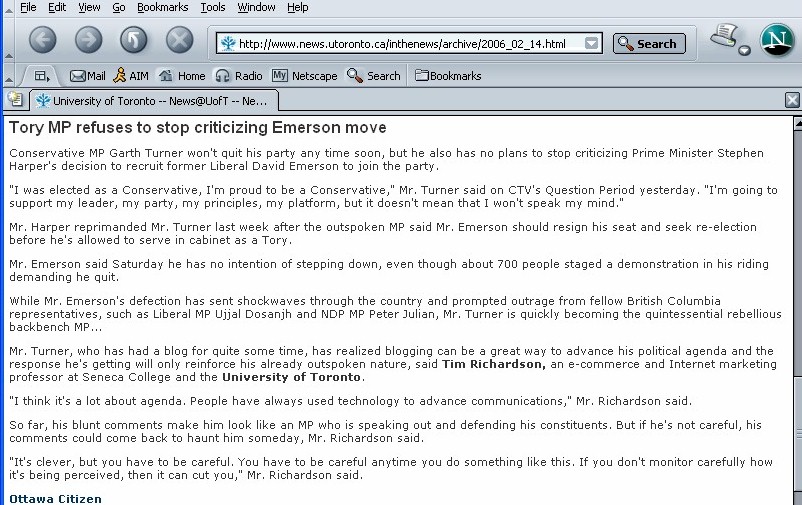 |
During
the 2nd week of September 2006, Richardson was interviewed by Alexandra
Zabjek of the Ottawa Citizen about about people who
blog for money -- be it folks who post advertisements on their personal sites, |
| or business people who have started blogs as a marketing tool for their businesses. I explained that blogs, and other forms of viral marketing are increasingly employed as companies recognize the limitations of conventional mass advertising to younger demographic segments. |
|
During the 1st week of September 2006, Richardson was interviewed by Katy of AM 640 news for a segment about Identity Theft and what citizens can do to protect against fraudulent use of their profile information. |
 |
During the 3rd week of August 2006, Richardson was interviewed by journalist Monica Wolfson of the Windsor Star about the information released in the recent Stats Can report on Canadian Internet Use. I explained that more and more people are using the internet for text messaging and google searches on their blackberries and other devices and this is changing the face of how people access web content, and leads to people building web content differently to accomodate these new users |
|
During the 4th week of June 2006, Richardson was interviewed by the Globe ? Mail's online TV show ROB as background for a segment on the visit to Canada by Japan's Prime Minister. |
|
During the 4th week of June 2006, Richardson was interviewed by Graham Fraser, National Affairs Writer for the Toronto Star about the visit to Canada by Japan's Prime Minister. Fraser said Canadian experts agree Japan has been overlooked in recent years. |
| "We cancelled the Canada-Japan Business Committee, which had high-level business people from both countries," observed Tim Richardson, former executive director of the Canada-Japan Trade Council who now lectures at the University of Toronto. While everyone acknowledges the new importance of China and India, Richardson points out that the gross domestic product per capita is still greater in Japan than the rest of Asia. "We should reduce our vulnerability," he said, arguing that China may prove to be unstable in the future. "The relationship with China is unique, built on individual Chinese Canadians," he said. "The Japanese business relationship is not personal, it's corporate." |
|
During
the 4th week of June 2006, Richardson's "Letter to the Editor" about "celebrating
diversity" was published. Tim suggested that the best way to build a country
is to celebrate what we have in common instead of what we have that is
different, and went on to offer some specific examples.
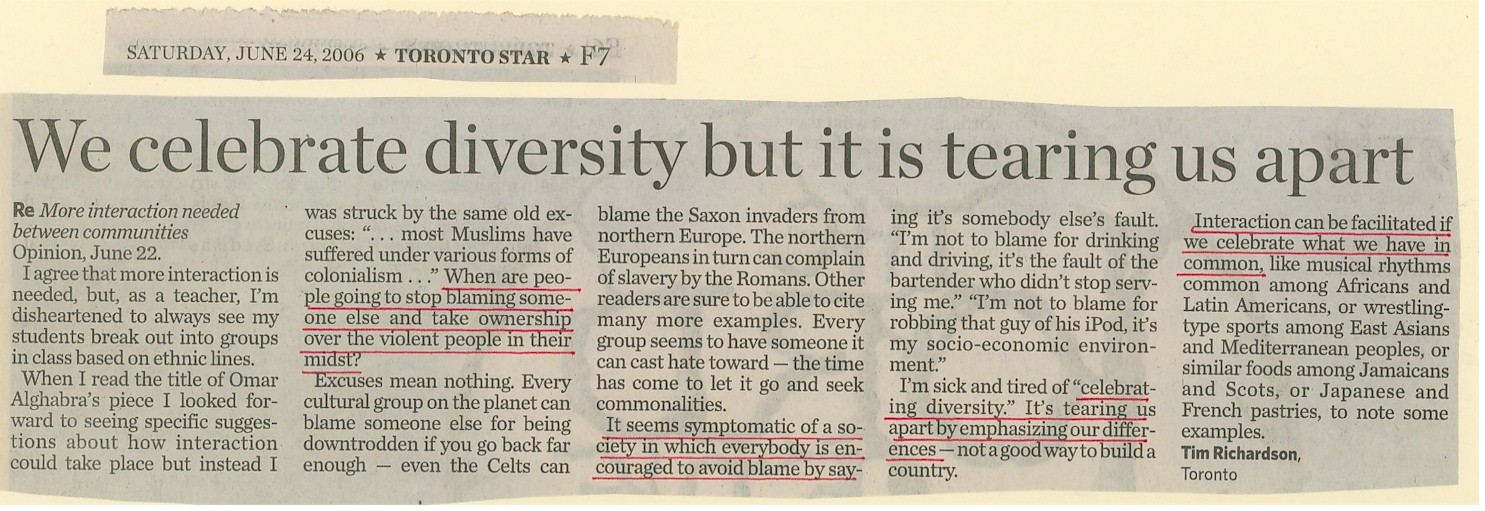 |
 |
During
the 4th week of June 2006, ipdgroup.com, based in Washington,
D.C., which is an online news service for research professionals, carried
Richardson's interview about cellphones working like credit or debit cards.
www.inboxrobot.com |
 |
During
the 3rd week of June 2006, The Discovery Channel under its
banner for Discovery Reports carried the Canadian Press interview that
Richardson gave about using cellphones like debit cards.
http://reports.discoverychannel.ca/servlet/an/discovery/1/20060621/discovery_cell_phone_060621/20060621?hub=DiscoveryReport |
 |
During
the 3rd week of June 2006, Yahoo! and several other online
news sites ran the Canadian Press interview that Richardson gave about
using cellphones like debit cards. Yahoo used "Cellphones will work like
credit or debit cards"
http://ca.news.yahoo.com/s/21062006/2/ztechnology-cellphones-work-credit-debit-cards.html |
 |
During the 2nd
week of June 2006, The National Post ran the Canadian Press
interview that Richardson gave about using cellphones like debit cards.
NP titled the story "Cellphones will work like credit or debit cards".
NP said "Richardson predicts that once the pay-by-cellphone technology
becomes available to the public, it will take off quickly. "This could
really happen fast. They say that television took 15 years to reach 50
million people. It took the Internet four years to reach 50 million people.
It took (camera phones) about four months to reach 50 million people,"
www.canada.com/topics/technology/story.html?id=45ce12b5-9e55-40ee-bc27-b830cd676047?k=74053 |
|
During the 2nd week of June 2006, Richardson was interviewed by journalist Brett Popplewell of Canadian Press for a story they were putting "on the wire" about pre-paid credit cards and e-payment systems. Tim commented about how Canada is well positioned with the oligopoly of our banks and our competitive cellphone companies to launch, in the near future, a system whereby you can use your cellphone as a payment device much like you can use a debit card now. |
|
During the 4th week of May 2006, Richardson was interviewed by itWorldCanada.comfor a story about the corporate espionage / competitor intelligence case between WestJet and Air Canada. Tim commented about the need for following SOP standard operating procedures regarding internet access security passwords of former employees. |
|
During the 3rd week of May 2006, Richardson was interviewed on air for CITY-TV / Cable Pulse 24 for a story about security aspects of passenger screening at Pearson Airport. Tim commented in the context of international business travellers and particular matters related to travel documents and boardings SOPs.. |
 |
During
the 2nd week of April 2006, Richardson was one of the invited "experts"
who made a presentation at a federal government conference hosted by the
Competition Bureau in Mt. Tremblant (north of Montreal). Richardson's
presentation dealt with false and misleading advertising in e-commerce
as well as unfair trade practices associated with e-commerce and m-commerce
marketing.
www.witiger.com/conference/2006April10.htm |
|
During
the 3rd week of March 2006, Richardson was interviewed by CBC
Radio 1 for a story about Identity Theft related to e-commerce security.
The interview was actually divided into several segments with a series
of CBC hosts across Canada from Newfoundland to B.C. and the Yukon. In
the interviews Tim explained some of the ways ID theft is conducted through
things such as a Trojan Horse virus and explained some practical ways to
protect your private information from being abused.
You can hear a recording of the Regina interview segment here IdentityTheft64kbps.mp3 |
 |
During the 3rd week of February 2006, Richardson was interviewed by Sheila Walsh of CHUM Radio News for a series of segments on email. Tim commented about the rise of spam and how spam and email volume effects productivity in the workplace noting that too often people send CC:'s and BCC:'s when it is not necessary. Tim also suggested companies develop email protocols that restrict email among employees so people don't waste time sending and reading email that is of little consequence. |
|
During the 2nd week of February 2006, Richardson was interviewed by journalist Carly Weeks of the Ottawa Citizen about the blogs used by MP Garth Turner and the role blogs plays in politics. Tim was quoted, in referring to Turner, as saying "blogging can be a great way to advance his political agenda and the response he's getting will only reinforce his already outspoken nature". |
 |
Textbook
During the 1st week in February 2006, McGraw-Hill made public the Canadian edition of the Hill McKaig textbook on international business Global Business Today. Tim Richardson was credited as a contributor due to several involvements with this Cdn edition. Tim wrote Canadian content and edited the special chapter on Ethics, also adapted the Cdn version of the PowerPoints for each Chpt, the Cdn version of the OLC Online Learning Centre, and a few other things. |
 |
During the 4th week of January 2006, Richardson was interviewed by Amy Sharaf of Ryerson University's Independent Newspaper " The Eyeopener Online" www.theeyeopener.com about fake websites that have URLs spelled similar to a legit site, and used to divert traffic for companies that are paying for "click throughs" |
 |
During the 3rd week of January 2006, Richardson was interviewed by James Hunter, Asst. Editor of Driven Magazine www.drivenmag.com for a story about Search Engines and how Google brings in revenue. |
|
During the 3rd week of January 2006, Richardson was interviewed by Tim Kocur for the Metro News regarding a story about his MGTD06 class at the University of Toronto. The story focused on teaching techniques for Viral Marketing and Stealth Marketing using the internet. |
|
During the 2nd week of January 2006, Richardson was one of the invited "experts" to make a presentation at a federal government conference hosted by the Competition Bureau in Ottawa. Richardson's presentation dealt with the consequences of the very latest technological developments in e-commerce using cellphones and emerging e-payment systems and how Canadian companies could be competitive by exploiting certain new opportunities. |
 |
During the 2nd week of January 2006, Richardson was interviewed by www.itbusiness.ca for a story about the federal election and the IT policy platform of one of the political parties. It was noted that the Green Party election platform would include support for open source. |
| Tim said "any impact of the Green Party’s campaign would likely be drowned out by the negative attack ads between the Liberal and Conservative parties. There are five or six hot technology issues that the parties should be dealing with, but the Green Party is the only one going to be spending any time on them”. |
 |
During the 2nd week of January 2006, Richardson was interviewed by journalist Catherine Paradis for the French language bureau of CBC Radio "Radio-Canada"www.radio-canada.ca regarding the federal election and the use of the internet and websites. |
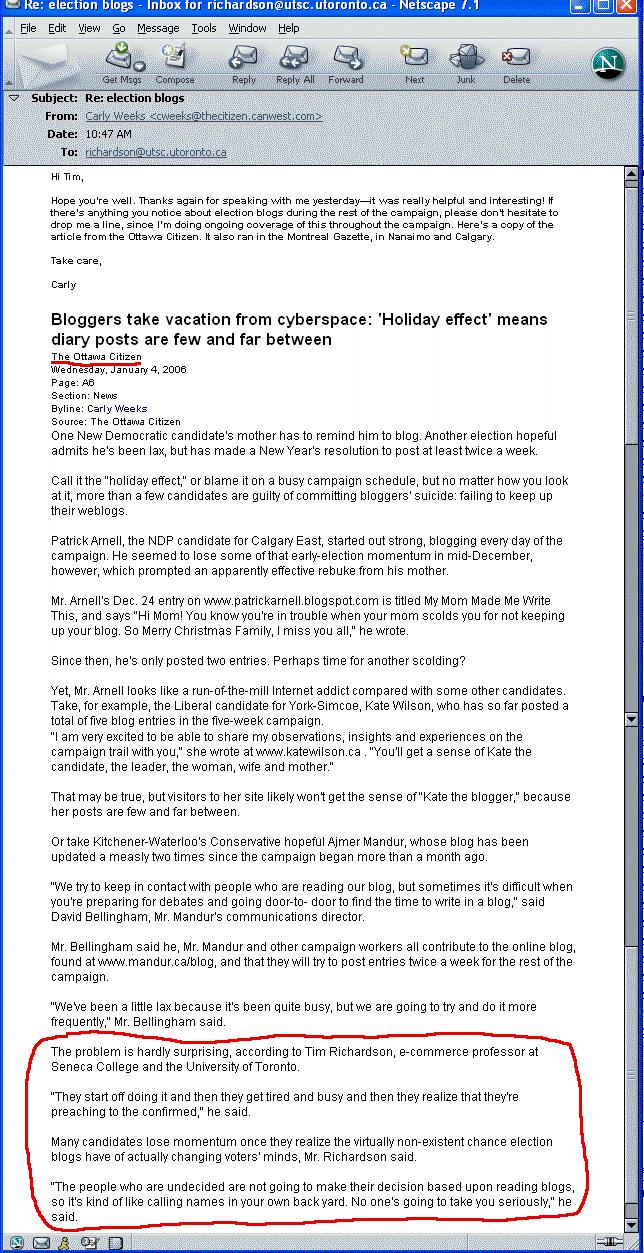
|
During
the 1st week of January 2006, Richardson was interviewed by journalist
Carly Weeks of the Ottawa Citizen about the blogs that are used
by politicians in the current federal election and the fact that many are
not maintaining their postings and updates. Richardson was quoted as saying
"many candidates lose momentum once they realize the virtually non-existent
chance election blogs have on changing voter's minds"
The story ran in the Ottawa Citizen, Calgary Herald and Montreal Gazette Jan 4th |
| 2005 | . |
|
During
the 3rd week of December 2005, Richardson was interviewed live on air for
the Report on Business television (ROB TV) program by host Howard
Green for a segment about how natural disasters effect international business.
Tim explained that it is important to have a contingency plan and business
continuity strategy which could be employed without delay. While the competition
is struggling to recover after a disaster, your enterprise can be more
operational and you'll achieve a competitive advantage that may yield months
of favourable business until others catch up.
The segment was recorded and a .mpeg clip is available http://people.senecac.on.ca/tim.richardson/audio/audioROBTV-DEC-2005-WITIGER.wmv |
 |
During the 2nd week of December 2005, Richardson was interviewed by journalist Maya Saibil for the financial website bankrate.caregarding a story about Identity Theft and security of S.I.N. numbers. It was explained that one has to be very careful allowing people to know your real S.I.N. number especially when so many companies outsource information about customer profiles to third party enterprises. |
|
During the 1st week of December, Richardson was interviewed by CTV News producer Susan Treen for background info on a story about online shopping for the holidays. |
|
|
During the 3rd week of November, 2005, Richardson was interviewed by Chris Sorensen of the Financial Post (of The National Post) for a story about the consequences of General Motors seeking more government support at a time when the federal government is approaching a national election; and the ramifications of needing to support some ridings that might be lost if unionized auto workers get laid off due to industry cut backs. |
|
During the 2nd week of November, Richardson was interviewed by Patrick Evans for an article in the Toronto Star about Splogs - spam blogs. As marketing people become aware of the power of personal web logs (blogs) for facilitating the propagation of publicity about a product or service, concurrently, stealth marketers are exploiting the popularity of blogs to produce fake blogs, or rather blogs that are full of content which is spam, instead of genuine individual opinion. Splogs can also be used to drive traffic to a site to falsely create hits on a page and drive up a site's search engine ranking in a highly competitive sector of the web. |
 |
During the 1st week of November, Richardson was solicited by publisher Sage, to contribute an article on Search Engines to The Encyclopedia of Measurement and Statistics. California-based Sage publishes more than 350 journals and 500 book titles annually. |
 |
During the 4th week of October, Richardson gave a presentation at a conference in Toronto, held at Seneca College, which was part of The McGraw-Hill Ryerson 2005 Teaching, Learning and Technology Conference Series. Richardson's speech addressed Hybrid Teaching and Web Based Learning Objects and was based, in part, on the research he did for his graduate degree. |
|
During the 1st week of October, Richardson was interviewed by journalist Jeremy Ferguson for a special report in the Travel section of The Globe ? Mail for a story about Business Travel Security. He explained that part of being a successful Int' Business Manager (especially after 911) is recognizing that risk and threat situations effect int'l business in many ways, and, these situations have to be dealt with, and "managed", or your company will be compromised and subsequently uncompetitive. |
| Richardson explained that risk and threat situations effecting int'l business travel are not just human based but also a consequence of climatic conditions - which effect corporate communications, topographical challenges - which stress land travel to remote areas, and (as recently portrayed in the southern U.S. and coastal South Asia) weather extremes. |
|
During the 3rd week of September, Richardson was interviewed by journalist Aparita Bhandari for Report on Business of The Globe ? Mail for a story about Online Communities and the consequences for marketing and business models. He explained that communication technology developments have made it possible for people to create and sustain personal and business relationships that cross far distances. |
| While this absence of a geographical requirement has freed people to engage in more relationships unbound by distance, it has also fostered a reduction in the former close relationship held between vendor and customer. Efforts to recover this close relationship is what drives a lot of the online communities developed by consumer product vendors. However this energy for creating communities is not a new thing completely—companies have been "community"-focused long before the Internet ; what the Internet does, however, is greatly enhance the frequency of communication and through the use of enriched images, audio and video, further encourages community members to interact with a frequency and duration unmatched in previous generations. The interview was with journalist Aparita Bhandari for Report on Business. |
 |
Textbook
During the 4th week in August 2005, Richardson's fourth textbook was published by Thomson Nelson. The book, titled Marketing in the Information Age is used in the course MGTD06 at University of Toronto, Scarborough College. The course covers most contemporary issues associated with internet marketing such as search engine optimization, things to make a website "sticky" and convince browsers to buy, privacy ? security issues and many other such topics. This 500 page text is accompanied by a complete website supporting the lectures www.witiger.com/universityoftoronto/MGTD06.htm |
 |
Textbook
During the 3rd week in August 2005, Richardson's third textbook was published by Thomson Nelson. The book, titled Current Issues in e-Business is used in the course BCS555 at Seneca College. The course covers most contemporary eBusiness topics including domain name issues, search engines, mobile ? wireless access to the web, online communities and privacy ? security issues. This 400 page text is accompanied by a complete website supporting the lectures www.witiger.com/senecacollege/BCS555.htm |
 |
Textbook
During the 2nd week in August 2005, Richardson's second textbook was published by Thomson Nelson. The book, titled International Business Management is used in the course MGTC44 at University of Toronto. The course covers globalization, the effect of the 6 environments, political risk and threat assessment, NGOs such as the WTO, IMF and OECD, foreign direct investment, ethics, ways to enter foreign markets including collaborative relationships, export financing and foreign exchange considerations. This 400 page text is accompanied by a complete website supporting the lectures www.witiger.com/universityoftoronto/MGTC44.htm |
 |
During the 2nd week of August 2005, Richardson's site www.witiger.com was cited in a Florida newspaper as a place to get "helpful hints to create your website fast and easy" www.floridatoday.com/apps/pbcs.dll/article?AID=/20050814/VERGE/508140305/1035/verge |
 |
During the 1st week of August 2005, The Washington Post said "The Associated Press carried some expert commentary: "Tim Richardson, an Internet commerce professor at Seneca College in Toronto, said ..." in the context of a story about some proposed U.S. legislation effecting the internet ..." |
|
During the 4th week of July 2005, Richardson's commentary to Associated Press about the U.S. age-verification legislation was carried by The Globe ? Mail print edition and also posted online in www.globetechnology.com |
 |
During the 4th week of July 2005, Richardson's commentary to Associated Press about the U.S. age-verification legislation was picked up by hundreds of newspapers and magazines across North America, including a long article in the Detroit News publication Detroit News Technology |
 |
During the 4th week of July 2005, Richardson was interviewed by Associated Press following the introduction of a bill in the U.S. Senate that would force pornographic Web sites to use age-verification filters and pay a 25 percent excise tax on any transactions. Richardson opinioned that many people who are parents of teens, are less worried about teens viewing porn, and more worried about them being part of the content creation. |
| Secondly, Richardson explained that reason for the rapid increase in the number of porn sites is due to various special techniques being employed by the site creators so they can have their content rank higher in Search Engines. Richardson added that it is a myth that much of the web content is porn and explained that the majority of porn sites do not do well as a consequence of the intense competitive environment, and problems with payment systems." for the full quote, click here |
 |
During the 4th week of July 2005, Richardson was interviewed by writer Don McDonald for a series of articles for the Business Development Bank www.bdc.ca . These articles are being created to serve the interests of small and medium sized businesses who want to develop e-commerce situations. The articles are syndicated to various community newspapers across Ontario in Q3 of 2005. |
|
|
During the 2nd week of July 2005, Richardson was interviewed by journalist Jacqueline Thorpe of the Financial Post (of the National Post) for a story about the ramifications of the Japanese gov't selling off the Postal Savings System. |
 |
During the 4th week of June 2005, Richardson was interviewed by CHRW Radio in Hamilton for a story about the expansion of the Toyota plant in Cambridge. Richardson answered from the perspective of his former position as Executive Director of the Canada-Japan Trade Council. |
 |
During the month of June 2005, Richardson contributed a chapter on "Ethics" for McGraw-Hill’s new text on international business. Part of the chapter dealt with Canadian mining companies and the ethical challenges they face in Africa and Asia. |
 |
During the 3rd week in June 2005, Richardson was interviewed by Smartmoney magazine www.smartmoney.com of New York for an article about online banking in Canada and future considerations of payment systems and e-banking and e-commerce. Richardson noted some of the developing technologies associated with payment systems through cell phones and other hand held devices. |
 |
During the 2nd week in June 2005, Richardson was interviewed by a journalist for an upcoming article in Canadian Retailer, the official publication of the Retail Council of Canada www.retailcouncil.org/cdnretailerThe interview dealt with e-commerce do’s and don’ts for small retailers. |
|
During the 1st
week of April 2005, Richardson was interviewed on 640 Toronto's
"Toronto Weekend" hosted by Paul Cross - the topic was business travel
and e-commerce
- the interview dealt with how internet devices and services can facilitate productivity |
|
During the 2nd week in March 2005, Richardson was interviewed at length by journalist Martin Patriquin, Montreal Bureau, for an article in the Globe's Report on Business Magazine (April 2005 edition) for a piece on the fruitfulness of small businesses using a website to market their services |
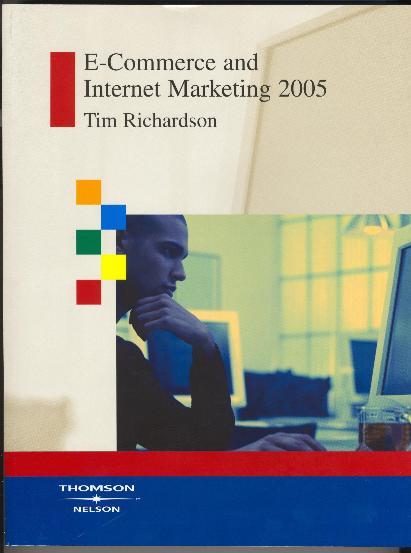 |
Textbook
During the 1st week in January 2005, Richardson's first textbook was published by Canada's largest publishing company, Thomson Nelson. The book, titled E-commerce and Internet Marketing 2005 is used in the course MRK 410 at Seneca College. It is one of the first examples of a hybrid-textbook at the college level and Prof. Richardson was profiled by Thomson Nelson as an example of this leading edge type of publication. |
| 2004 | . |
 |
2004 December 06, Richardson was interviewed by business reporter Andrew Mayeda of the Ottawa Citizen about SPAM and a recent ruling by the federal Office of the Privacy Commissioner. |
|
2004 October Richardson was quoted in an article in the Ottawa Citizen about "cleavage marketing". Richardson suggested that companies who use sexy images of women on webs sites, for selling everyday products and services, will find they are losing customers since a significant majority of Canadians surfing, and buying online, are women who find such marketing tactics offensive. |
 |
2004 Sept, Richardson was interviewed by the Computer Dealer News about reports issued Sept 2004 from the Canadian e-Business Initiative. The reports complain that many small and medium sized Canadian companies are falling behind SME's in other countries in adopting Internet business solutions. see www.witiger.com/ecommerce/storyCDN2004Sept.jpg |
 |
In the 2004 Aug 20th edition of The Business Review, thebusinessreview.ca Richardson was quoted at length in an article titled "Big Hurdles to clear for the electronic banking revolution". Richardson commented on the challenges of applying developments in cell phone technology to banking online. www.witiger.com/ecommerce/scanArticleEbanking1375x961.jpg |
 |
In
the 2004 Aug 6th edition of The Business Review, thebusinessreview.ca,
Richardson was quoted at length in an article titled "Why ISPs pray to
the portal gods". Richardson commented on the recent joint venture between
Rogers Cable and search engine Yahoo!
www.witiger.com/ecommerce/scanArticleISPs1354x968.jpg |
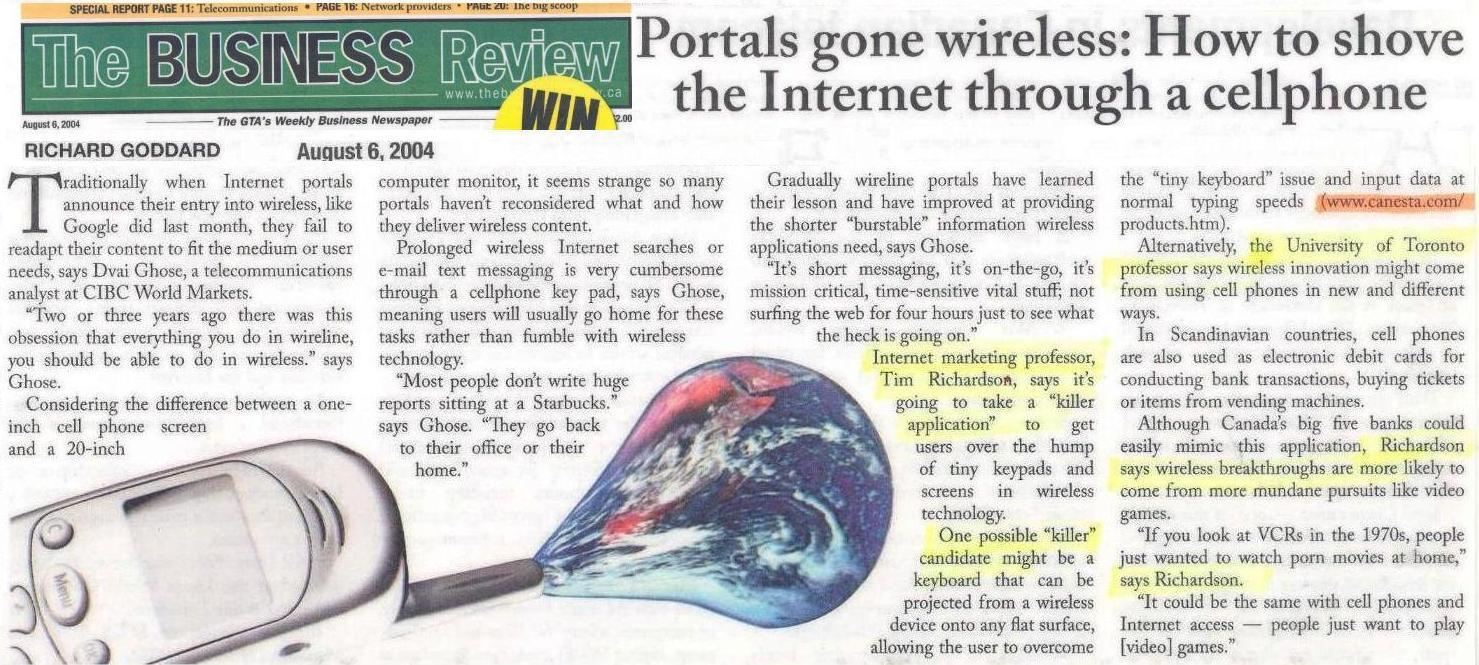 |
In the 2004 Aug 6th edition of The Business Review, thebusinessreview.ca, Richardson was quoted at length in an article titled "Portals gone Wireless: How to shove the Internet through a cellphone". Richardson commented on the need for a Killer Application to drive the development of mobile commerce. www.witiger.com/ecommerce/scanArticleWireless1479x665.jpg |
|
In July 2004 "Things to be Convincing About..." was published in its full length of 3,500 words in ecommercetimes.com under the title "Creating a Successful E-Business" in the ecommercetimes.com site www.ecommercetimes.com/story/34966.html |
|
As a consequence of "Things to be Convincing About..." AKA "Creating a Successful E-Business" running in ecommercetimes.com, the story was syndicated and carried on www.technewsworld.com/story/34966.html |
 |
As a consequence of "Things to be Convincing About..." AKA "Creating a Successful E-Business" running in ecommercetimes.com, the story was syndicated and carried on www.macnewsworld.com/story/32401.html |

THE ESSENTIAL GUIDE FOR CRM SYSTEM PURCHASERS. |
As a consequence of "Things to be Convincing About..." AKA "Creating a Successful E-Business" running in ecommercetimes.com, the story was syndicated and carried on www.crmbuyer.com/story/34966.html |
 |
As a consequence
of "Creating a Successful E-Business" running in ecommercetimes.com,
the story was syndicated and carried on several other sites., see
www.ecommercepartners.net/articles/creating-a-succesful-ebusiness.htm |
 |
In summer 2004
Richardson was interviewed by Peter Koven for a story titled "Get
paid to surf? Don't count on it" that was published in Ottawa Insight,
a publication of Carleton University’s School of Journalism and Communication.
www.carleton.ca/ottawainsight/2004/pfinance/pf5.html |
|
During the Canadian federal election in the early part of the summer, 2004, Prof. Richardson was interviewed by The Globe ? Mail www.globetechnology.comregarding "expert opinion" on the web sites of the three main political parties. In Aug 2004 the story is still carried on the Globe's site at www.globetechnology.com/servlet/story/RTGAM.20040608.elpartysites0607/BNStory/specialDecision2004/ |
|
"12 things you may want to be convincing about to get online buyers buying" written by Richardson and published in the June 2004 issue of Canadian Business magazine www.canadianbusiness.com- title of the article " Build a better mouse trap" www.canadianbusiness.com/article.jsp?content=20040607_60287_60287 |
 |
Richardson's interview by The Toronto Star , about self-googling, was carried on Cadastra.com which is a South American search engine portal based in Brazil. http://cadastra.com.br/noticias.php?noticia=758 |
|
Prof. Richardson has written articles for, or been interviewed by, The Toronto Star several times - the most recent article was January 2004 in which Richardson was questioned about aspects related to finding personal information in the Google Search Engine. The interview was conducted by Star journalist Chris Hutsul and the text of the article is available at www.witiger.com/internet/TStarArticle2004Jan13.htm |
| 2003 | . |
|
"10 things to increase your ranking in a Search Engine..." written by Richardson and published in the December 2003 issue of Canadian Business magazinewww.canadianbusiness.com. CB titled the article "Search Engine Savvy" www.canadianbusiness.com/article.jsp?content=20031222_57715_57715?page=1 |
|
In December
2003 "10 things to increase..." was published in a longer, two part series,
in the famous online media site www.ecommercetimes.com
part one, at www.ecommercetimes.com/perl/story/32391.html or www.witiger.com/ecommerce/searchenginerankingECT~PART~A.htm part two at www.ecommercetimes.com/perl/story/32401.html or www.witiger.com/ecommerce/searchenginerankingECT~PART~B.htm |
 |
The
ECT article was picked up by other websites and the story carried on sites
such LinuxInsider.com
part one at http://linuxinsider.com/perl/story/32391.html part two at http://linuxinsider.com/perl/story/32401.html |
|
In
addition to LinuxInsider.com, the ECT article was carried on technewsworld.com
part one at www.technewsworld.com/perl/story/32391.html part two at www.technewsworld.com/perl/story/32401.html |
 |
In
addition to LinuxInsider.com, ? technewsworld.com,
the article was also carried on Wonk www.marketingwonk.com/archives/2003/12/16/search_engine_optimization_tactics_listed/ Wonk's site also has reader comments about articles |
 |
When "10 things to increase..." was published in a longer, two part series, in www.ecommercetimes.com, it proved to be very popular and it was ranked as the # 1 read during the 2nd week in December 2003, as indicated by the screen capture to the left. |
| "10 things to increase..." was popular and syndicated to also appear in technewsworld.com |
.
|
"Japanese Foreign Direct Investment in Canada" written by Richardson and published in the December 1990 issue of Canadian Business magazine www.canadianbusiness.com - |
| . |  |
In 1989 a large
mission (Keidanren) of senior Japanese executives came to Canada for a
coast-to-coast trip that was quite significant for the subsequent direction
of Japanese FDI in Canada in the 1990's. At the time of the mission, Tim
was working for the federal Dept. of Foreign Affairs, Japan Div. for the
purpose of co-ordinating media circumstances of the visiting Japanese journalists.
In 1991, when Japanese FDI was still hot, Prof. Richardson, who was working on Bay Street at the time, was interviewed in TIME magazine in a special report on Japanese investment and the article referred to the 1989 mission as well as other situations. |
| . | ||
| . | 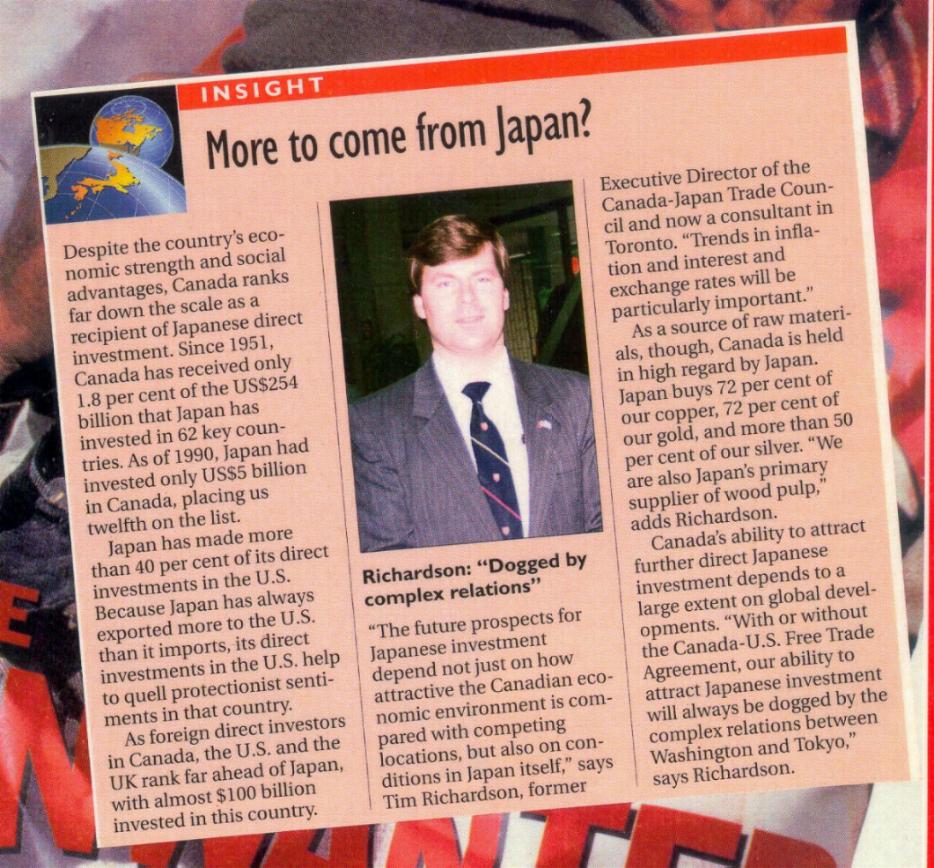 |
Here is a scan of the section
of the article featuring the comments by Richardson - the essential points
are related to Canada-Japan relations being effected by Japan's relationship
with the U.S.
1991 was the first time that Prof. Tim Richardson was interviewed for an article in TIME magazine. |
 |
 |
|
|
|
 |
 |
|
|
 |
|
|
|
|
 |
|
|
|
|
|
|
 |
 |
 |
|
 |
|
|
|
|
|
|
|
|
 |
|
|
 |
 |
 |
|
|
|
 |
|
|
|
|
|
|
|
 |
 |
 |
 |
 |
|
|
|
|
|
|
 |
|
|
|
|
|
 |
 |
|
|
 |
|
 |
|
 |
 |
 |
|
|
 |
|
|
|
|
|
 |
|
|
|
|
|
 |
|
|
|
|
CONTACT I MAIN PAGE I NEWS GALLERY I E-BIZ SHORTCUTS I INT'L BIZ SHORTCUTS I MKTG?BUSINESS SHORTCUTS I TEACHING SCHEDULE |
| . | |
|
MISTAKES
ITEXTS
USED I
IMAGES
I RANK
IDISCLAIMERI
STUDENT
CONTRIBUTORS I FORMER
STUDENTS I PUBLICATIONS
I |
|
| . |