- forcing competition
- opportunities for small companies
- sustainable development
- worldwide protests against globalization
- growing power of MNCs
- OECD Guidelines for MNCs
- specific consequences
- globalization and the environment

| GLOBALIZATION
- forcing competition - opportunities for small companies - sustainable development - worldwide protests against globalization - growing power of MNCs - OECD Guidelines for MNCs - specific consequences - globalization and the environment |
|
see witiger.com/internationalbusiness/globalizationSustainableDevelopment.htm
see witiger.com/internationalbusiness/globalization-soverignty-issues.htm
see witiger.com/internationalbusiness/globalization.htm
see
witiger.com/internationalbusiness/globalization-reverse.htm
|
including material
from
Global Business Today, 2nd Ed. Hill, McKaig ... and Richardson ISBN-10: 0-07-098411-5 |
.... |  |
| The debate over the positive
and negative effects of globalization is a hot topic for many individuals,
agencies, organizations and government departments who find themselves
in a position to defend or attack the current globalization trends. We
can have an interesting debate in class about the merits of globalization
but in the end, whether we like it or not, it is a situation we have to
deal with.
WTGR |
| OBJECTIVES | After reading
this online unit, and attending the lecture, the student will
o be able to define what globalization means in the context of int'l business o understand the effects of globalization in terms of corporate competitiveness o be able to define U.S. and Canadian differences in opinion on the issue of globalization o know some of the positions that entities have on the "pro" and "con" side o be aware of some of opportunities, and challenges, facing SMEs dealing with globalization o be able to explain how globalization effects sustainable development o be aware of some of the issues in the worldwide protests for, and against globalization o be able to explain how globalization effects social justice in some effected regions o understand how the global activities of large companies may effect national sovereignty o know some specific examples of the effect of globalization on business in Canada WTGR |
| INTRODUCTION
GLOBALIZATION
|
. | The economic
"disclocation" of the North American economy in 2008-2009 has created substantial
"ripples" which have effected, and are effected by the economic upheavals
in Asia (North America's largest trading partner) and Europe.
One thing that has become "evident" from the results of the North American economic problems is that
WTGR |
| GLOBALIZATION
TRENDS 2015
|
. | According to
the World Economic Forum (Davos)
- as quoted in Forbes magazine "Every year the WEF forecasts
the 10 biggest trends for the coming year, specifically looking at how
they will influence global and regional economic, political and social
change."
|
| GLOBALIZATION
TRENDS 2014
|
. | According to
the World Economic Forum (Davos)
- as quoted in Forbes magazine 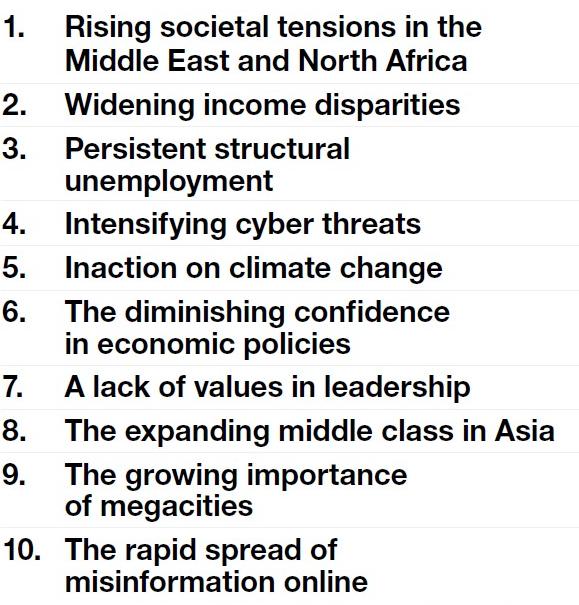 2014
2014
http://www.forbes.com/sites/louiscolumbus/2013/11/15 /top-ten-trends-of-2014-from-world-economic-forum-underscore-the-need-for-cloud-security/ |
| INTRODUCTION
GLOBALIZATION 2007 |
.. | "The great challenge
facing political leaders today is to persuade the public that continuing
to liberalize trade will bring more benefits than costs. Distrust of
globalization has probably never been higher in the past 60 years....China
and India are among the reasons. There is widespread fear
that globalization means job losses and lower
wages as the export power of these huge nations grows. So countries
are becoming more protectionist, more unwilling to deal with change and
make adjustments."
David Crane
|
Definition of Globalization
o People around the globe are more connected to each other
than ever before.
o Information and money flow more quickly than ever.
o Goods and services produced in one part of the world
are increasingly available in all parts of the world.
o International travel is more frequent.
o International communication is commonplace.
This phenomenon has been
titled "globalization."
From Keith Porterhttp://globalization.about.com/cs/whatisit/a/whatisit.htm
The
term “globalization” describes the increased mobility of goods, services,
labour, technology and capital throughout the world.
http://www.canadianeconomy.gc.ca/English/economy/globalization.html
"Globalization
is a term for the horizontal and vertical integration of manufacturing
and trade on an international level"
www.endgame.org/gtt-globalization.html
Globalization, an example in the forest products industry

| The vertical integration
of the wood products industry "is probably the single most recognized characteristic
of the industry" -- for example, most paper sales are by corporations which
also control timberland. Now the horizontal integration of the industry
is also being completed, as corporations like International Paper spread
their operations to dozens of countries."
www.endgame.org/gtt-globalization.html 1. |
The reason why we emphasize
the forest products industry in a Canadian course on International Business
is
|
| Forestry
trade
Deforestation Globalization |
"The effects
of deforestation have been known since ancient times. Empires from Roman
to colonial times have expanded to acquire wood supplies for shipbuilding
and fuel for industry, and have collapsed when those wood supplies were
depleted. The post-World War II ascendancy of U.S. timber corporations
has brought the industry to new heights, and promises to take it to new
lows as well. The global timber industry has tried to escape the ecological
limits to raw materials, and the social and economic limits to markets,
by relying on frontiers. While multinational timber corporations use the
rhetoric of sustainability and jobs, the centuries-old reality of cut and
run continues. Despite the public relations strategies of the corporations,
timber industry overcutting has been confirmed by numerous industry, academic,
and government studies. Now that the end of the forest frontier is being
reached, free trade agreements are threatening to remove the last barriers
to total industrialization and depletion."
by George Draffan, Public
Information Network, Seattle
|
."Globalization
forces everyone to compete with the cheapest producers."
see youtube.com/watch?v=YFVzjLqZj7g&feature=related
Italy's 'Made in China'
Label
Is this a good thing or a bad thing?"In the early 1990s, bleached hardwood pulp cost
- therefore the cutting down of the rainforest in Brazil !
- $78 per ton to produce in Brazil,
- $156 per ton to produce in eastern Canada, and
- $199 per ton to produce in Sweden."
by George Draffan, Public Information Network, Seattle
|
Globalization
of Markets / Customers
Globalization of Production Globalization of Government and NGOs as discussed in Hill / McKaig Global Business Today, 2nd Ed. |
|
Chpt 1 |
The Globalization
of Markets / Customers
Globalization of markets refers to the "merging of historically distinct and separate national markets into one huge global marketplace" For some products and services "the tastes and preferences of consumers in different nations are beginning to converge on some global norm" - a consequence of the "globalization of the customer" Why is this happening?
|
| Stuff = | ...
|
|
Chpt 1 |
The Globalization
of Markets / Customers
"Most global markets are
not for consumer products ... but markets for industrial goods and materials
that serve a universal need the world over".
|
|
Chpt 1 |
The Globalization
of Markets / Customers
A tricky concept One the one hand, there is an increasing tendancy for consumer product companies to narrow their "target market segmentation" for certain types of consumer products and services, - this helps achieve very large economies of scale which drive down the price of things such as consumer electronics; yet, for many things, ie cell phone ring tones, there is an increasingly diverse segmentation based on pandering to the diverse social/cultural market. "While modern communication and transportation technologies are ushering in the 'global village', very significant national differences remain in culture, consumer preferences, and business practices. A firm that ignores differences between [nations] does so at its peril" |

Tim with his Tim's |
Tim Hortons
has been named [2014] the Top Canadian Brand for the second year in a row
in the Canadian Business Magazine survey—but what does the brand actually
mean to Canadians?
http://www.canadianbusiness.com /lists-and-rankings/best-brands/ 2014-tim-hortons-marc-caira-interview/ CEO Caira says "We keep doing the same thing over and over, and we do it better than anybody else... in each of our 3,600 stores" Caira
CB How are you adapting the formula for the U.S. market? Caira "Different flavours, bolder flavours and, in some cases, larger portions in some cases. We’ve put a strategic business unit right in the U.S. market. Whereas in the past everything was done out of the Canadian office, we now have a dedicated team, with Mike Meilleur heading up our U.S. business. His job is to really cater to the needs of the U.S. consumer. There are differences, even in the coffee profiles. If we think we’re going to sell the same coffee to Americans that we sell to Canadians, I think that’s wrong." |
|
Chpt 1 |
The Globalization
of Production
Globalization of production refers to the "sourcing of goods and services from locations around the globe to take advantage of national differences in the cost and quality of factors of production like land, labor, and capital" Why is this happening?
|
.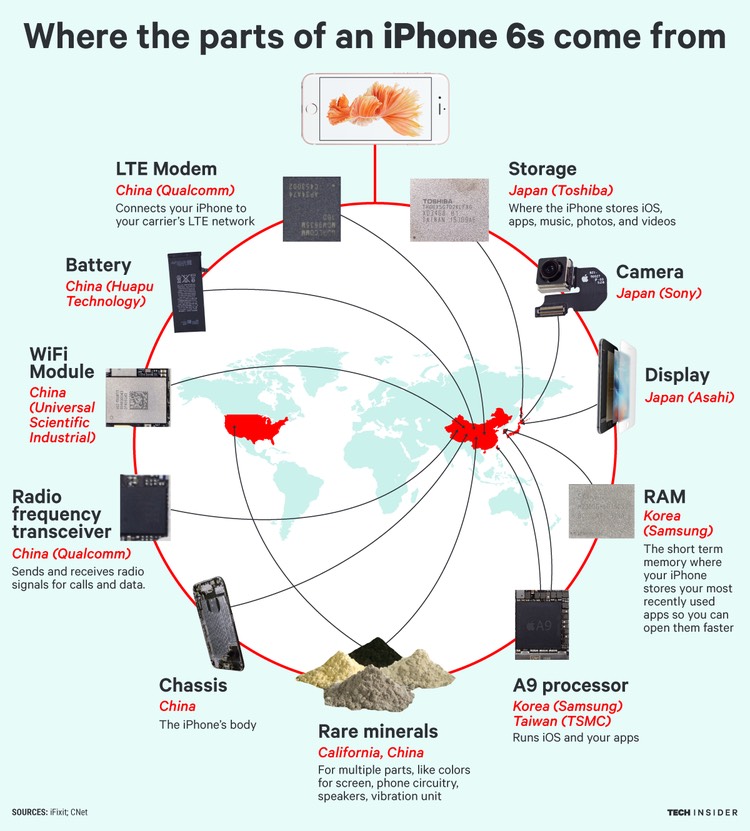
Where the iPhone parts come from |
The Globalization
of Production
Erosion of "national identity" associated with a branded consumer product. Given the diverse origins of component parts, it becomes increasingly challenging to say a complex consumer product (such as a large TV, computer or car) is predominantly from "X" country. Influences of, and changes in, the
Example: One particular model of a consumer branded electronic product may have internally three different battery pack arrangements, depending on how the supply chain people sourced the parts at the time a long production run was being carried out - some may come from Korea, some may come from China or Taiwan. When large companies establish extremely large production runs, supplier companies sometimes cannot meet the volume of requirements so supply chain staff source from multiple locations. |
| .
Where the iPhone parts come from |
The
Globalization of Production, iPhone parts
from https://www.scmp.com/infographics/article/2017191/iphone-sum-parts
|
|
Chpt 1 |
The Globalization
of Government / Emergence of Global Institutions
WTO - World Trade Organization
As companies grow from national to trans-national organizations, we have seen an emergence of institutions needed to "help manage, regulate and police the global marketplace". |
|
Chpt 1 |
The Globalization
of Government / Emergence of Global Institutions
Drivers:
- globalization of TV and entertainment
- allows "immigrant cultures" to remain viable
- relates to facilitating banking transactions globally - provides capability to know more detail about customers (CRM)
- contanerization; products, supplies |
| . | The Globalization
of Government / NGO's
Regional and national governments are increasingly "sensitive" to circumstances happening outside their national borders. For example the ability of a government to raise money selling bonds depends not just on the citizens buying, but also institutional investors in other countries, which in turn allows the gov't to use deficit financing for domestic projects. |
| Globalization
is good !!
|
from the front
page of the National Post, July 9th, 2002
"Globalization Cures Poverty:
Study"
Cienski says "Many globalization critics are "poorly informed about the historical record, and appear not to be aware of the contribution played by globalization in the struggle against poverty," the study's authors say." Cienski makes the interesting point that "Improved communications has had the perverse effect of undermining the case for globalization because "the poor that remain, though a shrinking proportion of the whole population, are more than ever aware of their relative deprivation." |
| Globalization
is good !! |
the study, referred
to in the Cienski article, was by the London-based
Centre for Economic Policy Research. Instead of relying on the Canadian newspaprs interpretation, we can use the resources of the Internet to go direct to the CEPR webpage and get direct information about this globalization study the CEPR has a press release on their study released in July 2002 and you can read it at www.cepr.org/press/PP8.htm |
| Globalization
is good !! Globalization
|
" the authors
of the new CEPR Report find that many of the charges levelled against
globalization are misguided:" - they list several points on their website
which deserve reading.
There is little evidence that governments are losing power to multinational corporations or that there is 'a race to the bottom' in environmental standards or taxation." |
| Globalization
is good !! |
David Crane
explained in a Dec 2006 article titled
"Don't discount the positive side of globalization" "Canada's clothing industry provides a good example of the trade-off that comes when a country lowers its trade barriers as Canada has done with clothing. According to Statistics Canada, production by Canada's clothing industry fell from $7.9 billion in 2000 to $5 billion in 2005, a 37 per cent decline. Employment fell by 34,000 to 60,000, a 36 per cent fall in the number of clothing industry jobs. About 70 per cent of this decline was due to a loss of share in the Canadian market to imports from China, Bangladesh, India, Mexico and other developing countries, while 30 per cent of the decline was due to a fall in exports to the U.S. as developing countries displaced Canadian shipments. So trade liberalization has meant a loss of jobs and output in Canada's clothing industry, though the Canadian companies that have survived have become more innovative and productive. But it has also meant cheaper clothing for Canadians. This matters, especially to low-income families and seniors living on fixed incomes. " |
"Globalization and the
Internet have created unprecedented opportunities for small and medium-sized
businesses in Canada"
is the title of a Sept 2002
story by Lopez-Pacheco
asc
| KEY
POINTS |
There are a
lot of stories in some media that discuss how Globalization is challenging
[read difficult and painful] for small and medium sized enterprises because
they are being forced by the competitive environment to sell product and
services to their customers, at lower prices ; cause - if they don't, some
vendor in another part of the world will steal away their customers. However
with every challenge, there are also opportunities - in some situations,
the consequences of globalization can be a benefit for SME's cause the
"shrinking world" [ facilitated by the developments in the technological
environment] can bring more opportunities to SME's that previously they
could not deal with. Therefore we have included in this section on Globalization
a story from the National Post about how "Globalization and the
Internet have created unprecedented opportunities for small and medium-sized
businesses in Canada".
WTGR |
The key thing about this story is that one of the ways small and medium sized companies are dealing with opportunities afforded by globalization is to be bigger companies !!! - and this can be affected through using strategic alliances.
"Globalization and the Internet have created unprecedented opportunities for small and medium-sized businesses in Canada -- an environment where competition is fierce. To take advantage of these opportunities, while avoiding some of the competitive obstacles often faced by the little fish in the big ocean, many of these businesses are forming partnerships or, more precisely, strategic alliances. "There are various advantages to forming strategic alliances," says Estelle Metayer, president of Montreal-based Competia Inc., a leading competitive intelligence and strategic planning company and publisher of Competia Online. "One is the ability to penetrate markets that would be too costly to develop on your own. For example, if you form an alliance with an American partner who can take on your products and distribute them through their network, you could save a lot of money on the marketing side." Another big advantage comes from joining forces with a business that can provide your enterprise with access to expensive technology you might not be able to afford otherwise. Management-based strategic alliances are also advantageous, Ms. Metayer says. "Often, smaller companies don't have big management teams. So if they need someone who has a certain expertise, but they really can't afford to hire such a person, then they can form an alliance with a company that has that management expertise."
"Strategic
alliances also benefit the big companies. "With large corporations,
one of the problems often is the inability to move quickly, because of
bureaucracy and more complicated internal politics. Smaller
companies are able to react more quickly to changes in the marketplace.
So from both parties' perspectives, it serves their needs," he says.
Although the concept of a strategic alliance can sound so appealing to
a struggling small business that they might be tempted to run out and get
one, experts warn businesses should not rush into partnerships, especially
if another company comes courting."
.
Globalization,
the development of strong, and sustained protests worldwide
v
| KEY
POINTS |
By mentioning
the worldwide growing protests movement against aspects of globalization,
we are not endorsing the violence by which the protestors are conveying
their message - we are recognizing that it has become an issue and some
consequences are effecting international business management.
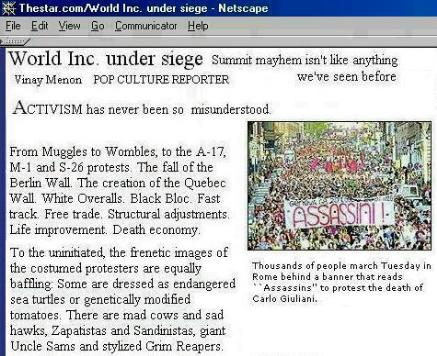
The screen capture below
comes from a newspaper article following the G8 Summit in Genoa in July
2001 - which was a particular noteworthy event due to the large organized
scale of the anti-globalization forces, and the fact the police countered
with lethal force.
|
 |
"This is the anti-globalization
movement. Sprawling, disparate, powerful. A political force unto itself
that, given its international scope and staggering number of
participants, is unprecedented in history. And, it would appear, at a significant
crossroads."
Vinay Menon |
Menon, noting comments from Ronald Deibert, a political science professor at the University of Toronto, says that "....another challenge anti-globalization protesters face: Many members of the public can't grasp the abstract, socio-economic principles upon which the movement is based. So critics start dismissing groups as "militant radicals," "Yuppie freaks," "Hippie wannabes," "flat-Earth advocates," "neo-Marxists," "neo-Luddites" and "anti-capitalist pipe dreamers."
Even the term "anti-globalization
movement" is misleading. There is no formal structure, no hierarchy. No
one leader. No one platform. For some, there isn't even an "anti"
- they believe it's not a question of "if we globalize," but how. There
are, instead, widely different groups, with widely different agendas. And
these groups will only get bigger and more effective".
.
Globalization,
social justice issues - commentary by David Crane - Article
1
.
| KEY
POINTS |
Whether or not
one agrees with the "social justice issues" being evangelized by some special
interest groups - it must be aknowledged that these opinions are increasingly
being expressed in many circles and it would be responsible for us to review
what these people are trying to communicate.
WTGR |
 |
David Crane writing in The
Star
2001 Nov 20th "Globalization can't ignore social justice" |
Crane's article refers, in part, to the G-20 meetings in Ottawa in mid-November 2001
Crane quotes some of the key figures at the event.
"As Gordon Brown, Britain's chancellor of the exchequer and chairman of the IMF and World Bank weekend meetings, said, "The real issue is not whether you are for or against globalization, because globalization is moving forward. The real issue is whether you are for or against social justice on a global scale, and I believe there is an increasing recognition that we have to work together to make the world and the global economy a better place for the world's poor." According to World Bank president James Wolfensohn, "in the next 30 years, the population of the world will increase from 6 to 8 billion, and virtually all of those 2 billion additional people will live in the developing world. The sooner we are able to grasp the implications of this, the better."
Crane further quotes Wolfensohn
adding ""Some form of globalization is with us to stay," Wolfensohn said.
"But the kind of globalization is not yet certain: it can be either a globalization
of development and poverty reduction - such as we have begun to see in
recent decades, although this trend still cannot be taken for granted -
or a globalization of conflict, poverty, disease, and inequality." Our
huge task is to tip the scales toward good globalization."
.
| KEY
POINTS |
So, one of the
reasons we discuss globalization and social justice issues is that it relates
to issues of stability or instability which in turn are part of the concerns
about risk and threat situations for international business in developing
economies..
WTGR |
|
David Crane writing in The
Star
2003 Feb 9th "Putting a human face on Globalization" |
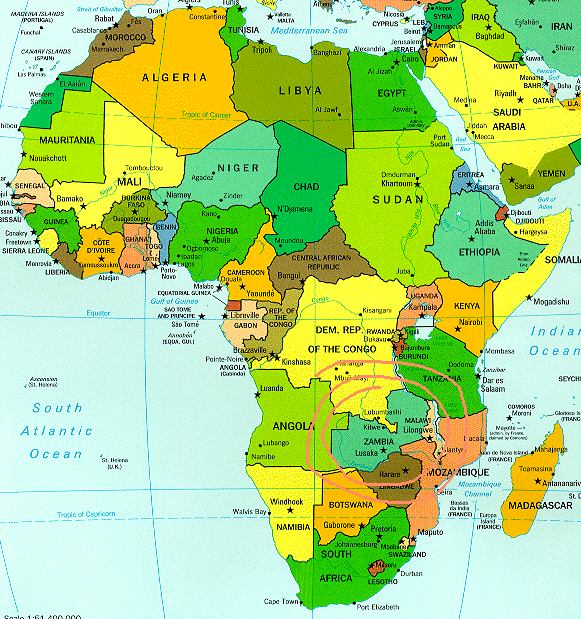
click to see Zambia |
Crane writes "When a group of Zambian farmers faced eviction by a Canadian mining company from lands they were using, they were able to get help in Canada. They were able to remain on the land for some further time as a result of a code of responsible corporate behaviour developed by the Organization for Economic Co-operation and Development in Paris. The guidelines for multinational enterprises were adopted by the OECD in 2000, and since then have become an important way of holding multinational corporations to a set of core standards of behaviour." |
| www.oecd.org
click to see get to OECD site |
from the OECD site
"The OECD Guidelines for Multinational Enterprises are non-binding recommendations to enterprises, made by the thirty-seven governments that adhere to them. Their aim is to help Multinational Enterprises (MNEs) operate in harmony with government policies and with societal expectations." |
Crane explains that "The guidelines, which can be found at http://www.ncp-pcn.gc.ca, cover corporate disclosure, employment and industrial relations, the environment, bribery, consumer protection, science and technology, competition, and taxation. They represent not a bad summary of what should be standard corporate citizenship and ideally would be taught to all MBA students."
Crane also adds that "the
[OECD] guidelines are of value to the International Monetary Fund and the
World Bank in their own dealings with developing countries and international
corporations." The point being that companies in contravention of the guidelines
cannot be participants in IMF and World Bank projects.
.
| KEY
POINTS |
Crane's article
is helpful because it ties in Globalization with social justice issues
in a real context, and also shows the links to OECD, IMF and World Bank
issues.
WTGR |
|
David Crane writing in The
Star
2004 Feb 25th "Globalization is not the Enemy" |
Crane's article refers to an article written by John Saul - husband of the Governor General. In this article, Saul suggests Globalization is bad and Crane counters by explaining that Saul's interpretation is flawed.
Crane argues "Saul's thesis is that globalization is essentially dead, and deserves to be dead because it has been nothing more than an assault on society and the environment by narrow corporate interests. If that were true, then he would have a case. But of course globalization is much more complicated than Saul's gross oversimplification. For him [Saul], globalization is a world in which global markets leave the nation-state powerless to look after the needs of its citizens.
But there are many concepts of globalization. And while there are some who argue and even advocate the end of the nation-state, more serious discussion of globalization is about how we can create a more prosperous global community, with fairer sharing of the wealth, while sustaining the environmental health of the planet, thwarting international crime and terrorism, and doing all of this in a way that takes into account the views and concerns of people everywhere.
The fundamental problem is
that Saul does not seem to understand what globalization is really about.
His quarrel should be with neoconservatism and market fundamentalism,
not globalization. It is the neoconservatives, the market fundamentalists
that have done damage, and they have done it both at the global level and
within the nation-state. The challenge we face is to sustain globalization
in a more human form, not to promote its collapse. More than ever
we will need stronger global rules and institutions if we are to have a
stable world in which population could increase 50 per cent by the
middle part of this century. We will also need more international trade
and investment if the world's poor are to be lifted out of poverty."
.
.
Globalization and poverty
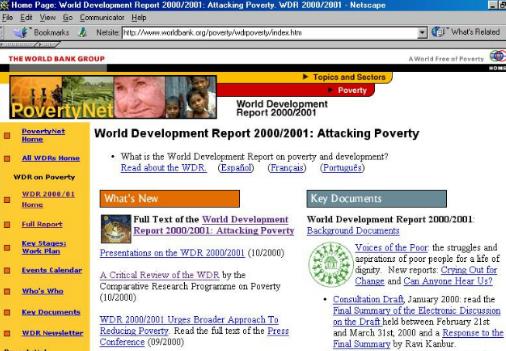
contact was made with the World Bank head office June 9th, 2005 for the purposes of obtaining permission to use this screen capture. Copies of emails kept in the permissions binder |
if you are interested, here
is the site where you can read the entire text of the
World Bank, World Development Report 2000 |
Globalization,
big companies forcing small companies to compete at an unfair level
cc
| How
Canadian
Tire's overseas sourcing led to a Canadian icon losing business |
www.woodscanada.com/_Messages/Msg_02_Dec06.html a significant part of Woods business was supplying Canadian Tire - in fact the two companies had a supplier - retailer relationship more than 80 years. Earthy explained Woods had to shut down operations following "...a decision by the Company’s largest customer, Canadian Tire, to discontinue purchasing domestically manufactured sleeping bags." It has been suggested by others in the industry that Canadian Tire (facing competition from Wal-mart and other big vendors of camping equipment) had to further cut costs and was simply geting cheaper sleeping bags from suppliers in China. |
| How
Walmart's low price policy was accused of shutting down a
North American manufacturing company |
An example of
North American workers losing jobs to cheaper labor overseas
Over a period of time, Wal-mart became Schrade's largest customer to the point where 80% of Schrade's product was going to the large discount chain. Then, Wal-mart squeezed Schrade by asking them to compete with low priced knives they were beginning to source in China. Schrade could not match the very low price from China so Wal-mart abruptly cut their business with Schrade. Faced with the loss of its largest customer, Schrade crashed in 2004 barely reaching the 100th anniversary of the founding of the company before all its assets were sold at auction as it was forced in bankruptcy. There are a number of "walmart sucks" sites on the web that have this story recounted by walmart insiders, and other similar tales, check http://www.freewebs.com/wallmartsucks/ |
xxc
| KEY
POINTS |
American public
opinion is, in the majority, negative towards Globalization. Canadians
are even further effected, on an individual basis, by international trade
since a higher proportion of Canadians have jobs which are effected by
international business competitiveness.
WTGR |
| Globalization
U.S.
|
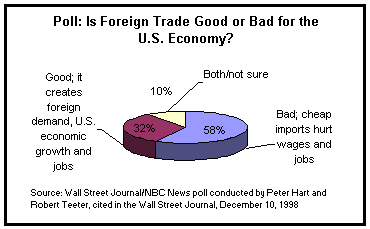
Wall Street Journal/NBC News poll found that 58% of Americans believed that trade had reduced U.S. jobs and wages, a view that is almost never expressed by commentators or those who shape public opinion. from www.cepr.net/GlobalPrimer.htm |
1.There
are positive and negative aspects of Globalization. Some people who champion
the negative aspects are very intense in their efforts to persuade others
to see their point of view.
www.endgame.org
discusses the downside of competition cause by globalization.
Resources
Toward Globalization of the
Forest Products Industry
http://www.rff.org/documents/RFF-DP-06-35.pdf
David Bael and Roger A.
Sedjo
Mill closures devastate Canada’s
forest industry
http://www.wsws.org/articles/2006/oct2006/fore-o31.shtml
.,,,,
|
|
CONTACT I MAIN PAGE I NEWS GALLERY I E-BIZ SHORTCUTS I INT'L BIZ SHORTCUTS I MKTG&BUSINESS SHORTCUTS I TEACHING SCHEDULE |
| . | |
MISTAKES
I TEXTS
USED I
IMAGES
I RANK
I DISCLAIMER
I STUDENT
CONTRIBUTORS I FORMER
STUDENTS I PUBLICATIONS
I TIPS
I  |
|
| . |