| BRANDING
- part of the "P" - Product |
![]() |
| .. | This
Branding unit is used in
o MRK106 o CCT322 and may be referenced in o MGTD06 |
Not all of the material in this unit will be used in each of these courses; the amount of material covered will be indicated by the actual lecture given in class by the professor. Some courses cover this topic extensively, some courses deal with it briefly. |
| INTRODUCTION | Brand
"A name, term, sign, symbol, or design (or some combination thereof) used to identify the products of one firm and to differentiate them from competitive offering"s. Something used to show customers that one product is different than the products of another manufacturer. |
| HISTORICAL origins | Branding came
about as a consequence of mass production to distinguish one "producer"
from another - before branding, most consumer products were made in a customized
fashion for the user - shoes by a cobbler, clothing by a dress maker, barrels
by a carpenter - there was no need for logos or brands because it had no
impact on the ability to sell - there was virtually no competitive market.
Originally branding helped
trace the source of the guild producer
|
| Brand
TERMS |
the following
terms are asociated with the degree to which a customer is aware of a brand,
and uses a brand
Brand Awareness / Recognition
- awareness, loyalty, quality, emotion “customers remember the brand”
Brand Preference / Loyalty - the degree to which customers are committed to further purchases eg. “choose the brand over other brands” Brand Insistence - “willing to search for it..”, and if they do not find the brand they want, WILL NOT but a substitute Brand Ambassador - a person who not only insists on wearing or using a brand, to the exclusion of all others, but tries to convince their friends and associates to also use the brand - in effect "representing" the brand to others. Compaines love these type of people since it is free advertising. Many companies facilitate this by making their brand logo easily available on clothiing and other products to extend awareness of the brand |
| Brand
Extension |
Brand Extension
means, exactly what you might think, extending the equity, or value of
the brand by creating other models, shapes, flavours, styles so you can
sell more "stuff" to people who like the original brand model.
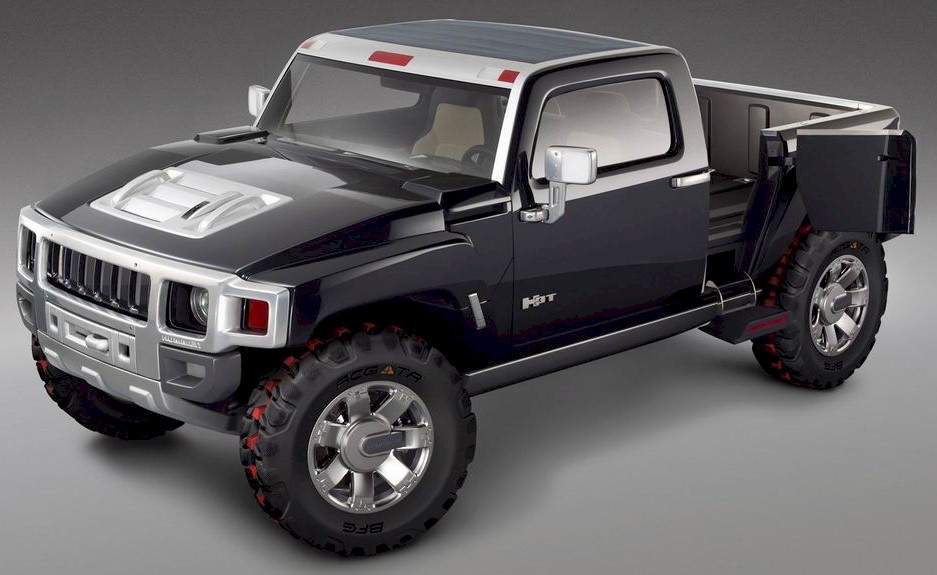
"General Motors Corp. is adding a pickup version of its Hummer H3 sport-utility vehicle at a Louisiana assembly plant as the struggling automaker tries to stem the brand's declining sales." The Star reported "Smaller Hummer models are part of chief executive officer Rick Wagoner's strategy to change the brand's reputation for excess as gasoline prices have risen. GM eliminated the largest Hummer, the five-tonne H1, last year." GM bought the licence for

the Hummer brand from AM General in 1999 and started selling the H1
|
![]() |
Brand Equity - “…
the value of a brand’s overall strength in the market …”
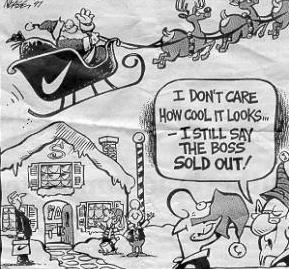
almost eveyone in the world knows the Nike logo, which makes this joke universally funny |
| Brand
Equity |
Brand
Equity - “… the value of a brand’s overall strength in the market …”
Sommers in his 10th ed p.
254
p. 255 says
As for Marketing
Information Products & Services, Sommers
explains on page 255
"Today,
creating brand equity is about more than positioning, packaging and imagery.
It involves developing a relationship with customers. Customers want brands
they can trust and be happy to tell other about"
|
| Brand
Equity - responding to changes in the Competitive Environment |
Brand Equity
- responding to changes in the Competitive Environment
Weiss explains " In late 2000, IBM consolidated its server brands into a single eServer brand. That move represented a marketing response to a marketing problem. IBM is the revenue leader in the combined RISC-Intel server market, but it ranks third in Unix and Intel servers--the two primary growth categories. IBM comes up short in terms of brand equity compared to RISC competitors (Sun Microsystems and Hewlett-Packard) and Intel competitors (Compaq Computer and Dell Computer). The eServer program is intended to fix that problem by shifting emphasis from independent server brands toward a stronger overall IBM brand. The company has reorganized across server lines. Individual organizations no longer report to product-oriented executives. Rather, server development reports to a single executive, and server marketing reports to a single executive. " |
| Branding
government
|
Brand building
- not just for consumer products - it can also be used for Government activities
Mazzetti explains "Success
in advertising usually means getting people to part with their hard-earned
cash. Ray DeThorne's success is measured by how many people he can get
to let go of their sons and daughters. As brand manager for the Army's
advertising account at Leo Burnett Inc., a Chicago ad agency, DeThorne's
job is to sell the Army. And these days, it's a difficult product to sell.
In marketing terms, the Army is a troubled brand. The daily images of violence
from
Mazzetti quotes Seth Godin, an author of books on marketing "Godin said the military had strayed from the marketing formula that had worked for decades: telling individual stories of battlefield heroism. "Most important, Godin said, the Army brand is hurt by a lack of effort in Washington to sell Americans on the value of military service. It is the White House, not an advertising agency, that needs to make the Army's case to the nation during wartime, he said. "In the end, it will not be Leo Burnett that sells the Army," Godin said. "The most important people in charge of marketing for the Army are the president and the secretary of Defense." "Even the gush of patriotism that followed the Sept. 11 attacks did not translate into a flood of young people signing up at Army recruiting stations, DeThorne said. "There was a surge of people buying American flags after 9/11," he said. "But there was no surge in people rushing in saying that they wanted to join the Army." Permission to use the Yahoo! logo and quote from Yahoo! given by Debbie MacLeod, Yahoo! Marketing Manager in email Jan 2005. Copy in the permissions binder. |
| Examples of companies trying to develop "product evangelism" by creating a community around the brand and other "especially innovative and exciting" situations | Beverage companies do not sell beer, ice tea and cola on the net, why do they have web sites and what do they use them for? |
![]() |
www.snapple.com
Snapple, in trying to compete against the Cola giants, Pepsi and Coke is trying to use their web site and other promotion to turn customers who are at the brand insistence stage into "evangelists". The point being not only will these people be faithful drinkers of the beverage line, but that they will be "fans" and encourage other people to drink the products. How do you facilitate their development of fan status - by giving them kewl screen savers, let them order merchandize with the logo, win prizes, enter contest etc. Snapple can also use the online site to gather specific name and address information of loyal customers which they will use in "direct mail" campaigns |
![]()
|
In April of 2000, Molson's
got much more reaction than it expected when it launched its TV commercial
"I Am Canadian".
The web site www.iam.ca on which the commercial is downloadable became, according to some accounts, the number #1 downloaded feature on the web for Canadian surfers in the spring of 2000. At the I AM website, people used to be able to get an email address such as joe@iam.ca or joe@onlycanadian.com or joe@canadianrocks.com The questionnaire which you
fill out to get the free email includes the statement
Such customer profiling techniques were done by the American cigarette companies in the 1980's in order to develop long-term brand insistence - however it was expensive to do that then due to the amount of free merchandize you had to give away - "kewl" web sites allow this customer profiling to be less costly and you can create communities of customers that in turn create a dynamic that can be very exciting. |
| Examples of companies trying to develop "product evangelism" by creating a community around the brand and other "especially innovative and exciting" situations |
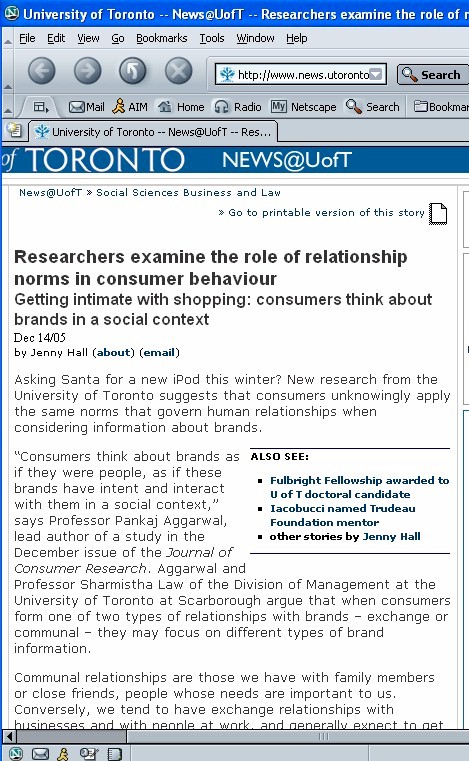
"This immediately reminded me of the situation with Wahoo' s Fish Taco restaurant chain situation (http://www.wahoos.com/index2.html.) A huge reason why people really enjoy dining at the restaurant (other than relatively good food and fast service) is the "surfer tribe" concept they constantly promote to diners. They package the experience of going to the restaurant as equal to being a member of this "cool" club and it's the ultimate "cool" thing to do. With its main target audience of the teenagers who practically eat out everyday seeks everything that indicates "coolness", the strategy proves to be extremely successful. Interestingly enough though, since I had a chance to watch a news report which features why the start-up company is so successful, no one from the show (the diners and the show host) has mentioned anything about that aspect. Whether they are too shy to admit it or it is actually an unconscious working process, these cues are all important symptoms of social conformity that got exploited successfully by marketing people. " The story found by Vicky
on the UofT news site at http://www.news.utoronto.ca
|
| Brand
Strategy in Different Regions |
Brand Strategy
in Different Regions
|
Brand Strategy in Different Regions |
Brand Strategy
in Different Regions
read also http://economictimes.indiatimes.com/%3E/articleshow/408473.cms
Part of the interview
There are three big differences this time. Firstly, this time round it’s starting off with an adult mindset where people are looking at the Internet and digital media as part of marketing; rather than hoping for it to take over all and eliminate all other forms of marketing. Second, it’s starting off with a much larger base than five years ago. As per US statistics, 60 per cent of all households have access to the Internet, close to half of those have access to broadband Internet, and therefore, they also tend to use Internet 12-14 hours a week. The third difference is that people are beginning to realise that the future is going to be impacted by digital marketing. So for instance, there’s a lot of interest in personal video recorders (PVRs) like Tivo and Replay which are currently present in around 2.5 million homes in the US. But it’s all about how consumers control their television. So marketers are saying, if you want to learn how consumers are controlling media, then we should pay a lot of attention to the Internet, because that’s where they control media!" |
| Brand
Strategy in Different Regions ![]() |
Brand Strategy
in Different Regions
http://economictimes.indiatimes.com/%3E/articleshow/408473.cms
Part of the interview " In which markets is the most innovative digital marketing happening? "The most sophisticated market when it comes to broadband and Internet penetration is South Korea. If you talk about digital gaming, ie households that have a Sony Playstation or Microsoft Xbox, then those tend to be in Japan and the US. When it comes down to telephone-based digital marketing, then it’s Scandinavian countries, some parts of Europe and Japan. When it come to digital music, then it’s the US and what we anticipate is that with digital TV, it will again be the US and the UK. We expect that with everything that’s built around broadband or the internet, India will catch up very fast. Even when it comes to digital music, India will catch up fast because it’s computer-based and connected to the internet, and digital video recorders will come in here in a big way. " |
Chapter
10
Brand Extension |
Brand Extension
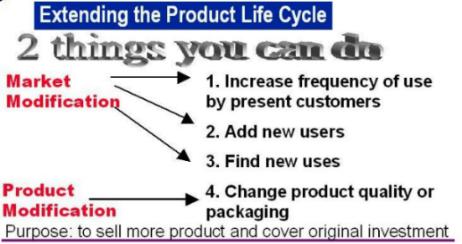
(AKA Product Diversification) A consequence of trying to extend the product lifecycle through Product Modification of Market Modification
|
| Brand
Endorsements Risky
|
Branding - by
using celebrities, or allowing wealthy people to be named as a "giver"
is risky business
There used to be a practice
at Queen's of only naming campus buildings after people who had died -
this way you could make sure it was impossible for them to do anything
stupid in the future and embarass the school !
|
Chapter
10
Trademarks |
This paragraph
below comes from an article reprinted from Visual Arts Trends.
The original author was By Craig J.J. Snyder and the original article was at http://www.icograda.com/web/feature-past-single.shtml?pfl=feature-single-2.param&op2.rf1=14 "A trademark is a word, combination of words, design, logo, or symbol that identifies to consumers the source of goods. That is, tangible goods or things that you can touch. A service mark is essentially the same thing as a trademark, but it identifies non-tangible services, for example, legal, accounting, and design. A trade name is the actual name of the provider of the goods and/or services. A mark is the word we lawyers use, mostly because we usually do not need to distinguish between trademarks and service marks. (R) is the symbol for a registered trademark or service mark. Under US and Canadian law, you may only use this symbol if you have a registration for the mark. TM is a symbol that is frequently used with marks to indicate that the owner believes the word, symbol, or phrase is a trademark. There is really no legal import to this symbol, but it is a useful deterrent. SM is same as TM, but it
is used with service marks. Few mark owners make this distinction because
relatively few people know what these terms mean. "
|