ONLINE
COMMUNITIES
This page last updated 2007 Sept 17th
..
This web page has audio clips - just click on the icon (like the one to the left) and you can hear Prof. Richardson's voice adding additional information to topics on the page. turn on your speakers to hear audio clips
.
. This page used in the following courses taught by Prof. Richardson
.
MGT D06
CCT 322
TCS 301
BCS 555
MRK 410, MRK 610
..
LEARNING
OBJECTIVES
After completing reading this unit, and listening to the lecture in class, student will have information about:

  o Key Elements of any Virtual (Online) Community
  o Types of Online Communities
  o The Five Basic Needs of online communities
  o Etiquette: Rules to Live By
  o Community Trends
  o Four distinct stages of an Online Community
  o The Membership lifecycle
  o Online forum created by BCS student Mark Fonseca

WTGR

.
KEY
POINTS
click to hear
The premise of online communities is "beyond geography" - in some respects, the "geographic environment" has no influence here.

As more and more of the population in North America, Europe and parts of Asia and Africa gravitate to urban and suburban centers with the concepts of neighbours and neighbourhoods being eroded by transiency and mobility, many people are developing relationships that are not related to, and dependent on the immediate square miles of their geographical location for living and working.

WTGR

click to hear Communication technology developments have made it possible for people to create and sustain personal and business relationships which cross far distances. While this absence of a geographical requirement has freed people to engage in more relationships unbound by distance, it has also fostered a reduction in the former close relationship held between vendor and customer.
The Internet is a recent [compared to TV or radio] development in communications technology that allows geographically distant relationships to not only be sustained, but in fact thrive due to the particulars of the medium. Low cost frequent transmission of images and text can great a closer relationship between people and lead to a sense of "relationship" that was not previously possible.

And so it is the case that Online Communities (which started in the chat rooms and other personal communication forums) have been picked up by online organizations as something to nuture since it leads to creating that close relationship with the customer that had been lost when we went from small towns to big cities.

WTGR

.
click to hear There are several texts we refer to in this unit.
For full details, see www.witiger.com/ecommerce/ecommercetexts.htm

.
Using the Web to Compete in a Global  Marketplace was finished by Browning Rockwell in 1998. Rockwell got several  experts to write key chapters so he is the editor, not author..
ISBN 0-471-25262-x 300 pages, soft cover
Brand Building on the Internet by Martin Lindstrom and Tim Frank Andersen  was published in March 2000

ISBN 0-749433-13-2 
310 pages, soft cover

Community Building: Secret Strategies for Successful Online Communities on the Web    by Amy Jo Kim 
The author seems to have a  genuinely strong personal experience in the  subject area and this makes the content of the book very credible

ISBN 0-201-87484-9 
350 pages, soft cover

.
 
 
One thing the medium and larger sized companies are trying to do in their Customer Relationship Management is maintain loyalty (leading to future repeat purchases [CLV]) by fostering communities of customers.Click on the truck to go to a good example of how Ford fosters an on-line community through an extensive web site.
.
Types of Communities

Customer
Relationship
Management

within
Online
Communities
"Expanding relationships through Worldwide Internet Communities"
Chpt 7 in the Browning Rockwell book was written by Brian Eckert.

"One of the most successful business models to emerge and capitalize upon the Internet's capabilities is the creation and maintenance of Internet Communities."

Key Elements of any Virtual (Online) Community
 
click to hear Community Members
- try to create among the members a sense of ownership - that they have control over what the community does
click to hear Community Organizer
- sometimes this is technically focused - a person from an ISP, sometimes this is corporate based - a PR person from a company that produces the product in question eg. barbie.com
click to hear Guiding Principles
- rules and regulations by which people interact
- see Chpt 6 in Amy Jo Kim's book "Etiquette: Rules to Live By"
click to hear Interactivity
- the ability to connect and speak with others through postings, chat, thumbnail galleries, etc.
- keep barriers to entry low
- inspire participants to be involved for a long time, thereby building "product evangelists"

Brian Eckert (2005)  is Vice President of Marketing for ObjectVideo. From 2001 to 2004, Mr. Eckert served as the Executive Vice President of Marketing and Business Development for Dimension Data North America.
Permission to quote was given in an email 2005 April 12th by ETroha@ObjectVideo.com. 

....

Chapter 10

click to hear

Brand Building on the Internet by Martin Lindstrom and Tim Frank Andersen 
Lindstrom is the founder of ZIVO, Australia's largest (2000) web development company. 
In 2005 see www.martinlindstrom.comAnderson founded Framfab which is (2000) the largest internet consultancy in Europe. in 2003 he was CEO Where2Go A/S
Chapter 10 "Online Communities - the virtual marketplaces of the future"

The Five Basic Needs of online communities page 212

Interest - there must be content which attracts participants and usually you plan your content based on the fact that this information cannot be obtained any other place
Information - there must be volume of information indexed and searchable to cover every conceivable requirement so that participants will not be drawn outside the community to other sources
Interaction - the ability to work interactively with the content helps create a sense of ownership among the participants. Ideally you want them to be contributors to the building of the community, not just people reading information posted on the pages.
Communication - there must be structure to the pages on the site which allow for message to be left and answered and there must be clearly marked contact information for the hosts so participants can be in contact with the site builders. If the community involved testimonials about experiences with a product or service the people providing the testimonials should not be selected unless they agree to provide real emial addresses, and further agree to answer emails from the community
Transactions - many communities are based on customers of a product who are very enthusiastic owners. These people are not content to own the product but they also want everybody else to know they own it - which is evidenced by the rise in North America and Europe of product brands in clothing eg. Ford trucks T-shirts, Nike wrist watches, Online communities are a great source for affiliated products and services in addition to the core product.

.
Customer
Relationship
Management

within
Online
Communities
Including Activities in your Business Strategy

Rockwell has a section in Chpt 8 about communities in the business strategy. He makes the point that "rich content and a well-researched, targeted context make a site compelling, but it is the community element that makes a site a part of a person's life worth visiting repeatedly"
 

KEY
POINTS
This is not a new thing for online business - companies have been "community" focused long before the internet ; what the internet does however is greatly enhance the communication among members of the community and communication is often one of the key reasons members get together.
.
..

Chapter 10
Chapter 10 "Online Communities - the virtual marketplaces of the future"

"Why communities are so interesting to companies" page 203-205

  • concentration of customers "It is extremely useful to own these communities as by their very presence the members provide a mass of relevant information which makes targeted marketing possible"
  • "members' profiles tell a lot about their interests and needs - which is information companies can utilize in their communication and product development"
You wouldn't sell a Harley Davidson motorcycle on the Harley site, but you do have a selection of clothing and relatively inexpensive accessory items which you can buy.   www.harley-davidson.com

The Harley site, like many up and coming corporate web sites, is endeavouring to track visitors and collect demographic information by inviting frequent visitors to the page to sign up and login for access to special features. By offering rewards to regular visitors to the site, Harley is building loyalty and also increasing the opportunities to upsell and cross sell within the range of accessory items online.
..
Community Building: Secret Strategies for Successful Online Communities on the Web 
by Amy Jo Kim  Chapter 6 Etiquette: Rules to Live By
companion website http://www.naima.com/community/

"In a medium as fluid and as flexible as the Web, establishing and maintaining community standards can be challenging. Online culture has long been anti-authoritarian, and people in Web communities routinely do and say things they'd never dare to say in a face-to-face encounter. To complicate matters further, the tools for enforcing community ground rules are still primitive, and the laws governing cyberspace are in their early formative stages and changing rapidly"

Googling Dr. Kim in 2005 yielded many sites related to her book several years ago, but we could find no contact information dated 2004 or 2005.

.
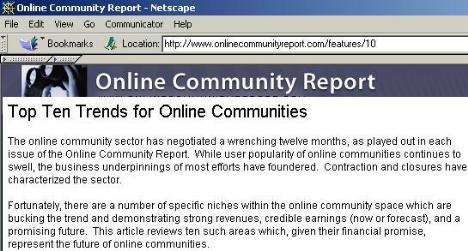
This page on "Top Ten Trends for Online Communities" was found by Mark R. of MRK 610 March 2003.
.http://www.onlinecommunityreport.com/features/10
The most interesting point about this article that Mark found is that Online Communities continue to grow in popularity, but the businesses that sponsor them have not reaped proportionate rewards. This suggests that one of the job opportunities for new graduates may be to help companies "max out" benefits from sponsoring an online community since this seems to be an area in which companies are not getting ROI.
.
Community Trends


Community Trends

"The classic description of "online  community" has centered on online gathering places where thousands or millions of users would discuss issues of importance (or triviality).  These gathering places would prove economically potent through a combination of advertising, subscriber fees, e-commerce, and other sources of revenue. Unfortunately, this vision didn't play out. While many sites were successful in attracting huge usage, revenue hasn't kept pace.  Most online communities are not economically viable.  Most never will be viable due to several tricky issues  which conspire against online communities."

"The good new is that while many online community sites whither financially, a number of niches within the online community space are faring very well, suggesting ten important trends to watch"
1) Search Communities, like classmates.com or geneology research sites
2) Trading Communities: 
3) Education Communities: Online education is booming.
4) Scheduled Events Communities:
5) Subscriber-based Communities: (qualified success)
6) Community Consulting Firms: - companies telling other companies how to do communities
7) E-mail-based Communities - some specialty clubs and groups, eg Zenriders
8) Advocacy Communities: - they do not seek profit, they just want a voice
9) CRM Communities - Customer Relationship Management
10) M&A Activities (not a good one)
 

KEY
POINTS
This page on "Top Ten Trends for Online Communities" was written by Jim Cashel of the Online Community Report - a person who makes money writing about Online Communities and has a vested interested in making sure they seem a viable aspect of websites.

WTGR

.
See also Building Online Communities: The Barriers and the Bruises
 www.ukoln.ac.uk/web-focus/events/conferences/iadis-2004/bruises/html/
by John Heap, Leeds Metropolitan University and Brian Kelly, University of Bath in the U.K.

several attempts were made to contact Jim Cashel, in order to ask permission to quote the above, through editor@OnlineCommunityReport.com  and cashel@OnlineCommunityReport.com in late 2004 and early 2005 but all emails were rejected saying recipient address cannot be delivered

.
Online
Communities
as part of
CRM
http://www.cabelas.com/
a giant sized U.S. based hunting, hiking and outdoor equipment, supplies and services company

Their extensive web site enthusiastically fosters online communities 
 www.cabelasoutdoors.com/community/
and they have a professional e-comsulting company that handles their community.

sc
e-companies creating online communities for consumer product companies
http://www.participate.com/
KEY
POINTS
We feature participate.com because they were the company that first put together Cabela's online community. In late 2004 participate.com was taken over by a larger dot.com.
.

"Online communities are groups of businesses, customers or  employees with common interests that interact via the Internet.  Communities allow companies to get much closer to their most    important customers through innovative programs that inspire  participation such as member-generated content, events,  member-to-member interaction and outreach efforts."


"Whether the focus is business-to-business, business-to-consumer or employee-to-employee, online community enables companies to achieve measurable business benefits. That's because online community, if managed effectively, allows businesses to:"
from participate.com's old website

..
http://www.participate.com/ according to participate.com
"Every online community has four distinct stages. 
  • create
  • convert
  • participate
  • evangelize
The first two stages depend on the traditional marketing and product decisions  a company makes. It's in the third and fourth stages - driving  participation and encouraging evangelization - that online communities contribute the most value."
from http://www.participate.com/why   the URL no longer works in 2005
.
Community Building: Secret Strategies for Successful Online Communities on the Web 
by Dr. Amy Jo Kim from Chapter 4 , section titled
"The Membership Life Cycle"
  • Visitor - people without a strong identity to the community
  • Novice - peope who need to learn the ropes
  • Regular - people who are comfortable interacting and know all the features and benefits of the community
  • Leader - volunteers, contractors and staff as well as highly enthusiastic "Regulars" who come to have a vested interest in the community continuing
  • Elder - long-time regulars and leaders
Why do you need to worry about the life cycle?
Kim points out "Time passes quickly on the Net. Social Dynamics that take months and years to evolve in the physical world can emerge in a matter of days and weeks on the Web - especially when a community becomes hot. You set up a gathering place and before you know it you are faced with a contingent of regulars who think they own the place and are complaining loudly about the clueless newbies bumbling around and ruining their culture."

Googling Dr. Kim in 2005 yielded many sites related to her book several years ago, but we could find no contact information dated 2004 or 2005.

.
 
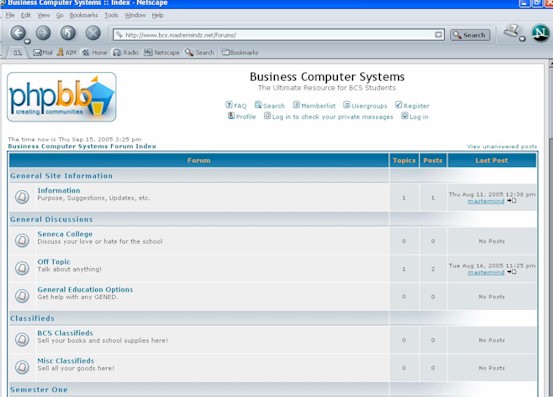
Mark F. in BCS 555 in Sept 2005 sent an email to the professor and explained that he was involved personally in creating and building online communities. Mark has done some interesting work and we have added some space below for Mark to explain, in his own words, what he did. Marks's idea sounds pretty interesting and if we can get a lot of BCS people to participate, it could be a very fruitful thing.
.
Mark said "I created an online community “also known as a forum or bulletin board”, for students in the BCS program to interact with each other online. The forum acts as a resource for courses of all semesters. Students can discuss their current subjects with fellow classmates as well with those who have previously taken the course. The forum has a classified section where students can easily post sales of their used text books and other items for others to see, making it a one-stop shop for students. The forum is by no means limited to school related material. Miscellaneous forums are also available within where BCS students can have off-topic discussions with others about any topic. As a user, the student has the choice to remain anonymous by using an alias or they can publicly announce who they’re so colleagues can identify them. As the forum grows and generates interest, I will add more content and resources. The forum can be accessed at; http://bcs.mastermindz.net - or click the screen capture below" (UPDATED: the section of the site was not active in Nov 2006 - Mark has completed his courses and no longer in the BCS program)
http://www.bcs.mastermindz.net/forums/
Mark explained in 2005 "The forum was created using phpBB. phpBB is one of the most popular Open Source bulletin board “forum” used on the internet today. It has a friendly user-interface and is compatible with a variety of different operating systems and works with all internet browsers. For more information visit their main site at http://www.phpbb.com"
 
 
Online
Community

security
vulnerabilities

Cyber Criminals Now Lurking In Social Networking Communities
was the title of a Sept 2007 story on CMP Channel  www.crn.com 

The CMP Channel story quotes a Symantec study that says "Social networking Websites are becoming favored targets for cyber criminals taking advantage of human nature and using increasingly sophisticated toolkits "

Symantec explains "As Web applications have been more widely deployed, they have been increasingly targeted by attackers as a means to circumvent network security measures, such as IDS/IPS and firewalls,...Social networking sites have proven fruitful for attackers because they give attackers access to large numbers of people, many of whom implicitly trust that the site -- and the content on it -- are secure. Attackers are increasingly targeting social networking sites as Web users are becoming wary of unsolicited e-mail attachments and other enticements."
 

WTGR says, it is a fundamental characteristic of criminals to "go where the quarry is feeding", meaning, target victims in a place they feel safe, like the chatrooms and message boards of their favourite online community (myspace, facebook etc.) where they reveal all sorts of personal information to strangers.
s
 
http://www.TimeZone.com/forum.aspx?forumId=omega An example of an online community that Witiger visits sometimes.
It is for people enthusiastic about fine Swiss watches


witiger.com
  CONTACT I MAIN PAGE I NEWS GALLERY I E-BIZ SHORTCUTS I INT'L BIZ SHORTCUTS I MKTG&BUSINESS SHORTCUTS I TEACHING SCHEDULE
.
  MISTAKES ITEXTS USED I IMAGES I RANK IDISCLAIMER I STUDENT CONTRIBUTORS I FORMER STUDENTS I
.
.
  Prof. W. Tim G. Richardson © www.witiger.com