a category of Political Risk

| CONTINGENCY
PLANNING and RISK ANALYSIS
a category of Political Risk |
|
see
also www.witiger.com/internationalbusiness/politicalrisk.htm
see
also www.witiger.com/internationalbusiness/politicalriskcontingencyplanning.htm
see
also www.witiger.com/internationalbusiness/geographicenvironment.htm
see
also www.witiger.com/internationalbusiness/politicalriskdefensiveintegrative.htm
see
also www.witiger.com/internationalbusiness/personalrisk.htm
and www.witiger.com/internationalbusiness/alanbell.htm
.
| Contingency
Planning using your imagination to adapt to unseen circumstances and overcome a difficulty so that you can continue working to achieve the original objective |
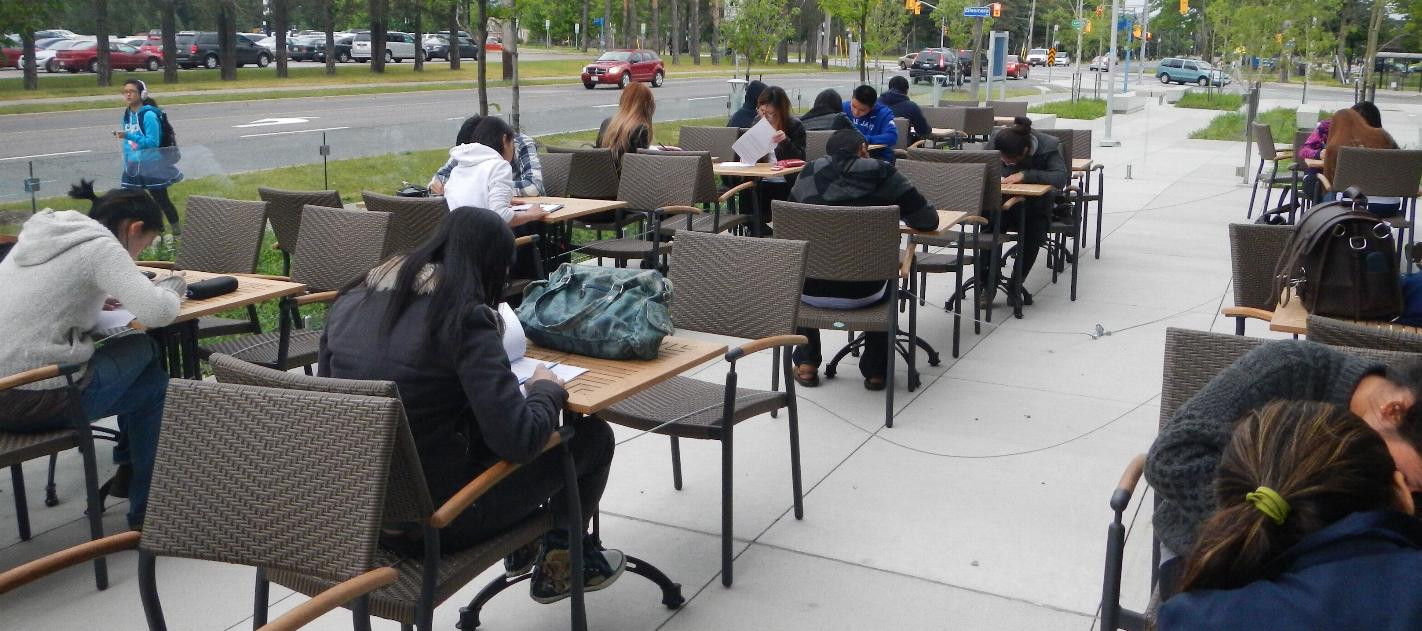
Probably the biggest part of contingency planning is having a calm cool attitude and reacting to an unusual situation with some imagination and thinking "outside" the box - like,, literally outside. It is important that when you have a situation that changes your plan, you think about alternatives, and don't give up right away.When the power went off in the new IC Instructional Centre at UofT Scarborough Campus Monday night (2012 June 4th) all the other profs walked out of their 7pm classes and told their students that class was cancelled. Actually, the power went out at 6:40 pm - no "authorities" showed up til 5 minutes to 8pm so nobody knew "nuthing 'bout nothing". Rather than waste the class, I said let's do our test outside on the patio
WTGR |
 |
Are
you in this pic?
UTSC summer 2012 I was teaching int'l business and when the power went out, my "contingency plan" (arranged in advance) was to move you to the outdoor patio to finish the test. Have subsequently used this pic for years in courses in which I talk about contingency planning and thinking "outside the box", or "outside the building". If you remember this, would love a shout out so the current students can learn from your experience. (2020 Sept 15th) I posted this on my FaceBook account within the faceBook group titled "Former Students of Witiger" |
| INTRODUCTION | , | The topic of
Political Risk is very large. For the sake of being able to divide this
large topic into "teachable" components, I have created this particular
unit dealing just with the immediate considerations of Contingency Planning.
In late 2009 the topic of Contingency Planning took on a new, and "immediate" meaning in the context of planning for medical situations that involved illness on a large scale - so it was no longer a theoretical concept but something that could effect the readers of this page - as potential victims of the H1N1 virus. Most institutions, including
colleges and universities have been making Contingency Plans to deal with
absences of students and instructors for flu.
WTGR |
| KEY
POINTS |
, | Alan Bell explains
that when companies are assessing the possibility of developing a contingency
plan, and the expected security requirements to make it work, it is necessary
to ask one tough question.
How much will it cost to develop a contingency plan, and increase our security where risk situations warrant? compared to NOT doing this, and paying for the consequences if something does happen? For some large scale projects overseas, it could cost millions of dollars to get the operation "up and running" after a disaster, which would also see the company fall behind other businesses that did have contingencies in place. Or, a company could spend tens of thousands of dollars on security and contingencies so if a bad thing happens, the company can respond, and recover. Or, a company can do nothing, and just hope that they are lucky, and nothing bad every happens. Unfortunately,
WTGR |
| CONTINGENCY
PLAN BREAKDOWN |
, | In Sept 2008
a student in C44 was hearing guest speaker Alan Bell discuss contingency
planning and the student asked what are the components of Contingency Planning
It was explained that this course does not have the time to be able to delve into specific components, rather it is important for the student to understand the more simple aspect of WHY contingency plans are important and what are the basic circumstances in which they are necessary - in the context of the 6 environments challenging business these days. However - for the sake of answering the student's query, here listed below are some of the specific components of a contingency plan
|
| CONTINGENCY
PLAN BREAKDOWN |
, | Listed below
are some of the specific components of a contingency plan
security planning
|
| CONTINGENCY
PLAN BREAKDOWN |
, | Listed below
are some of the specific components of a contingency plan
security planning
|
| CONTINGENCY
PLAN BREAKDOWN |
, |
|
 |
YouTube video in which security
expert Alan Bell (former British Special Forces) discusses the Communications
aspects of Contingency Planning and Kidnap and Ransom situations.
Includes explanation of "lost comms" scenario 3 min 32 sec. |
| CONTINGENCY
PLAN BREAKDOWN |
, |
|
 |
YouTube video in which security expert Alan Bell (former British Special Forces) discusses the Medical aspects of Contingency Planning and responding to medical risk situations. |
| CONTINGENCY
PLAN BREAKDOWN |
, |
|
| CONTINGENCY
PLAN BREAKDOWN |
, |
|
 |
BP Oil Spill - Mexico
2010
Student Pranya Y. in MGTC46
in Feb 2011 emailed to comment on how the geographic environment effects
business and the problems with B.P.'s Contingency Planning re: the big
oil spill in the Gulf of Mexico in 2010.
|
| CONTINGENCY
PLAN Examples |
,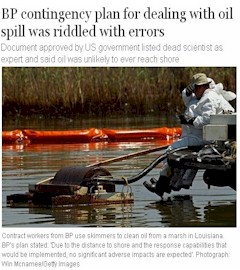 |
Student Anne
M. in MGTC44 at UTSC in Sept 2010 was reading stories about contingency
planning online and came across a good article discussing how BP had a
poor contingency plan for dealing with the oil spill.
The original story was at
From the article, Anne reviewed
several points
|
| CONTINGENCY
PLAN BP |
Anne emailed
to say
"BP
made a lot of mistakes in its risk assessment and contingency planning
which has cost the company billions of dollars in cleanup costs and
lawsuits (not to mention more than a 40% decrease in company's shareholder
value) and here is what I learned from the company's mistakes:
|
 |
Anne M's helpful comments
about the BP Oil Spill (and their lack of effective contingency planning)
was read by Alan Bell in advance of his Sept 2010 "guest lecture" to MGTC44.
Mr. Bell used Anne's comments in the Sept 2010 lecture to draw out some important considerations of the consequences of failure to develop contingency plans. Pictured to the left is Alan Bell, Anne M. and Prof. Richardson |
| CONTINGENCY
PLAN Business Continuity Examples |
 |
Student Gohul
S. in MGTC11 at UTSC in March 2011 emailed to say
"Professor Richardson, I found the class on Contingency Planning and Business Continuity to be quite interesting and on my drive back home and over the weekend I thought about some different ways contingency planning and business continuity apply to the sports world." Gohul comments on Business Continuity in the case of how the New Orleans Saints managed the hurricane fiasco. Gohul explains "When Hurricane Katrina hit, it essentially damaged every building in the city that included the stadium the team played in." |
 |
Gohul
explains
"When the Superdome was partially destroyed due to the hurricane 2005, the team went through the incident response phase. They notified the season ticket holders, the fans, the NFL, the media and the people of New Orleans that the damage was too extensive and that there was a large chance that come kick-off for the upcoming season, they would not be playing at the Superdome. They assured them however they would try to come with a solution so that the team does not forfeit the season. Then came the disaster recovery phase. In this stage with the season only a few months from starting they gathered their players together and let them know regardless the team would be playing the season. The owner of the team managed to rent out a stadium in San Antonio (relatively close) so that the players could practice to ensure they would be ready. At this time the Superdome was being repaired so the team could eventually play there later on during the season. Finally the business continuity phase in which the team got the league to approve the stadium at Louisiana State University and the stadium at which they practiced at to be the home stadium until the Superdome was fixed. By doing so the team did not forfeit any money or games that season due to the damages of their stadium. They managed to continue playing and eventually when their stadium was fixed they went back to playing in the stadium they called home for so many years. |
|
WTGR
adds
Thanks Gohul, "Business Continuity" s a term we use with references to terminology - that doesn't really take in to account the "will to survive". The people of New Orleans, as reflected by their football team, did rebuild, and it was tremendous to see just 4 years later the Saints make it to the NFL final, and WIN Superbowl 2009 - Television ratings for Super Bowl 44 were the highest for any TV program, sports or otherwise, in history |
| Risk
Analysis |
 |
| Risk
Analysis |
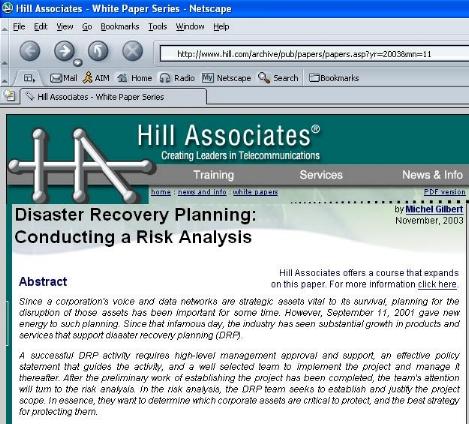
Michel Gilbert
of Hill Associates provides an Introduction to Risk Analysis
"The risk analysis is the most complex part of a properly conducted disaster recovery plan. However, a clear understanding of the primary goal of a risk analysis, a grasp of the critical terminology, and adherence to a well-structured process renders this complex activity manageable." The Goal of a Risk Analysis
o What
am I protecting?
|
| Risk
Analysis broken down |
The fundamentals
of Contingency Planning requires that you first understand the Risks,
which requires some degree of "Risk Analysis" to understand
o what am I protecting, what do I have that is important o sometimes this requires an inventory of assets in order to have a dollar value on what is at stake o what am I protecting against, what are the specific risks o this can be very complicated and is effected by human factors, the economic and technological environment, as well as weather extremes and other geographical circumstances o how much am I willing to spend to protect these assets o how much money am I willing to spend o costs of people to act as guards o money for defences o money for countermeasures o time: how much time will I dedicate o how much effort - what part of job descriptions will I task to this WTGR |
 |
YouTube video in which security expert Alan Bell (former British Special Forces) discusses the fundamentals of Contingency Planning in the context of Risk Analysis. |
| Risk
Analysis Terms
|
Risk Analysis
Terminology
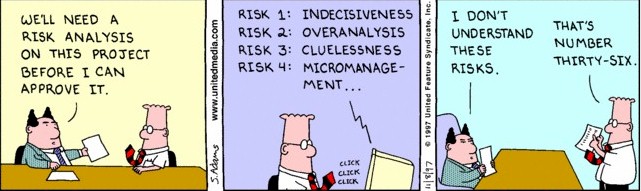
To better understand discussions on Risk and Threat Analysis, it is necessary that readers understand what is meant by some terms particular to this part of the security industry. o Asset:
something worth something
terms from Alan Bell of globerisk.com and Michel Gilbert of Hill Associatesbasically, the definition of an asset is something which is valuable for your company to have to carry out the critical aspects of business |
| Risk
Analysis Terms
|
o
Threat agent: Any person or thing that can do harm
threats by themselves are not a problem, it is a problem when that threat is facilitated by a person "bringing it", or a situation causing the threat to go from "maybe" to "now" |
| Risk
Analysis Terms
|
o
Vulnerability: A deficiency that leaves an asset open to harm
any weakness which, left unprotected, could cause the company to lose productivity |
| Risk
Analysis Terms
|
o Exposure: Harm caused when a threat becomes real
In international business, an example of an exposure could the consequence of a particular currency rising very high, which wipes out the profit margin expected in an enterprise |
| Risk
Analysis Terms
|
o
Countermeasure:
Any protective measure we take to safeguard an asset, and respond to an exposure In the case of preventing against a flood, you could dig a large trench to divert flood water around the mine shaft so the drifts will not be flooded |
| Contingency
planning
what are the
MEDICAL |
List of specific
medical risks and threats that Contingency plans are used for
|
| Contingency
planning
what are the
VIOLENCE |
List of specific
violent risks and threats that Contingency plans are used for
|
| Contingency
planning
what are the
|
List of specific
risks from government problems that Contingency plans are used for
|
| contingency
planning preventive measures
|
Plans
The following points are things a company can do in order to be able to respond appropriately when a risk situation effects the ability to carry on business as usual.
|
| contingency
planning preventive measures
|
Personal
Plans
While I was watching CBC news today, i see the Canadian gov't are promoting [to] us that we all should have a 72 hours plan. To me it seems like this is another kind of "contingency plan" and i think it will be helpful for all of the students. www.getprepared.ca(link still works in 2011 March) Sincerely, Aaron |
| contingency
planning preventive measures
|
Personal
Plans
WTGR wrote back to Aaron saying your
email makes a good point
-Because of government cutbacks in municipal infrastructure, it could be a week (or two) in some areas to get power back online - and in a big city, it would take longer My step-brother happens to be in charge of the physical-plant and generators for a large city hospital - he says the generators can supply power, but A.
they can't run 24 hrs non-stop, they have to be shut down to cool the machine
parts
- it has the potential to be a big big problem and something that Canadian businesses should think about thanks again for your contribution Aaron |
|
|
CONTACT IMAIN PAGE I NEWS GALLERY I E-BIZ SHORTCUTS I INT'L BIZ SHORTCUTS I MKTG&BUSINESS SHORTCUTS I TEACHING SCHEDULE |
| . | |
| MISTAKES I TEXTS USED I IMAGES I RANK I DISCLAIMERI STUDENT CONTRIBUTORSI FORMER STUDENTS I | |
| . |