AND
BAD TRANSLATION

| TRANSLATION
CHALLENGES
AND BAD TRANSLATION |
|
suggested
by a MRK460 student Chris Scott
http://www.i18nguy.com/translations.html

pic suplied by Keting |
Many times in
the international business class I ask two students (who read and write
a language other than English) to volunteer to demonstrate "translation"
and "back translation" on the blackboard at the front - invariably
the back translation doesn't match the originakl sentance and everybody
has a good laugh.
After we did this in MGTC44 in February 2008 I received a nice email from one student who had some experience with these challenges of "exactly" translating difficult words and she kindly offered to share her experience with the rest of the class. Keting wrote to say
|
| Keting explained further
"At first, I thought it was going to be easy, but then I realized that it is impossible to translate word for word from Chinese to English. Most of the translation I did were from summarizing the basic idea of the report and then translating it to English. While I was translating, I was really afraid to make mistakes because the slightest detail may affect the owner's decision on the selection of manufacturers. Like you've mentioned, sometimes it gets really hard to translate some of the words from language to language, because Chinese is not written in words, but in characters, and 4 characters may translate to a sentence in English. When you talked about it in class, I finally realized I wasn't alone in this! See you next class." |
| VERY
VERY
bad translations |
You'd think that several decades after MLK that the "N" word would not be found - except in some of the more vulgar rhyming of black rappers, however, in April 2007, a story (first broken by The Toronto Star) spread around North America in which a Toronto woman noted that the "N" word was used on the labelling of her furniture. |
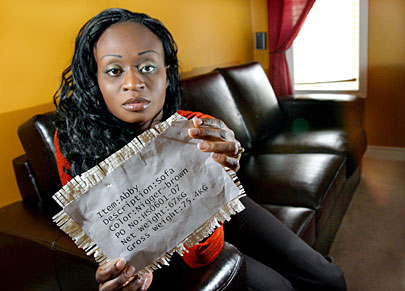
photo - Jim Wilkes: Toronto Star, 2007 April 6th |
Doris Moore and her husband
bought a sofa from Vanaik Furniture in Toronto. After the sofa was delivered,
Mrs. Moore explained that her daughter asked about the wording on the label
and asked why they wrote the "N" word.
Upon examination, it was found that the sofa was describe as "N"-word brown. A few weeks after the story broke in the first week of April, the fault of the racial slur was traced to the Chinese company that used an old dictionary for writing the English language on their labels. |
| VERY
VERY
bad translations |
Mr. Huang Luoyi,
Product Manager for the Beijing-based company Kingsoft Corp., was quoted
by Associated Press as saying "we got the definition from a Chinese-English
dictionary. We've been using the dictionary for 10 years"
This led some people in the black community in Toronto to be very very upset saying that such an excuse from the Chinese manufacturer is ridiculous because the phrase "N***** brown" was never in any North American dictionaries to describe a shade of colour so it must have been a Chinese racist expression to begin with. Some members of the black community in Toronto were quoted as saying that this is an example of how some Chinese people are racist towards blacks, and maintain racist opinions to blacks, decades after the "N" word has been dropped from North American media. see the Black Business and Professional Association www.bbpa.org of Toronto |
some of these came from
http://www.rowan.edu/business/FACULTY/dosoglu/intmkt4.html
EXAMPLES OF BAD TRANSLATION
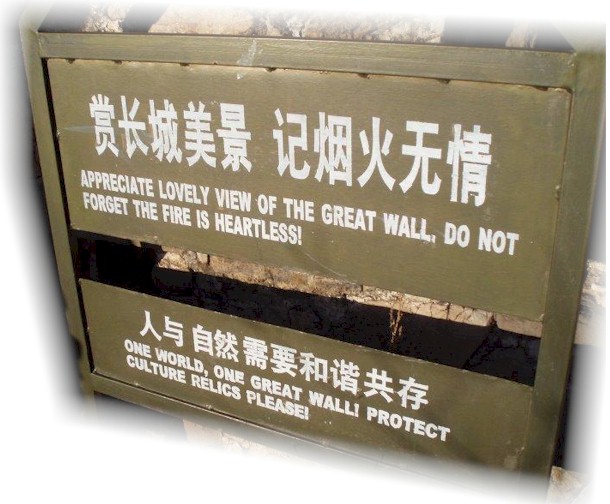 |
example sent to me by a
UTSC Chinese student - neither he, nor I had any idea what they were really
trying to say here with the words about "fire is heartless", am guessing
it maybe be something to do with fire safety
click to view larger |
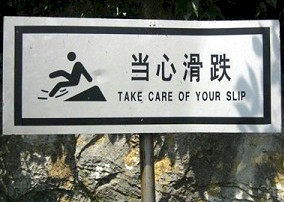 |
One of many examples contributed
by
Jen C. in MGTC44 at UTSC in Jan 2009.
Jen explained
|
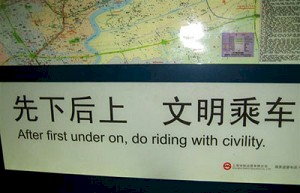 |
Another example from Jen
C.
Jen explains
|
 |
UTSC student
Danni Z. in MGTC44 in May 2010 emailed to discuss Idioms.
Danni explains
|
 |
Danni adds
I encountered such a situation yesterday when I was in a line up at Walmart. Next to me, there was a Caucasian lady (I believe she is a English native speaker) who had trouble finding her coins. There was a Asian man (probably, English is his second language) behind her who was very impatient, and made sounds of irritation at the long wait. The lady became angry as well and turned around to the man and snapped "Hold your horses!" The man stared for a moment in silence, then he turns around to his companion and asked in mandarin "What horses? I don't get what she's saying?" Idioms are great hurdles to cross when learning languages. We may understand the meaning of the individual words, but not understand the meaning of the phrase. |
| WTGR adds
Great example Danni. Many idioms are confusing because they make reference to situations that no longer exist. For example, a hundred years ago, and longer, many times people would be waiting in line with their horse (not a car) and horses become impatient just standing - so the horse would start to move around and bump into other horses and other things - hence the expression "hold your horses" - meaning get control. I experienced this first-hand growing up on a farm and owning and riding horses as a child - they don't mind being ridden, and the don't mind being led for short distances, but they very quickly get bored and want to move around if they are required to stand in one spot for a long time. |
 |
The name
Coca-Cola in China was first rendered as Ke-kou-ke-la meaning,
"bite the wax tadpole" or "female horse stuffed with wax" depending on the dialect. True?? - no, it is an urban legend - sort of. The "Urban Legends Reference Pages" by Barbara and David Mikkelson explain what really happened The Mikkelson's explain that when Coke started selling in China in 1928 there was no official translation, but shopkeepers started writing out their own arrangements of ko-ka-ko-la. Some of the combinations of characters resulted in sily meanings but this was not official policy of Coke. Coke later found the right Chinese characters that are phonetically close to the brand, "ko-kou-ko-le" which can be translated as, happiness in the mouth". |
In Taiwan, the translation of the Pepsi slogan "Come alive with the Pepsi
Generation" came out as "Pepsi will bring your
ancestors back from dead". - the urban legend is explained more correctly
at
snopes.com/business/misxlate/ancestor.asp
In Chinese, the KFC slogan "finger licking good" came out as "eat your fingers off".
In Latin America
Pinto, a Ford brand car, was Brazilian slang for "tiny male genitals".
Frank Perdue's slogan "It takes a tough man to make a tender chicken" got
translated in Spanish as "It takes a hard man
to make a chicken aroused".
In Europe
In Italy, a campaign for Schweppes Tonic Water translated the name into
Schweppes Toilet Water.
|
|
CONTACT I MAIN PAGE I NEWS GALLERY I E-BIZ SHORTCUTS I INT'L BIZ SHORTCUTS I MKTG&BUSINESS SHORTCUTS I TEACHING SCHEDULE |
| . | |
MISTAKES
I TEXTS
USED I
IMAGES
I RANK
I DISCLAIMER
I STUDENT
CONTRIBUTORS I FORMER
STUDENTS I PUBLICATIONS
I TIPS
I  |
|
| . |