re: International Business Management

|
Canada
- U.S. relations
re: International Business Management |
|
.
.
| DISCLAIMER | The range and magnitude
of the Canada-U.S. relationship is much too complex and diverse to be contained
in a page like this - this page is for giving undergrad students a primer
for a lively class discussion which will incorporate current news issues...
and the content is built, mostly, using students suggestions and input.
WTGR |
| INTRODUCTION | Some Canadian universities
have entire courses devoted to the complex subject of Canada-U.S. relations.
It is arguably the largest bilateral relationship in the world.
This unit serves the purpose of discussing some of the main aspects of Canada-U.S. relations as it applies to being an effective International Business Manager operating with a company in Canada. WTGR |
| LEARNING OBJECTIVES | After reading this unit,
and attending the classroom lecture, students will
|
 |
 |
Prof. WTGR holding the July 2008 cover of Maclean's in which the whole issue was devoted to discussing Canada-USA differences |
| Canada-U.S. relations |
|
| Canada-U.S.
relations from the American
perspective |
|
| Canada-U.S.
trade frictions
examining the sources of some problems |
One
of the things that has always made the U.S. nervous about a close relationship
between Canada and the U.S. is in the context of the economic environment
and the technological environment.
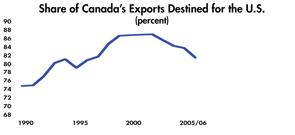
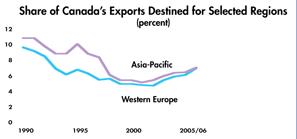
Since
the early years of the new millennium, Canada has started to decrease it's
overwhelming dependence on business with the U.S.
|
| Canada-U.S.
trade frictions
2023 |
Many
of the trade frictions between Canada and the U.S. are based on farming
and forestry. Canadians are always trying to block cheaper milk and cheese
coming in to Canada because Canadian dairy farmers cannot produce large
quantities at low prices - primarly because of the "geographic environment".
Canadian farmers of dairy cows have higher costs and a shorter summer growing season. It is geoography. 2023
January
However, Canadian politicians will continue to support the Canadian dairy farmers because the farmers have political power through the members of parliament elected in southern Ontario, Quebec and B.C. |
| The
"MILK BUSINESS"  |
"The
dairy sector is different because since the 1970s it has been subject to
supply management. Basically, it’s a government-sanctioned cartel: The
Canadian Dairy Commission dictates the precise amount of milk produced
every month in the country and uses this top-down control to keep dairy
prices artificially high. Similar systems are also in place for chicken,
turkey and eggs."
"The Canadian dairy sector can do this without fear of international competition because foreign imports are subjected to prohibitive tariffs of up to 300 per cent; this is why border guards will often explicitly ask you if you have any cheese in your luggage " "Type the keyword “dairy” into the federal lobbyist registry, and you’ll turn up just short of 7,000 results. By contrast, the word “lumber” yields only 1115 results and the word “beef” turns up only 456." Some
people have compared the Canadian Dairy lobby to the Americans NRA
|
| Canada-U.S.
trade frictions
examining the sources of some problems |
As a consequence
of Canada doing business with other countries, there have developed some
ramifications that effect U.S. companies doing business in Canada, and
collaborating with Canadian companies in areas of high tech research.
Example: The National Post
and the CBC reported in October 2007 that the
( www.sinodefence.com/airforce/helicopter/z10.asp ) military analyst Richard Fisher explains that "the Z-10 attack helicopters is just one major military program, amongst hundreds, that China is pursuing in order to prepare for a possible war against Taiwan". |
| Canada-U.S.
trade frictions
examining the sources of some problems |
CBC says "Under
U.S. arms trafficking laws, Washington must give its approval for U.S.
products and technology to be used for military purposes in a third country."
www.cbc.ca/world/story/2007/10/19/pratt-engines.html
|
| Canada-U.S.
relations
Academic
|
|
| Canada-U.S.
relations
Academic
|
Prof. Andrew
Johnston teaches History at the University of Western Ontario and is co-director
of The Centre for American Studies at UWO http://cas.ssc.uwo.ca/
Prof. Johnston wrote an article
in The Toronto Star 2004 Dec 28th titled
Johnston explains
Johnston continues
In Canada, we complain ceaselessly about our milquetoast nationalism that seems capable of only defining itself negatively. But if we were as careful about understanding the United States as our critics wish us to be, we would not only give our own nationalism a break, we might discover how incomplete American nationalism is too. The ideas of American character that we take for granted — individualism, materialism, inventiveness, productivity — were not the founding characteristics of the "nation," but emerged through a dialogue between the Yankee North and the slaveholding South (In 1828, Andrew Jackson's vice-president John C. Calhoun said: "I never use the word nation. We are not a nation, but a union, a confederacy of equal and sovereign states.")" |
| Canada-U.S. Differences | This is a list
based on the personal opinion of Tim Richardson and the points on the list
are not necessarily something my students or colleagues are obliged to
agree with.
In Canada, we are so concerned
about appearing racist and prejudiced, we have even changed the term immigrants
and now the politically correct phrase we use here is "new Canadians"
|
| Canada-U.S. Differences | 1. Americans are a melting pot - when you come to the U.S. you can be proud of where you came from, but you have to quickly "be an American", pledge allegiance and support the U.S. way of doing things - Americans want immigrants to adapt to their culture, they resist adapting to you. |
| Canada-U.S. Differences | 2. Canadians celebrate diversity and multi-culturalism, which in practice seems to mean you come here from country "X", and you are welcomed to continue to think of yourself as still in that country with X's hairstyles, clothing, language, religion etc. - to the point where the local, provincial and federal government does many things to accomodate you, like letting you write your drivers test in dozens of different languages. There is, for many people, no strong identifiable Canadian culture that immigrants are encouraged to "become", instead they stay as "Jamaican-Canadians", "Chinese-Canadians" etc. with many emphasizing usually the first word not the second. |
| Canada-U.S. Differences | 3. Americans
are more religious. Black Americans and White Americans in particular
attend church in much greater percentages than Black Canadians and White
Canadians.
Americans have a president who was elected, and re-elected on a platform that made many references to God and the Christian faith - you never hear a Canadian Prime Minister or Provincial Premier end a speech with a line like "so help me God", or "and God Bless Canada" |
| Canada-U.S. Differences | 4. In the
U.S., sports is "Big Business", in Canada, sports are more personal
- the exception being Hockey which is a national passion that competes with religion for the soul of the people. With the long history of Canada hockey success going back to the Russia series in '72 and recently with the Men and Women's gold at the Olympics, Canadians (and rightfully so) feel they are the complete master's of this sport on the planet. For a large percentage of Canadians, especially in rural Canada and small villages, the local hockey rink is the centre of life. |
| Canada-U.S. Differences | 5. Americans are concerned with buying products at competitive prices and still good quality, Canadians want to buy cheap products, but seem to accept that cheaper will also mean cheap quality. An expert in the Canadian fashion business explained that Walmart Canada operates differently than Walmart USA based on this difference. |
| Canada-U.S. Differences | 6. USA is
bigger in size???? It is a common myth that Canada is the 2nd largest
country in the world - actually, the land area of the U.S. is 9,162,000
sq km, Canada is 9,093,000 sq km - what makes us a bigger country on the
map, is the fact that we also take into account a large part of the Arctic
ocean making out total area of land and ocean 9,984,670 sq km, whereas
the U.S. is 9,826,630 sq km
The U.S. has far more habitable land than Canada, whereas most Canadians live close to the 49th parallel |
| IMMIGRATION
and ETHNICITY Canada
|
Canada has 5.8
migrants / 1,000 population
USA has 3.0 migrants / 1,000 population - we have almost twice as many immigrants, per capita, than the USA Asians in Canada represent
12% of our population
Blacks in Canada represent
2.2 % of our population (mostly from the Caribbean
in the 1960's - 80's)
Canada - people speaking
French 22% and declining (proportionate to the rest
of the population)
read an interesting essay by a Muslim who thinks multi-culturalism is wrong in Canada because it can lead to such things as the setting up of the Sharia tribunals www.jihadwatch.org/dhimmiwatch/archives/001298.php read also 10 Ways to Fight
Hate on Campus www.tolerance.org/campus/index.jsp
|
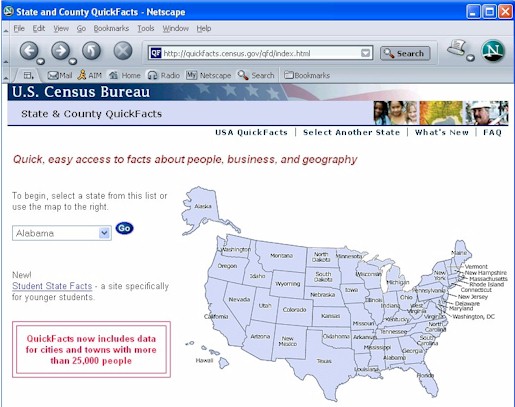 |
One of the obvious differences
between the Canada and the United States is the population difference.
There is a very good U.S. gov't website that gives you population by state, and other demographic info. |
.
 |
nnnnnnnnnn
|
 www.witiger.com
- this
means other professors and teachers and students can use my stuff for teaching
and learning without having to ask first
-
it would be nice if you identified me as the source, just refer to witiger.com