Trade
Theories

| International
Trade Theories |
|
for
UTSC students
 |
please
note: International trade theories are discussed in more detail in
the course ECM C62H taught by Prof. Walid Hejazi
see http://www.utsc.utoronto.ca/~hejazi/ |
Below you'll see some screen captures of an old powerpoint presentation that was used to discuss "International Trade Theories".
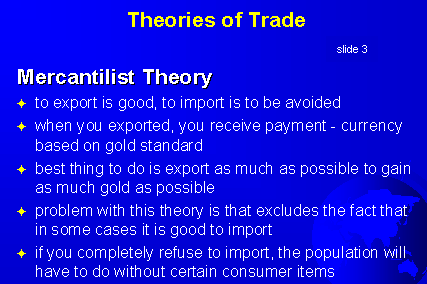
Our Canadian government's "Dept. of Foreign Affairs" still seems to cling to the "Mercantilist Theory"
The senior trade commissioners working in the Canadian embassies and consulates are very helpful to Canadian exporters but when you ask them for advice importing from another country there is not the same level of assistance. The personal experience of some Canadian involved in international business has been that the Embassy will help them export, but not import. Embassy staff officials have said "we can't give you that information", or "our mandate is only on helping exporters". This "one-way" policy has been frustrating to some Canadians involved in international business because it means they are more "challenged" in trying to import from other countries. One of the avenues to address this is to seek hekp from the Embassy of the other country. For example, if the Canadian Embassy in South Korea will not help a Canadian find information on importing some product from South Korea, you can simply go to the office of the South Korean (ROK) Consulate in Toronto or the Korean Embassy in Ottawa and their staff will be pleased to provide assistance.
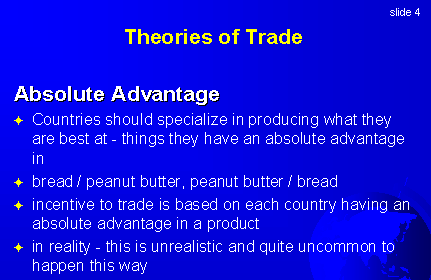
Adam Smith said - each nation
should specialize in producing things it has an "absolute advantage" .
The theory of "Absolute Advantage" seems to make sense in situations where
the circumstances of the geographic and economic environment are relatively
simple and straight forward - example: - Switzerland and watches, Canada
and cereal grain.
A useful video explaining the difference between Comparitive Advantage and Absolute Advantage |
Student Kenny K. in MGTC46
at UTSC in Feb 2011 wrote to say
"I was reading about International Trade Theories on your webpage and while doing so, wanted to find a video that made more sense of the information. I believe that the YouTube video (see left) is very effective in helping to explain absolute and comparative advantage in addition to the notes you provided" WTGR replies
|
.
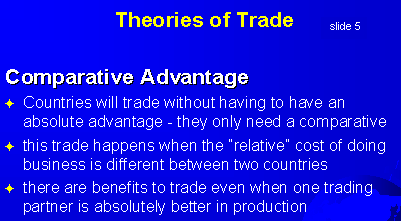
In most cases, a straight-forward
Absolute Advantage does not exist in the real world. Some countries may
have an advantage in one commodity, and also a slight advantage in another
commodity - however there is still an opportunity for them to trade.
| Comparitive
Advantage
re: red carrots?  |
UTSC
student Shawn T. in MGTC44 in May 2010 emailed to suggest that a current
situation involving farmers in the "Holland Marsh" north of Toronto may
be an example of a decision that runs contrary to the "theory of Absolute
Advantage" and shows how a situation can develop where the producing country
has a slight Comparitive Advantage.
Shawn explains
|
Comparitive
Advantage re: red carrots?
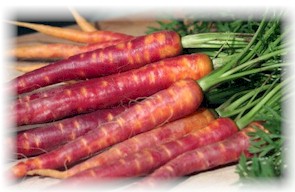 |
Shawn adds
In the ad it mentioned Indian red carrots. I thought it was really interesting because on the one hand there is the idea that a country that grows it's own food is sustainable, but on the other hand there is trade theory that you discussed which states that countries should produce what they are naturally good at producing. Not only is Canada trying to compete where they don't have an advantage but they are investing in going against nature and create seeds that can thrive in an environment that isn't natural itself in the name of sustainability. |
| Shawn concludes I figured it was worth mentioning because it just seemed downright strange to me that there is such a promotion for it. |

| WTGR replies I think what you queried Shawn is a good example of how the infleunces of the Technological environment and the Social-cultural environment can result in a situation that does not fit accepted theory. Technology through advanced farming practices (chemicals to stimulate growth and technology for water irrigation) together with new food demands created by immigrant communities, result in producers moving away from traditional products in order to satisfy the possibility of a new market. |
In 1817, David Ricardo looked
at Adam Smith's theory and suggested that "there may still be global efficiency
gains from trade if a country specializes in those products that it can
produce more efficiently than other products - regardless of whether other
countries can produce those same products even more efficiently"
.
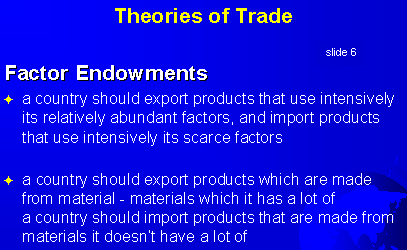
The Theory of Factor Endowments
suggested you should trade in the products which you can make from the
production factors and resources you naturally possess. So for Canada this
means we should trade in lumber and minerals and grain since we naturally
possess these resources in large quantities. Following this theory it would
then make sense for Canada to import citrus fruits since our climate does
not naturally give us weather to allow this food to grow without expensive
greenhouses. This theory was espoused by Heckscher and Ohlin.
.
The Product Life Cycle
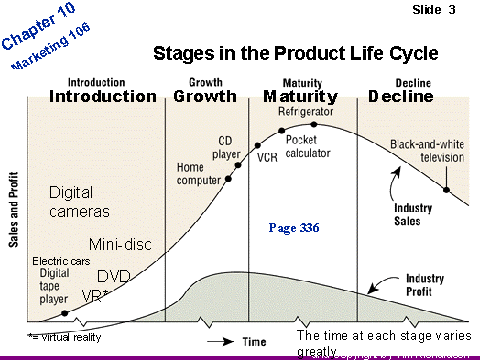
The PLC, is taught to eveyone
in first year business and marketing courses.
How is the PLC effected
by International Business?
The introduction stage can
be shortened due to other competitors from around the globe copying your
product, the decline stage can be extended, by exporting beyond your existing
markets.
The big challenges of the
International Product Life Cycle these days are
1. dealing with a very short
Introduction Stage, due to technological competitiveness
2. extending the length
of the PLC through
|
|
CONTACT I MAIN PAGE I NEWS GALLERY I E-BIZ SHORTCUTS I INT'L BIZ SHORTCUTS I MKTG&BUSINESS SHORTCUTS I TEACHING SCHEDULE |
| . | |
| MISTAKES ITEXTS USED I IMAGES I RANK IDISCLAIMER I STUDENT CONTRIBUTORS I FORMER STUDENTS I | |
| . |