INTRODUCTION
to Canadian International
Business Management

updated 2006 Sept 13

All Business is International Business

The reason we say that "All Business" is "Int'l Business" is that we mean all business, even domestic companies that do not directly exporting or import, are effected by international circumstances which can positively and negatively effect their business performance.
 
 
All 
Business 
is International Business


.
We can find many examples of "All Business" is "Int'l Business"  but for the sake of humour & hunger, we will use the example of Harvey's Hamburgers - a Canadian hamburger chain that was founded the same year as when the professor of this course was born.
Harveys is part of a corporate group that is owned by Cara Operations Ltd.

Cara also owns Swiss Chalet, Second Cup, Kelsey's, Montana's, Milestones and Outback Steakhouses

When Cara held its AGM July 24th, 2003 it noted that profit dropped 50%. One of Cara's biggest business is supplying the in-flight meals of Air Canada. The airline industry, worldwide, has been very bad since Sept 11 and was also effected by SARS in mid-2003. Add to this the American ban on Canadian beef because of the "one case" of mad cow disease in Alberta, and these factors all have effected Cara's seven restaurant chains.
.A
All 
Business 
is International Business


As reported in The Toronto Star
"sales at Harvey's fared badly as the fast-food burger concept coped with the mad cow scare and increased  competitive pressures. System sales fell 4.2 per cent to $62 million, while same restaurant sales fell 3.4 per cent. Six  restaurants closed in the quarter. The company ended the quarter with 339 Harvey's."
 
. What can you do to help this great Canadian company? - before coming to class, go to Harveys - or, better yet, bring Harveys to class and share ;-).

WTGR

.
.
An important part of a course on international business management is looking at "what is" international business for Canadians

Canada's major international export products/commodities
   o forest products
            o dimension lumber (2x4, 2x6 etc.)
            o wood pulp for making newsprint and cardboard
            o paper in giant rolls for cutting and processing
            o processed wood, like plywood, fiberboard, mouldings, shingles, etc.
   o grains and oilseeds (wheat, canola)

   o marine products (frozen fish, roe, crustaceans)
   o mining and minerals
            o ore and ore concentrates
            o coal (metallurgical and thermal)
            o processed metal products (sheets of aluminium, steel. copper)
            o precious metals such as gold and silver
   o agricultural products (cheese, beef, maple syrup, etc.)
   o automobiles, automotive parts (GM and Ford cars from Oshawa and Oakville to the U.S.)

Canada's major international import products/commodities
   o consumer products (VCR's, computers, cell phones)
   o processed food products
   o automobiles, automotive parts
   o clothing
            o Canada used to have a strong garment industry in Quebec
                   but competition from Asia shut that down in the late 1990's

Now that we know have a bit of a short intro to "what is" international business, let us keep in mind the title of this course, it is "International Business Management" - meaning understanding management (or, being the boss of other people) in the context of international business.

International Business Management requires us to not only have a grounding in what the key sectors are, but we must also know some of the players.

So, Who is big business in Canada? - Do you really know the company names?
If you wanted to get a good job in "international business" in Canada, do you know the playaz ?

Most student will know the American company names of the big players in international business because you have been living in North America. The purpose in having you look through lists on Top 500 websites is to see the names of some of the big European and Asian companies - they are important players too and also influence your business, or may even be your employer .

What can we infer from knowing the number of Cdn companies on the Fortune Global 500?

You can see the position changes of some of the well known company names - might help you deciding which ones to send your resume to when you finish 4th year - or it may indicate which sectors are hot and which are fading. For example Walmart, a service company, has moved ahead of Exxon and GM, manufacturing companies (from 2000 - 2002), but then in 2003 fell behind Exxon.
..
Who made the Fortune Global 500 from Canada in 2000
130 - Nortel Networks
322 - Canadian Imperial Bank of Commerce
327 - Royal Bank of Canada
337 - George Weston (Loblaws)
344 - Seagram (alcohol)
387 - Toronto-Dominion Bank
410 - Bank of Montreal
466 - Power Corp. of Canada
482 - Canadian Pacific
491-  Magna International 
Who made the Fortune Global 500 from Canada in 2002
263 - Nortel Networks
299 - Royal Bank of Canada
318 - George Weston (Loblaws)
339 - BCE - Bell Canada Entreprises
360 - Bombardier
361 - Canadian Imperial Bank of Commerce
366 - Bank of Nova Scotia
370 - Toronto-Dominion Bank
408 - Alcan
432 - Power Corporation
435 - TransCanada Pipelines
449 - Bank of Montreal
456 -  Magna International
465 - Sun Life Financial Services
483 - Manulife Financial Corporation


not in the 500 for 2002 - Canadian Pacific
.
Who made the Fortune Global 500 from Canada in 2003
240 - George Weston (Loblaws)
303 - Royal Bank of Canada
310 - Bombardier
328 -  Magna International
337 - Sun Life Financial Services
388 - BCE - Bell Canada Entreprises
404 - Alcan
458 - Manulife Financial Corporation
459 - Canadian Imperial Bank of Commerce
487 - Power Corporation
500 - Toronto-Dominion Bank
(couldn't find Nortel on the list, I must have made a mistake)
Who makes the Fortune Global 500 from Canada in 2007 ?
.
Canada's Largest Corporations: FP500 for 2007
taken from  http://www.canada.com/nationalpost/financialpost/fp500/charts/data1.html on Sept 5th 2007 
Ranking
Revenue
Profit
2006 2005 Company Amount 2006 $000s Amount 2006 $000s
1 4 Royal Bank of Canada, Toronto 36,045,000 4,728,000
2 2 Manulife Financial Corp., Toronto 34,194,000 3,970,000
3 1 General Motors of Canada Ltd., Oshawa. 33,340,112 n.a.
4 3 George Weston Ltd., Toronto 32,167,000 121,000
5 7 Power Corp. of Canada, Montreal 30,304,000 1,393,000
6 6 Magna International Inc., Aurora, Ont. 27,420,120 598,752
7 8 Alcan Inc., Montreal 26,808,894 2,029,860
8 5 Imperial Oil Ltd., Calgary 24,505,000 3,044,000
9 9 Sun Life Financial Inc., Toronto 24,287,000 2,144,000
10 14 The Bank of Nova Scotia, Halifax 22,482,000 3,579,000
11 13 The Toronto-Dominion Bank, Toronto 22,302,000 4,603,000
12 10 DaimlerChrysler Canada Inc. 20,534,000 n.a.
13 12 Canadian Imperial Bank of Commerce,  20,166,000 2,646,000
14 16 Petro-Canada, Calgary 18,911,000 1,740,000
15 18 Onex Corp., Toronto 18,620,000 1,002,000
16 17 EnCana Corp., Calgary 18,596,466 6,409,368
17 19 Bank of Montreal, Montreal 18,153,000 2,663,000
18 11 BCE Inc., Montreal 17,713,000 2,007,000
19 15 Bombardier Inc., Montreal 16,830,976 304,448
20 20 Shell Canada Ltd., Calgary 14,651,000 1,738,000
21 33 Suncor Energy Inc., Calgary 14,342,000 2,971,000
22 22 Wal-Mart Canada Corp.,  14,300,000 n.a.
23 21 Ford Motor Co. of Canada, Ltd.,  13,809,000 n.a.
24 25 Empire Co. Ltd., Stellarton, N.S. 13,161,100 296,800
25 26 The Jean Coutu Group (PJC) Inc. 13,093,142 121,965
26 24 Nortel Networks Corp., Toronto 12,948,012 31,752
27 29 Husky Energy Inc., Calgary 12,664,000 2,726,000
28 23 Honda Canada Inc., Toronto  12,600,000 n.a.
29 30 Alimentation Couche-Tard Inc., Laval, Que. 12,056,715 232,889
30 32 Novelis Inc., Atlanta, Ga. 11,168,766 -311,850
31 27 Hydro-Québec, Montreal 11,161,000 3,741,000
32 51 Metro Inc., Montreal  10,944,000 253,000
33 35 ACE Aviation Holdings Inc., Montreal 10,657,000 408,000
34 39 Enbridge Inc., Calgary 10,644,500 622,300
35 38 Canadian Natural Resources Ltd.,  10,398,000 2,524,000
36 34 Falconbridge Ltd., Toronto  9,867,228 1,055,992
37 31 Quebecor Inc., Montreal 9,822,100 -93,900
38 37 Mouvement des caisses Desjardins,  9,398,000 988,000
39 41 Costco Wholesale Canada Ltd., Ont.  9,049,005 n.a.
40 44 Rogers Communications Inc., Toronto 8,838,000 622,000
41 40 Telus Corp., Vancouver 8,681,000 1,122,500
42 36 Ultramar Ltd., Montreal 8,622,326 n.a.
43 105 Direct Energy Marketing Ltd., Toronto 8,553,199 369,612
44 43 Canadian Tire Corp. Ltd., Toronto 8,269,100 354,600
45 42 Talisman Energy Inc., Calgary 7,931,000 2,005,000
46 46 Shoppers Drug Mart Corp., Toronto 7,786,436 422,491
47 56 Brookfield Asset Management Inc.,  7,780,374 1,326,780
48 45 Canadian National Railway Co.,  7,716,000 2,087,000
49 48 Fairfax Financial Holdings Ltd., Toronto 7,715,396 257,985
50 28 The Thomson Corp., Toronto 7,530,894 1,270,080


Globe & Mail's top companies in Canada by profit (2004)
 
 
Rank Company and Year-End Profit Revenue
2004 2003 $000 % Ch’ge $000 Rank % Ch’ge
1 1 EnCana Corp 3,513,000 38 12,241,000 21 10
2 3 Bank of Nova Scotia 2,931,000 18 16,497,000 19 -4
3 2 Royal Bank of Canada 2,817,000 -6 25,204,000 6 2
4 11 Manulife Financial 2,564,000 66 27,265,000 3 65
5 7 Bank of Montreal 2,351,000 29 13,208,000 23 0
6 19 Toronto-Dominion Bank 2,310,000 115 16,015,000 20 2
7 5 Cdn. Imp. Bank of Commerce 2,199,000 7 16,705,000 17 -2
8 9 Imperial Oil 2,033,000 21 21,206,000 11 18
9 nr Manufacturers Life Insurance 2,015,000 23 19,991,000 13 3
10 10 Petro-Canada 1,757,000 6 14,442,000 22 10

 
Clearly the banks and the oil companies appear to be the big players in the Canadian economy
Both kinds of companies (operating in a monopolistic environment) are, in a sense, companies which make money off of other companies.

The phrase "economic pimps" was used by one student and he dared me to use it on the web site.


The reason we discuss these big companies, in the first class, is because this list gives some indication of just how big, or small we are in the total world community of international business - which may help us appreciate the competitiveness of our various industries and companies within those sectors. It is also interesting to look at how some Canadian companies rose, or fell as a consequence of the influencing environments (competition, technology, economics, social-cultural etc.)
.nn
The biggest areas of Canadian International Business 
re: Physical and Environmental Forces
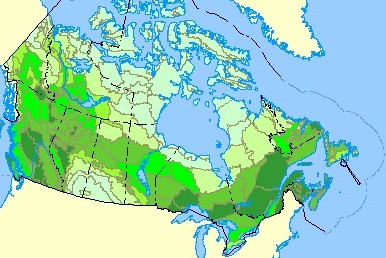
In order for you, as a Canadian student of International Business, to be successful in finding a job in international business in Canada, it is very helpful for you to have an appreciation for what types of business most large and medium sized Canadian companies are involved in. The geographical size of Canada, and the "gifts" of our natural resources means that Canadians companies are doing international business on a large scale, are mostly involved in the following
(WTGR.)
  • Forest products
  • Grain exports
  • Marine and Fish products
  • Mining
.
Key Points  It is important to acknowledge, and understand the effect of the environmental forces on international business because business does not happen in a vacuum - there is always things - which you can do nothing about - which will effect your success or failure. Being aware of these environments, and dealing with them, will allow you to survive and thrive.

WTGR

mmmbn.
Physical and Environmental Forces influencing and effecting Int'l business in Canada?
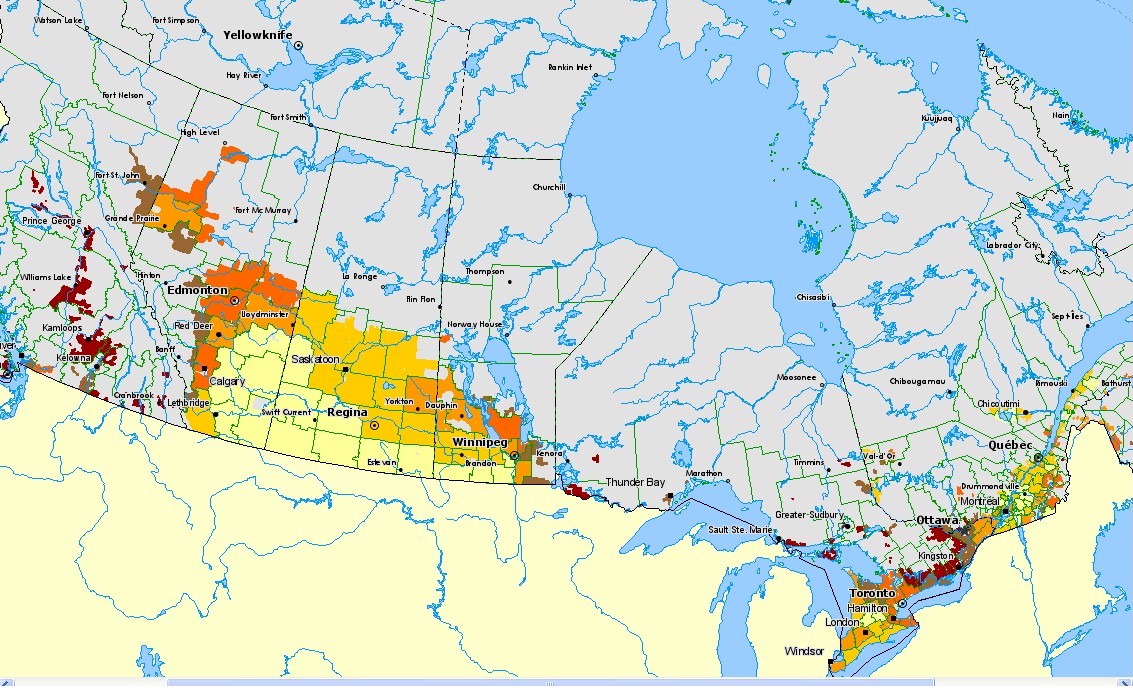
  • geographical size and east-west spread of Canada
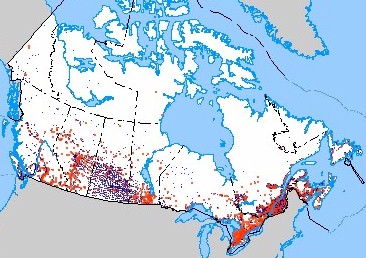
    • effects communications
    • population density low  outside of major urban centers
  • topographical and climatic challenges
    • many areas of Canada not suitable to living all year round
    • weather effects growing seasons for food
    • cost of food effects health and lifestyles
    • mountains act as barriers to transportation, communication, and limit habitable land space
  • the "gifts" of our natural resources
    • endowed us with timber for logging, lumber, paper
    • rich soil for agriculture
    • coastline for fishing many species of marine life

    • minerals to mine, gold, silver, coal, copper, nickel, uranium, etc.
.mbn.
Resources
Driving
Canada's
growth

2006

The IMF in April 2006, stated in its "World Economic Outlook" that
"In Canada, the economy continues to perform strongly, benefiting from the improvement in the terms of trade caused by high energy and other commodity prices,

Peter Morton, writing in the National Post in April 2006, analysed the IMF report and makes the following comments.

"Oil and other natural resources will continue to drive strong economic growth in Canada for the next several years"
- if you are an int'l business student looking for a job - pick this sector, or pick companies serving this sector

Morton cautions that the largest risks to the Canadian economy come if there is a slowdown in the United States, a sharp depreciation in the U.S. dollar or "a worsening of the terms of trade caused by weaker global commodity prices."
- what this means to Canadians is that diversifying away from the U.S. economy would be a good contingency strategy to reduce vulnerability

Morton also notes the world is not totally driven by the U.S. economy - While the United States -- with an expected growth rate of 3.4% this year and 3.3% next year -- will continue to be the main economic driver among the leading economies, there are signs that an expansion in Japan and the European Union will also contribute to global growth....China's gross domestic product is seen expanding by 9.5% this year and 9% next, helped by booming investment and export growth.

.
 
 
Sometimes in the 1st or 2nd lecture of this course we will have a short discussion about
Why you need International Experience.
These are some of the key points from that discussion, 
  • globalization means all business is international business
  • living and working in Toronto is a form of international business given the large amounts of people in different cultures
  • a high proportion of Canadian companies are involved in international business - getting some experience in this area will make you a competitive candidate to hire
..
Modes of  International Business
- this is just a simple listing
- a detailed explanation will follow later in the course
- the purpose of listing these modes is to allow you to understand the range of "what" international business is

Import/Export

  • Export, Goods
  • Export, Services
  • Import, Goods
  • Import, Services
Investment
  • Direct Investment
  • Portfolio Investment
Also collaborative Modes discussed later in the course
  • Joint Ventures
  • Consortiums
  • Strategic Alliances and affiliations
  • Franchises
  • Opening an Overseas Office.
.
.
.
useful sources of information


http://w01.international.gc.ca/canadexport/
 http://w01.international.gc.ca/canadexport/ 

Canadexport is a publication from the federal government.
This publication is free and it contains much much information relevant to international business development. You can be on the mailing list "for free" and it will allow you to learn a lot about Canada's business with many countries + provide you with helpful Canadian government contacts at embassies and consulates overseas.

The archives section allows you to search the many previous documents they have on specific countries or specific types of international business
 http://www.infoexport.gc.ca/canadexport/archives-e.asp

It was suggested to students in class that they could contact canadexport and be put on the mailing list.

.
.
 
witiger.com
  CONTACT I MAIN PAGE I NEWS GALLERY I E-BIZ SHORTCUTS I INT'L BIZ SHORTCUTS I MKTG&BUSINESS SHORTCUTS I TEACHING SCHEDULE
.
  MISTAKES ITEXTS USED I IMAGES I RANK IDISCLAIMER I STUDENT CONTRIBUTORS I FORMER STUDENTS I
.
.