NEW   PRODUCT DEVELOPMENT
.
Updated 2011 Feb 16

see also BCS 555 assignment based on this unit
 witiger.com/senecacollege/BCS555/assignment555homework1.htm

viewed best in 
 
. This page used in the following courses taught by Prof. Richardson
.
CCT 322
BUS 106
BCS 555
MRK 106
.
 
New Product
Development
Process
.... Five steps in the New Product Development Process, as understood by most marketing textbooks

1. Idea Generation 

  • brainstorming - thinking about it 
  • creating a new product based on some observed need
  • thinking of a new product based on some accident or chance circumstance
2. Screening 
  • getting opinions from 
    • employees
    • potential customers
    • media
    • government
  • what are the weaknesses of existing products that are similar
  • is there any competition for a new product
  • What are the industry sales and market trends the product idea is based on
3. Idea Evaluation / Concept Development 
  • estimate costs, revenue, profit, 
  • do market research 
  • target market segmentation
    • describe the main group of people who will be the first customers
4. Development of Product / Business Analysis
  • physically design and manufacture the product 
  • estimate likely selling price based upon competition and customer feedback
  • estimate sales volume based upon size of market 
  • produce a physical prototype or mock-up
  • test the product (and its packaging) in typical usage situations
5. Commercialization 
  • "make enough to sell" 
    • manufacture a large amount to send out to the stores that will stock the items so enough inventory on hand for the public to buy
  •  launch "promotion campaign"
 
.

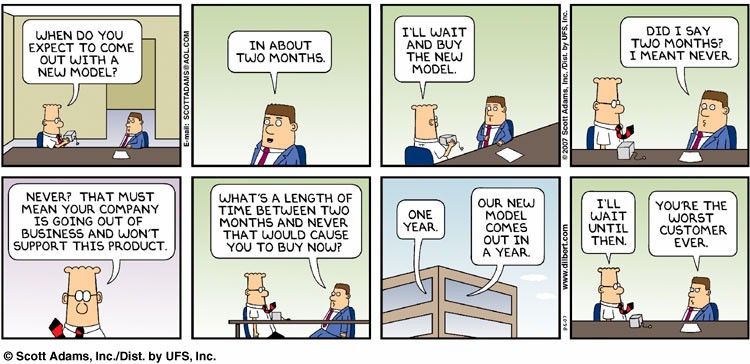
While the Dilbert cartoon is funny, it represents the challenge that companies always have coming up with new products

Shapiro book,
10th edition
Chpt 7 page 209
also
Chapter 10

of the MRK 106 text
and
Chpt 4

of the BUS 106 Text

.
1. Idea 
Generation
Five steps in the New Product Development Process

1. Idea Generation - thinking about a new product or service

sources of where new ideas come from
(see also  www.witiger.com/internationalbusiness/countryinfo.htm

.
2. Screening Five steps in the New Product Development Process

2. Screening - obtaining opinions from potential users

sources of where you can obtain opinions

  • employees 
    • do they think the new product will sell
    • can they see themselves being able to sell the product compared ti the existing product line-up
  • customers
    • can be done with a survey, formal or informal

    • "what do you think if we came out with this..."
    • customer opinion may help you tweak features of a new product, eg. colour, shape, size, pricing
  • media
    • newspaper stories may discuss a similar product being launched in another part of the world and the initial feedback may help you decide how to develop your product
    • newspaper stories may discuss deficiences in existing products which may suggest new opportunities
    • online blogs may discuss cuistomers disastisfaction with a certain product, which may provide ideas to inventors or a new product or service
  • government agencies
    • rules and regulations may have some limitations on what your new product can do
    • governments can enact new laws making changes to the way people use a product, which provides opportunity
      • when new law created banning cell phones while driving, many companies rushed to sell bluetooth devices for "handsfree" calling
    • some government agebncies can tell you if a new product is complient with pollution controls, or language laws or labelling rules
.
 
New Product
Development
and the Net

Chpt 8 in Hanson
New Product Development
- physical products
- cyber products


Internet Time
Two important apsects, says Prof. Ward Hanson in his book

First - it refers to the rapid change and evolution of

  • internet tools, 
  • markeplace (the customers) 
  • business practices
Second - it is also the acceleration of 
  • new product development, 
  • competitve activity 
  • and business tactics that are made possible by the internet
.
 

New Product
Development
Process

Chpt 7 p. 209
How New Product Characteristics affect adoption, as explained in the Shapiro book, 10th edition
Chpt 7 page 214

1. Relative Advantage
- the Competitive Environment
... better price than competition
... better features than competition
2. Compatibility
- does it fit with what the consumers want to do
3. Complexity
- is it easy to use
- adoption resistance must be comparably low
4. Trialability
- you have to get people to sample it
5. Observability
- can you actually see it work
- is it obvious it is effective and saves time and money

.
.
witiger.com
  CONTACTIMAIN PAGE I NEWS GALLERY IE-BIZ SHORTCUTS I INT'L BIZ SHORTCUTS  IMKTG&BUSINESS I TEACHING SCHEDULE  IMISTAKES ITEXTS USED IIMAGESIRANKI
.